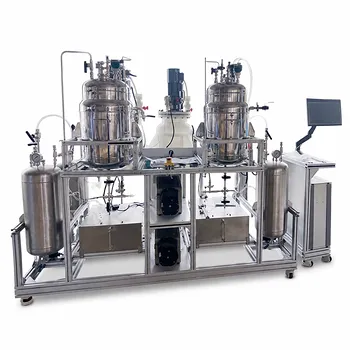
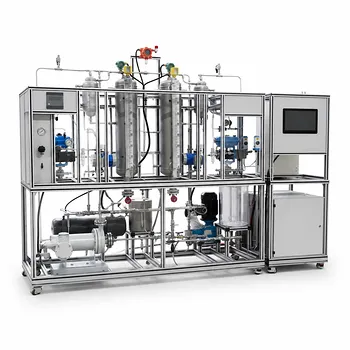
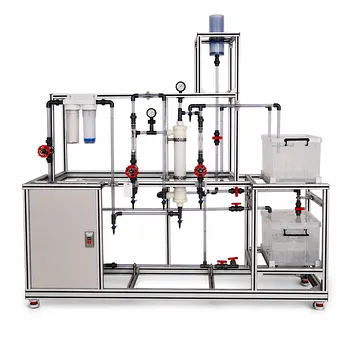
Phosphate rock is useless to plants, but a simple chemical transformation turns it into one of the world’s most vital fertilizers. The process involves treating insoluble tricalcium phosphate ([Ca_3(PO_4)_2]) with either dilute sulfuric acid or phosphoric acid to produce water-soluble primary calcium phosphate ([Ca(H_2PO_4)_2]). Chemical engineering pilot plants then replicate these reactions at a manageable scale, using stirred reactors, acid dosing, filtration, and real-time sensors to teach the unit operations, kinetics, and control strategies that underpin industrial fertilizer manufacturing.
The two dominant chemical pathways—using sulfuric acid to form superphosphate or phosphoric acid to form pure primary calcium phosphate—are the industrial bedrock of soluble phosphate production. Pilot plants translate these exact reactions into concrete, hands-on platforms where students and researchers can safely dissect mass balances, reaction rates, slurry handling, and process control.
The Two Chemical Pathways to Soluble Phosphate
The starting material, tricalcium phosphate ([Ca_3(PO_4)_2]), is a naturally occurring mineral that plants cannot absorb. Its conversion into a soluble salt is a classic acid-base reaction. The choice of acid determines the by-products and the final fertilizer composition.
Pathway 1: Sulfuric Acid – The Superphosphate Route
Treating phosphate rock with dilute sulfuric acid is the original and most widely used industrial method. The reaction directly produces a mixture of soluble primary calcium phosphate and calcium sulfate (gypsum):
[ Ca_3(PO_4)_2 + 2H_2SO_4 \rightarrow Ca(H_2PO_4)_2 + 2CaSO_4 ]
This product is known as superphosphate. The calcium sulfate remains in the mixture, which can be advantageous for soils deficient in sulfur but results in a lower phosphorus concentration per ton of product. The by-product gypsum must be managed, but it is non-hazardous and can be sold for construction or agricultural use.
Pathway 2: Phosphoric Acid – The High-Analysis Route
To avoid the calcium sulfate by-product entirely, manufacturers use phosphoric acid. This route yields pure primary calcium phosphate, often called triple superphosphate when concentrated:
[ Ca_3(PO_4)_2 + 4H_3PO_4 \rightarrow 3Ca(H_2PO_4)_2 ]
The product is fully water-soluble and contains a higher percentage of phosphorus, making it more economical to transport and apply. The downside is that phosphoric acid itself must first be produced from phosphate rock and sulfuric acid, so this pathway adds process complexity upstream.
How Pilot Plants Bring These Reactions to Life
Chemical engineering pilot plants do not simply replicate the chemistry; they compress entire industrial flowsheets into a learning environment. By operating at bench or mini-plant scale, they make the invisible parameters of mass transfer, kinetics, and fluid dynamics visible.
Core Unit Operations in the Pilot Plant
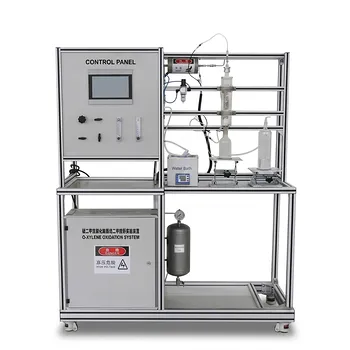
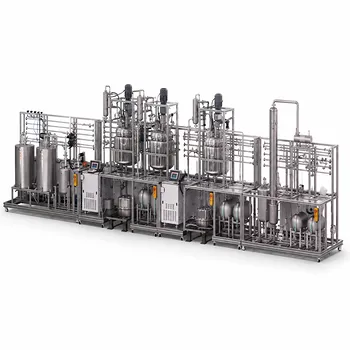
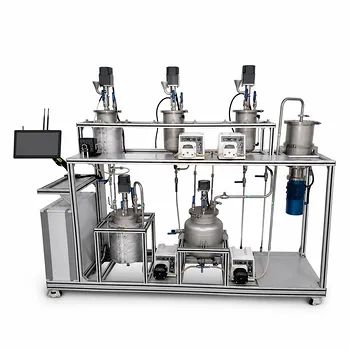
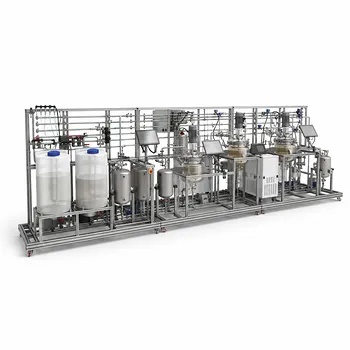
The primary reference specifies that these educational units feature batch or continuous stirred-tank reactors (CSTRs), acid dosing systems, and solid-liquid separation units such as vacuum filters. Supplementary details add slurry mixing, crystallization, and drying stages.
In a typical pilot run, students load finely ground tricalcium phosphate into a reactor, then meter in the chosen acid through a controlled dosing pump. The exothermic reaction demands precise temperature monitoring. Once the reaction completes, the resulting slurry is transferred to a vacuum filter or centrifuge to separate solids (gypsum, if sulfuric acid was used) from the soluble phosphate solution. The solid stream is dried, weighed, and analyzed to close the mass balance.
Integrating Process Analytical Technology (PAT)
Modern pilot plants may incorporate online sensors, such as Near-Infrared (NIR) spectroscopy, directly into the process stream. These sensors stream real-time concentration data to a distributed control system (DCS), allowing the plant to automatically adjust acid feed rates or reactor temperatures to maintain optimal stoichiometry. This closed-loop control transforms a simple batch experiment into a demonstration of feedback control, process stabilization, and yield optimization.
Educational and Research Value
The primary purpose of these pilot plants is not bulk production—it is to teach reaction engineering fundamentals. Students can measure:
- Reaction kinetics: How temperature and acid concentration affect the dissolution rate of the rock.
- Mass balances: Tracking phosphorus from the rock input to the liquid and solid outlets to verify conservation of mass.
- Filtration rates: Characterizing how slurry properties (particle size, viscosity) influence the throughput of a vacuum filter.
- Energy consumption: Calculating the heating and cooling loads required to keep the reactor isothermal.
These direct observations connect textbook equations to real, messy process behavior—foaming, particle settling, filter clogging—that no simulation can fully reproduce.
Understanding the Trade-offs
Pilot plant demonstrations carry inherent limitations. They operate far below industrial production rates, so certain phenomena like large-scale heat transfer inefficiencies or mechanical stress on pumps do not fully scale. The gypsum produced in the sulfuric acid route can contaminate plant piping with scaling if not thoroughly flushed, mimicking a real-world maintenance headache. The phosphoric acid route requires handling a more corrosive reagent, so materials of construction (e.g., stainless steel vs. glass-lined reactors) become a critical safety and cost lesson. Moreover, the simplified DCS controls in educational settings may lack the redundancy and robustness of industrial systems, so students must recognize that what they see is a stripped-down model, not a fully automated factory.
Making the Right Choice for Your Learning or Teaching Goal
How you configure a phosphate pilot plant should align with what you want the students or researchers to learn. Focus on the route and sensor integration that matches your objective.
- If your primary focus is demonstrating classic industrial fertilizer chemistry: Use the sulfuric acid pathway. The visible gypsum precipitation and handling of a co-product slurry teach mass balancing and by-product management in a directly industrial context.
- If your primary focus is maximizing product purity and phosphorus content: Run the phosphoric acid route. The cleaner product stream simplifies analysis and shifts the lesson toward upstream acid production and corrosion control.
- If your primary focus is modern process control: Integrate NIR spectroscopy and DCS feedback loops. Prioritize experiments where students tune PID settings and observe how real-time adjustments counteract disturbances in acid flow or cooling.
The pilot plant’s real power is not in the phosphate it produces, but in the process understanding it cultivates—a lesson that scales far beyond the laboratory.
Summary Table:
| Pathway | Acid Used | Main Product | Key By-products / Features | Educational Focus |
|---|---|---|---|---|
| Superphosphate Route | Sulfuric Acid ($H_2SO_4$) | Single Superphosphate | Gypsum ($CaSO_4$); lower P concentration | Mass balance, slurry handling, solids separation |
| High-Analysis Route | Phosphoric Acid ($H_3PO_4$) | Triple Superphosphate | No gypsum; higher P concentration | Process complexity, corrosion control, product purity |
Bring Industrial Chemistry to Life with LABPARK
Are you looking to bridge the gap between textbook theory and industrial chemical engineering? LABPARK provides state-of-the-art Educational and Vocational Unit Operations Pilot Plants in chemical engineering, bioprocess & biotech, and environmental & water treatment.
Designed specifically for universities, research institutes, and enterprises, our pilot plants empower students and researchers to master reaction kinetics, mass balances, filtration rates, and advanced process control in a safe, controlled environment.
Contact LABPARK today to discover how we can customize a unit operations pilot plant to elevate your training and research capabilities!
Related Products
- O-Xylene Oxidation to Phthalic Anhydride Educational Unit Operations Pilot Plant
- Bio-fermentation Ethanol Production Practical Training Unit Operations Pilot Plant
- Polymerization Granulation and Pellet Processing Educational Unit Operations Pilot Plant
- Multi-Functional Special Distillation Educational Pilot Plant
- Natural Product Extraction Unit Operations Training Pilot Plant
People Also Ask
- What materials fit high-temp oxidation pilot plants? Key Hastelloy & Titanium Requirements
- Under what conditions can axial diffusion be neglected? Reactor Simulation Guide
- What limitations exist in high-temp pilot reactor design? Key Material & Safety Rules
- What pressure parameters ensure pilot plant safety? Analyze reactor profiles & gas evolution.
- How are sensitivity functions applied to parameter estimation in chemical reactor pilot plants? Guide