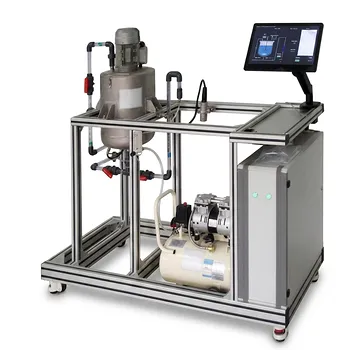
Operating microchannel mixers in a pilot plant immediately confronts you with three intertwined physical challenges: pressure-driven leaks at the seals, the high energy demand of forcing fluid through tiny channels, and the poor energy efficiency of adding external mixing fields like ultrasound to miniature fluid volumes. These issues stem from the very dimensions that make microchannels attractive—reducing channel size to 100 µm slashes diffusion lengths for rapid mixing but multiplies pressure drop and pump work, while fragile silicon‑glass interfaces can fail as pressures exceed 100 psia. Crucially, applying ultrasound to accelerate mixing often wastes most of its energy when the fluid volume is too small, unless you deliberately spread that energy over a larger mass flow rate.
The pursuit of faster mixing through ever‑smaller channels creates a steep rise in pressure drop and a fragile sealing environment, while well‑intentioned external energy inputs like ultrasound frequently dissipate without improving performance. The path to stable, efficient operation is not to minimize every dimension, but to intelligently scale channel size, manage pulsations, and parallelize flow to match energy input to throughput.
The High-Pressure, High‑Stress Mixing Environment
Why Smaller Channels Demand Higher Pressures
Reducing a mixing tee from 254 µm down to 100 µm improves mixing performance at a constant Reynolds Number by shortening the diffusion path and boosting the surface‑to‑volume ratio. However, to maintain that same Reynolds Number in a smaller channel, the fluid velocity must increase dramatically, which drives a disproportionate rise in pressure drop.
This higher pressure drop directly translates into the need for substantially more pump work. The system must operate at elevated pressures simply to maintain flow, pushing pumps, seals, and connectors to their mechanical limits. In a pilot plant, where reliability and repeatability are paramount, this extra energy burden is not just a cost—it is a primary source of failure.
The Weak Link: Substrate‑to‑Connector Seals
The most common failure point is not the channel itself, but the interface where fluidic connectors meet the microchannel substrate. Silicon mixers with 100 µm channels, often sealed with borosilicate glass, are particularly vulnerable. When internal pressures climb above about 100 psia, the seal between the rigid silicon/glass stack and the inlet/outlet connectors can open, causing leaks that ruin experiments and pose safety hazards.
Supplementary pressure pulsations from positive displacement pumps make this worse. Each pulsation hammers the seal, accelerating fatigue. Therefore, robust packaging—such as high‑pressure‑tolerant holders—becomes mandatory, but even then the risk remains high in the smallest channels.
Mitigating Leaks with Pulsation Dampening
One of the most effective countermeasures is inserting diaphragm pulse dampeners immediately after the pump. These devices absorb the cyclic energy spikes, smoothing the flow into a near‑steady stream. Stable, low‑pulsation flow dramatically reduces the dynamic stress on substrate‑to‑connector seals, allowing operation closer to the pressure limit without leakage.
For educational or research pilot plants, selecting units with high‑integrity sealing materials and corrosion‑resistant piping also minimizes leakage risks, especially when thermal expansion joints are involved. The lesson is that pressure management in microchannels is never just about the pump—it is a system‑level sealing challenge.
The Energy Utilization Paradox
When Ultrasound Becomes Inefficient
Introducing external energy, such as ultrasound, can enhance mixing without further reducing channel size. But there’s a hidden catch: if the fluid volume exposed to the ultrasound field is too small, the majority of the acoustic energy simply passes through or dissipates as heat without significantly disturbing the flow.
This poor energy utilization means that a 100 µm mixer, despite its excellent passive mixing baseline, may still require disproportionately high ultrasound power to achieve a marginal improvement. The result is a low‑efficiency system that wastes energy and can generate unwanted temperature gradients, counteracting the benefits of process intensification.
Scaling Energy Input Through Parallelization
To optimize energy utilization, pilot plants can operate several microchannel mixers in parallel within a single system. Flowing the combined mass streams past the ultrasound source distributes the applied energy over a larger total volume, increasing the fraction of energy that actually contributes to mixing rather than being lost.
This parallel approach also partially alleviates the pressure‑containment challenge. Instead of forcing the entire flow through one extremely small channel at extreme pressure, multiple larger channels (for example, 177 µm) can be used, each operating at a more moderate pressure drop while maintaining high overall mixing quality when assisted by an external energy source.
Understanding the Trade‑offs
There is no universal “best” channel size. The 100 µm tee delivers unrivaled passive mixing speed but sits at the razor’s edge of seal failure, demanding costly dampening and containment. Conversely, a slightly larger 177 µm channel reduces the diffusion advantage slightly but provides significantly greater pressure integrity, making it a reliable compromise for lab‑scale pilot plants.
Adding ultrasound to the 177 µm design recovers much of the lost mixing performance while avoiding the extreme leakage risks of the smallest channels. However, this introduces the energy utilization problem—solved again through parallelization, but at the cost of increased system complexity and footprint.
The operator must also anticipate how energy trade‑offs cascade. Higher pump work not only stresses seals but also increases operating costs and thermal load. Poorly coupled ultrasound can overheat a system without improving mixing. Every decision ripples through pressure, sealing, and energy efficiency simultaneously.
Making the Right Choice for Your Pilot Plant
Your path forward depends on which operational priority you cannot sacrifice. Begin by identifying your non‑negotiable constraint—mixing intensity, pressure‑safe operation, or energy budget—and build out from there.
- If your primary focus is maximum mixing intensity: Use 100 µm channels, but invest heavily in robust high‑pressure holders and diaphragm pulse dampeners. Accept that pump energy costs will be higher and that you operate close to the seal’s pressure ceiling.
- If your primary focus is operational stability and leak prevention: Select a 177 µm mixer and augment mixing with ultrasound. You sacrifice a small amount of passive mixing speed but gain a system that holds pressure reliably and requires far less aggressive dampening.
- If your primary focus is energy efficiency across the unit: Run multiple 177 µm mixers in parallel, applying ultrasound to the combined stream. This spreads the energy input over a larger mass, drastically cutting the specific energy loss that plagues single‑channel ultrasound setups.
Every microchannel mixing operation sits at the intersection of these three forces. Mastering them isn’t about eliminating trade‑offs—it’s about choosing the combination of channel scale, pulsation control, and flow distribution that keeps your pilot plant running safely while delivering the mixing quality you actually need.
Summary Table:
| Channel Size | Mixing Speed | Leak/Pressure Risk | Energy Efficiency (with US) | Recommended Use Case |
|---|---|---|---|---|
| 100 µm | Maximum | Very High (>100 psia) | Low (small volume) | Max mixing intensity (needs dampeners) |
| 177 µm | Moderate | Moderate / Low | Low | High stability & pressure safety |
| Parallel 177 µm | High | Low | High (distributed volume) | Optimized energy & throughput scale |
Optimize Your Unit Operations with LABPARK
Overcoming complex fluidic, pressure, and sealing challenges in chemical engineering requires robust, precisely engineered systems. LABPARK provides premium Educational and Vocational Unit Operations Pilot Plants across chemical engineering, bioprocess & biotech, and environmental & water treatment.
Designed specifically for universities, research institutes, and enterprises, our pilot plants bridge the gap between theory and industrial practice safely and efficiently.
Contact LABPARK today to discuss your pilot plant needs and discover how we can enhance your research and training capabilities!
Related Products
People Also Ask
- How do cost-capacity exponents vary across chemical equipment? Scaling insights.
- What are the primary considerations when managing and scaling up shear rates in pilot plant mixing operations? Guide
- What are the differences between set-point, servo, and program control? Master unit operations training.
- Evaluate Tablet Compaction: Force, Density & Porosity in Unit Operations Pilot Plants
- Why Switch Unit Operations Flow Configurations? Impact on Experimental Measurements