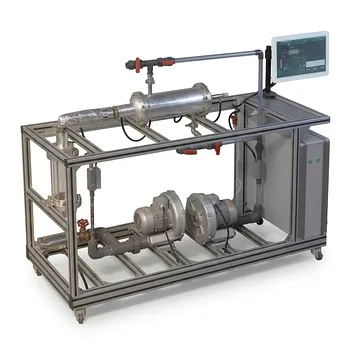
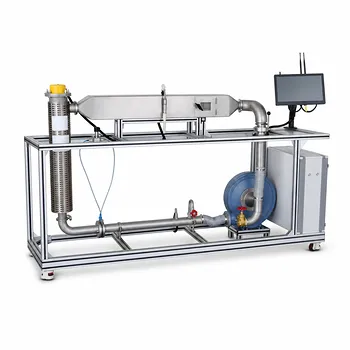
The pedagogical selection of heat exchangers for a unit operations pilot plant is not about finding a single "best" technology—it's about curating a diverse portfolio that turns abstract textbook theory into tangible, comparative experience. The main types integrated into educational settings include double-pipe, shell and tube, plate and frame, and specialized units like spiral or air coolers. They are selected to allow students to directly measure and contrast fundamental parameters like heat transfer coefficients, pressure drops, and maintenance requirements across fundamentally different geometries.
The core need in an educational pilot plant is to teach the relationship between mechanical design and thermal-hydraulic performance. The goal isn't industrial optimization but pedagogical clarity. Selecting a mix—from a simple double-pipe to a complex shell-and-tube—provides a physical curriculum where each heat exchanger type is deliberately chosen to isolate and illuminate a key engineering principle or constraint.
The Selection Framework: Matching Hardware to the Lesson Plan
Choosing heat exchangers for a pilot plant starts with defining the specific learning outcomes. The hardware is secondary to the concept it must demonstrate.
Defining the Core Pedagogical Objectives
The simplest designs are often the most instructive. Double-pipe heat exchangers are included precisely because they are not industrial workhorses.
Their transparent operation allows students to directly observe and calculate temperature profiles for co-current versus counter-current flow. This foundational concept is often obscured in more complex units, making the double-pipe an indispensable first step.
Demonstrating Industrial Relevance and Complexity
To bridge the gap to real-world applications, shell and tube heat exchangers are essential. They are the industrial standard, and their presence teaches students to grapple with real-world complexities.
These units force students to consider shell-side bypass, baffle configurations, and multi-pass tube arrangements. The selection of different TEMA front-end and rear-end types in a lab—such as a fixed tubesheet (BEM) versus a removable bundle (AES)—directly illustrates the critical relationship between thermal expansion, mechanical cleaning access, and cost.
Prioritizing Hands-On Learning and Visual Inspection
An often-underestimated selection criterion is the ability to disassemble a unit. Plate and frame heat exchangers excel here.
Students can physically take apart the unit, inspect individual plates for fouling, and then reassemble it with a different number of plates to alter the heat transfer area. This tactile experience cements lessons on fouling factors and the critical function of gaskets, linking physical assembly to calculated performance.
A Pedagogical Hierarchy of Heat Exchanger Types
Once the learning goals are clear, the pilot plant can be populated with a logical progression of technologies, each selected for its unique ability to teach a specific principle.
The Starting Point: Double-Pipe Exchangers
The double-pipe exchanger is the fundamental building block for teaching heat transfer. Its sole purpose in a pilot plant is to demonstrate the driving force for heat exchange without distractions.
Students can plot the non-linear temperature difference driving force in a single-pass unit. The transparent, inline flow path makes it the purest physical representation of the Q = U·A·ΔTlm equation, forming the baseline against which more complex designs are compared.
The Industrial Backbone: Shell and Tube Exchangers
This category’s pedagogical value lies in its internal complexity. The strategic selection of different TEMA types turns the lab into a masterclass in design constraints.
- Fixed Tubesheet (BEM) Units: Teach the core concept of multipass flow and its impact on the LMTD correction factor. They also introduce the limitation of thermal stress when the shell and tube materials expand at different rates, constrained by an economical but inflexible design.
- Floating Head (AET/AES) Units: Demonstrate the industrial solution to thermal stress. The removable bundle becomes a talking point for maintenance, as students can understand the trade-off between operational accessibility and the higher cost and potential for internal flange leakage.
- U-Tube (BEU) Units: Illustrate a compromise design. The U-bend naturally accommodates expansion but students quickly learn the practical limitation: the tube interiors are impossible to mechanically clean, making this design suitable only for clean shell-side fluids.
The Compact Alternative: Plate and Frame Exchangers
The plate heat exchanger is selected to contrast directly with the shell and tube. Its pedagogical power comes from its dramatically different geometry.
With heat transfer coefficients that can reach 7000 W/(m²·°C) for water-like fluids, it creates a powerful "aha" moment when students compare its footprint and efficiency to the shell-and-tube for the same heat duty. It is specifically chosen to teach the limits of gasket technology, with clear operating constraints below ~2.0 MPa and 130–250°C.
Specialized Units for Specific Operations
A complete educational setup may also include specialized units to broaden the curriculum beyond standard liquid-liquid heat exchange.
- Agitated Vessel Heat Transfer: The inclusion of a batch reactor with both a simple double jacket and an internal coil teaches the profound impact of thermal surface area and fluid dynamics. The jacket is easy to build but slow to heat; the coil provides more area but can obstruct mixing. This pairing makes thermal runaway scenarios and process control tangible problems to be solved.
- Fired Heaters and Air Coolers: These shift the focus away from recuperative liquid-to-liquid principles. A fired heater teaches direct radiative heat transfer, while an air cooler introduces the low-efficiency but economically vital process of large-scale cooling with ambient air, complete with finned-tube geometries.
- Direct Contact and Regenerative Exchangers: Though less common, a hybrid condenser demonstrates the most efficient heat transfer possible—when mixing is allowed. A regenerative unit, using a solid packing bed, can be showcased for high-temperature gas applications where a wall-type exchanger would need to be made of exotic ceramics.
Understanding the Trade-offs and Common Pitfalls
A curriculum that only highlights strengths is incomplete. True engineering judgment is forged by confronting limitations head-on.
The Efficiency-Flexibility Trap
The most powerful learning often comes from a failed or suboptimal experiment. A plate heat exchanger is instructive not only for its high performance but also for what forces its removal.
Students discover that its high efficiency is non-negotiable with fibrous slurries that instantly plug its narrow channels. They learn that a seemingly "worse" shell-and-tube is the only viable choice when the process demands 5.0 MPa pressure or a 300°C fluid that would destroy any gasket.
Overlooking Auxiliary System Design
A pilot plant’s educational mission is undermined by poor peripheral choices. The heat exchanger itself is only one link in a fluid transport chain.
A common pitfall is generic valve selection. Students gain authentic training when the system reflects industrial reality: a globe valve on a bypass line for precise flow control, a diaphragm valve on a hazardous chemical dosing line to prevent stem leakage, and a ball valve for tight, low-resistance isolation of the heat exchanger itself. The lesson is that process control is inseparable from heat exchanger performance.
The Educational Opportunity Within Constraints
Even a fixed tubesheet exchanger’s limitation, like a maximum shell-to-tube temperature difference before thermal stress becomes critical, is a teaching moment.
Instead of ignoring it, the pilot plant manual can be designed around it. Students can be tasked with calculating the precise operating window where the BEM unit is safe to use, and then demonstrate the need for a floating head design in a second experiment with steam. The vulnerability of the equipment becomes a rigorous lesson in mechanical design constraints.
Making the Right Choice for Your Educational Goal
The final selection of heat exchangers must be driven by the specific skills you intend to build, creating a deliberate journey from fundamental theory to complex industrial constraint.
- If your primary focus is teaching fundamental heat transfer theory: Start with a single double-pipe unit to isolate co-current vs. counter-current profiles. Measure the log-mean temperature difference directly from easily accessible thermowells along the length of the tube.
- If your primary focus is preparing students for industrial process roles: Build the lab around a shell and tube unit with a removable bundle. Expose students to shell-side bypass, TEMA nomenclature, and the maintenance protocols for pulling and inspecting a tube bundle.
- If your primary focus is exploring high-efficiency and compact design: Include a plate and frame exchanger and task students with altering the plate count to fit a new heat duty. Use this to directly contrast its performance and stringent gasket limitations against the shell-and-tube for the same liquid-to-liquid service.
- If your primary focus is illustrating the trade-off between thermal duty and mechanical reaction design: Implement a batch reactor with both a double jacket and an internal coil. Have students calculate the time to heat up the reactor with each method and correlate that with the visual obstruction of the coil to the agitator.
- If your primary focus is demonstrating complete fluid management: Ensure the pilot plant piping incorporates the correct valve types for each service. Use a diaphragm valve on a chemical dosing line and a globe valve on a bypass, turning a simple heat transfer experiment into a lesson on process safety, control, and industrial best practices.
A well-designed unit operations pilot plant is ultimately a library of physical experiences, where each heat exchanger is a carefully selected chapter in the larger story of process engineering.
Summary Table:
| Heat Exchanger Type | Key Pedagogical Value | Major Operating Constraint / Limit |
|---|---|---|
| Double-Pipe | Demonstrates co-current vs. counter-current flow profiles & basic LMTD. | Low heat transfer area; not suited for large-scale heat duties. |
| Shell and Tube | Teaches complex industrial design, TEMA standards, & thermal stress. | High mechanical complexity; cleaning access varies by TEMA type. |
| Plate and Frame | Illustrates high-efficiency compact design & gasket limitations. | Restricted to operating pressures < 2.0 MPa and temperatures < 130–250°C. |
| Agitated Vessel | Shows impact of surface area & dynamics (jacket vs. coil) in batch systems. | Internal coils can obstruct mixing; jackets have slower thermal response. |
Bring Hands-On Process Engineering to Life with LABPARK
Looking to equip your laboratory or training facility with versatile, industry-standard process equipment?
LABPARK provides premium Educational and Vocational Unit Operations Pilot Plants in chemical engineering, bioprocess & biotech, and environmental & water treatment. Engineered specifically for universities, research institutes, and enterprises, our pilot plants bridge the gap between textbook theory and industrial reality.
Help your students and researchers master thermal-hydraulic principles, fluid dynamics, and system maintenance with safe, scalable, and highly visual heat exchange systems.
Ready to upgrade your curriculum? Contact LABPARK today to request a custom proposal!
Related Products
- Shell and Tube Heat Exchanger Heat Transfer Coefficient Determination Educational Pilot Plant
- Comprehensive Multi-Modal Heat Transfer Unit Operations Pilot Plant for Engineering Training
- Dual Mode Heat Transfer Pilot Plant for Unit Operations Training
- Three-Tube Heat Transfer Educational Pilot Plant for Unit Operations Training
- Comprehensive Heat Transfer Coefficient Determination Educational Unit Operations Pilot Plant
People Also Ask
- Why Apply LMTD Correction in Shell-and-Tube Pilot Plants & How to Determine It
- Why adjust baffle spacing in shell-and-tube heat exchanger pilot plants? Master heat transfer & pressure drop.
- How to Estimate Shell-Side Pressure Drop in a Shell-and-Tube Heat Exchanger Pilot Plant: Key Parameters Explained
- How is the fouling factor (Rd) evaluated? Key Pilot Plant Insights for Students
- How is fouling factor demonstrated using shell and tube pilot plants? Practical Lab Guide