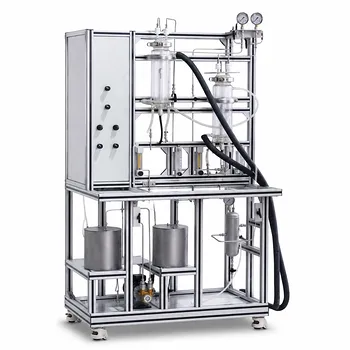
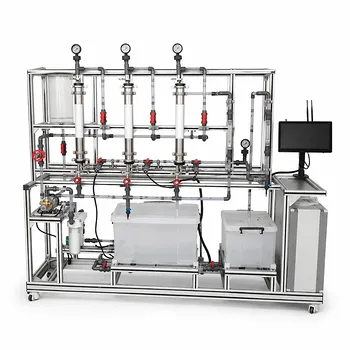
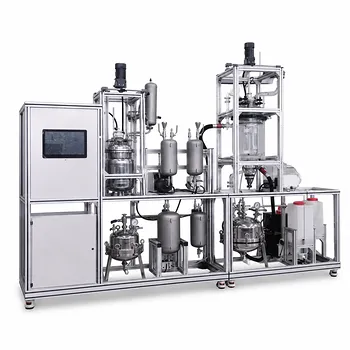
The plate model offers a beautifully simple conceptual framework, but it fundamentally stumbles when you move beyond basic educational demonstrations. In educational unit operations reactors, plate models assume instantaneous equilibrium within each theoretical stage and ignore the physical rate of mass transfer. This makes them inherently unable to capture the distinct kinetic events that cause band broadening, and using a single average plate height for all solutes reduces calculation precision. A general rate model becomes essential whenever you need to account for the full interplay of convection, axial dispersion, diffusion, and adsorption kinetics—particularly for non‑ideal reactive chromatography in research and scale‑up work.
The plate model trades mechanistic detail for mathematical simplicity, making it an excellent teaching tool but a poor predictor of real‑world chromatographic behavior. The moment your goal shifts from conceptual illustration to accurate prediction of band shapes, reaction yields, or scale‑up performance, the general rate model’s comprehensive description of mass transfer phenomena becomes non‑negotiable.
The Pedagogical Appeal of the Plate Model
The plate model persists in educational settings because it reduces a complex, continuous process to a familiar, discrete series of steps. This makes it an accessible first contact for students learning reactor design.
A Simple, Intuitive Stepwise Equilibration
In the plate model, a chromatographic column is imagined as a stack of distinct, well‑mixed compartments called theoretical plates. Within each plate, the mobile and stationary phases are assumed to reach full equilibrium instantly.
This stepwise analogy is easy to visualize and mathematically tractable. It allows students to quickly relate separation efficiency to a single number—the height equivalent to a theoretical plate—and to grasp the concept that more plates yield sharper peaks.
A Single Parameter for Column Efficiency
The model’s strength lies in its parsimony. It boils the entire complex choreography of a separation down to one lumped parameter: the plate count.
For early coursework, this abstraction is a feature, not a bug. It lets instructors illustrate why longer columns or smaller packing particles improve resolution without forcing students to simultaneously solve coupled partial differential equations.
The Hidden Limitations That Undermine Accuracy
Beyond the classroom, the very simplifications that make the plate model elegant become its fatal weaknesses. When you try to simulate an actual separation in a reactive unit operation, three critical gaps emerge.
The Equilibrium Assumption Erases Mass Transfer Resistance
The model’s foundational assumption is that equilibrium is achieved at every moment in every plate. In reality, molecules need finite time to diffuse through pore networks, traverse boundary layers, and adsorb onto surfaces.
By ignoring these mass transfer resistances, the plate model cannot predict the kinetic contributions to peak broadening. It offers no insight into how slow intra‑particle diffusion or sluggish adsorption kinetics distort a peak, leaving you blind to precisely the bottlenecks that matter in reactive chromatography.
Lumping All Sources of Band Broadening
True band broadening arises from multiple distinct physical processes: axial dispersion, film mass transfer, pore diffusion, and reaction kinetics in the case of reactive chromatography. The plate model folds all of these into a single, adjustable plate height.
That lumping destroys mechanistic information. You lose the ability to diagnose whether a poorly shaped peak stems from packing irregularities, too fast a flow rate, or an overly slow reaction. Without knowing the root cause, you cannot rationally fix the problem.
The Peril of a Single Plate Height for All Components
Even more troubling for multi‑component reactive systems is the practice of assigning one mean plate height to every solute. Different molecules experience different diffusivities, different adsorption isotherms, and different reaction rates.
Using the same plate number for a fast‑moving reactant and a slowly diffusing product introduces a systematic error that grows as the components become more dissimilar. For precise simulation of conversion and selectivity in an educational reactor that might later be scaled, this averaging strategy is a liability.
When to Transition to a General Rate Model
The general rate model addresses each of these gaps by simultaneously incorporating all mass transfer kinetics, convection, axial dispersion, and adsorption dynamics. This shift is not about replacing the plate model out of pedantry; it is about aligning your simulation rigor with your purpose.
The Need for Mechanistic Fidelity in Research
For advanced studies in reactive chromatography—especially those bridging from a benchtop educational unit to a pilot plant—the general rate model becomes indispensable. It describes the temporal and spatial evolution of concentration in the mobile phase, the stagnant pore liquid, and the stationary surface.
This mechanistic fidelity lets you isolate the contribution of each transport step. You can, for example, vary the particle size and immediately see the effect on pore diffusion limitations, or alter the reaction rate constant and watch the peak shapes respond realistically.
Simulating Reactive Chromatography and Non‑Ideal Effects
Educational unit operations reactors are often designed to demonstrate how simultaneous reaction and separation can push equilibrium‑limited conversions. These non‑ideal, rate‑driven processes break the plate model’s core equilibrium assumption.
The general rate model, by contrast, can explicitly incorporate adsorption kinetics and reaction terms. It accurately depicts how reactive zones travel, how products are separated, and how the overall performance deviates from an idealized equilibrium case—exactly the insight a graduating engineer needs before scaling a process.
Understanding the Trade‑offs
Choosing between a plate model and a general rate model is not purely a question of correctness; it is a matter of fitness for purpose, computational cost, and parameter availability.
- Simplicity vs. Predictive Power: The plate model requires only a plate number and a retention factor. Its predictions are quick but qualitative. The general rate model demands independent measurements of diffusion coefficients, mass transfer coefficients, and kinetic parameters—but returns quantitatively meaningful chromatograms.
- Educational Clarity vs. Design Reality: In a sophomore‑level lab, introducing the general rate model can obscure the fundamental principles of separation with mathematical complexity. However, in a senior design course or research environment, relying on the plate model risks teaching students a habit of ignoring rate‑limiting steps that will later cost them time and resources.
- Parameter Uncertainty: The more parameters a model has, the more opportunities for measurement error to creep in. A general rate model built with poorly estimated diffusion constants can yield results as misleading as an oversimplified plate model. The plate model’s single adjustable parameter is both its greatest weakness and a shield against this curse of dimensionality.
Making the Right Choice for Your Goal
The decision hinges on what you are trying to achieve with your simulation. Below is a goal‑oriented guide to help you decide.
- If your primary focus is conceptual illustration for beginners: Stick with the plate model. It provides a clean, intuitive picture of how multiple equilibrium stages create separation, and the number of theoretical plates remains a useful yardstick for comparing columns in a teaching context.
- If your primary focus is diagnosing or optimizing a reactive chromatographic separation: Move immediately to the general rate model. Only a rate‑based model can reveal whether conversion is limited by slow reaction kinetics or by mass transfer resistance, enabling you to rationally adjust particle size, flow rate, or catalyst loading.
- If your primary focus is translating lab‑scale results to a pilot plant: Use the general rate model. Scale‑up predictions that rely on a lumped plate height are notoriously unreliable; a model that respects the physics of convection, dispersion, and intra‑particle diffusion gives you a far safer foundation for engineering decisions.
- If your primary focus is balancing learning objectives with realistic exposure: Introduce the plate model early but do not let students graduate without hands‑on experience with a general rate model implementation. Let them see for themselves how the equilibrium assumption breaks down and where real‑world performance deviates from the ideal.
Choosing the right model is ultimately about matching the resolution of your tool to the resolution of the question you are asking—and in reactive chromatography, the questions that matter rarely stop at the ideal equilibrium case.
Summary Table:
| Feature | Plate Model | General Rate Model |
|---|---|---|
| Core Assumption | Instantaneous equilibrium in discrete stages | Dynamic mass transfer (convection, diffusion, adsorption kinetics) |
| Parameters | Single lumped parameter (plate height) | Multiple physical parameters (diffusion, mass transfer, reaction rates) |
| Accuracy | Qualitative / Conceptual illustration | High quantitative fidelity for real-world predictions |
| Best For | Introductory teaching & basic demonstrations | Advanced research, reactive chromatography, & scale-up |
Scale Up Your Chemical Engineering Education and Research with LABPARK
Transitioning from simplified classroom models to real-world industrial applications requires hands-on, high-fidelity experimental setups. LABPARK provides state-of-the-art Educational and Vocational Unit Operations Pilot Plants in chemical engineering, bioprocess & biotech, and environmental & water treatment.
Engineered specifically for universities, research institutes, and enterprises, our pilot plants enable students and researchers to analyze real-world mass transfer kinetics, reactive chromatography, and non-ideal system behaviors.
Equip your laboratory with the tools to bridge the gap between theory and practice—contact us today to discuss your custom pilot plant requirements!
Related Products
- Photocatalytic Membrane Separation and Degradation Unit Operations Pilot Plant
- Carbon Material Thermal Pretreatment Multiphase Separation Educational Pilot Plant
- Multi-Functional Membrane Separation Educational Pilot Plant for Unit Operations Lab
- Multifunctional Membrane Separation Educational Pilot Plant with Ultrafiltration, Nanofiltration, Reverse Osmosis
- Gallium and Indium Selective Extraction Educational Pilot Plant
People Also Ask
- What are the key differences in membrane configurations? Choose the Right Unit Operations Pilot Plant
- How Do Pervaporation, Vapor, and Gas Permeation Differ in Pilot Plants? Key Comparison
- What are the structural & performance trade-offs of flat-sheet, spiral-wound, & hollow-fiber membrane modules?
- Pervaporation vs. Vapor Permeation: Handling Suspended Solids in Membrane Pilot Plants
- How do PEI, PVDF, and PSU membranes compare in pilot plants? Find the best fit.