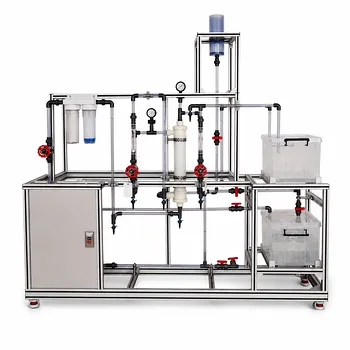
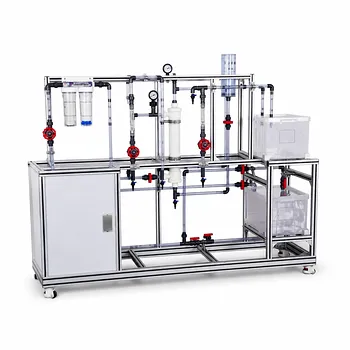
Bipolar membranes are a class of ion-exchange composites designed to split water molecules into protons (H⁺) and hydroxide ions (OH⁻) under an applied electric field.
The membrane laminate consists of a cation-exchange layer and an anion-exchange layer. When current flows in the reverse bias direction, mobile ions are pulled out of the interfacial region, causing a sharp drop in electrolyte concentration at the junction. This forces water molecules to dissociate into H⁺ and OH⁻, which then migrate out of the membrane to carry the current. Modern bipolar membranes incorporate low‑dissociated metal groups (often iron‑based) at the junction to catalyze the water‑splitting reaction and suppress recombination, allowing the process to run at a remarkably low potential drop—around 0.8 V. In advanced membrane separation pilot plants, this mechanism is harnessed to produce pure acids and bases directly from salt streams without any external chemical addition.
The core operational principle is a catalytically enhanced water‑splitting reaction that occurs at the sub‑micron junction of a bipolar membrane. This gives the membrane its defining electrochemical property: an exceptionally low energy barrier (~0.8 V) that enables on‑demand generation of acids and bases from simple salt feeds.
Inside a Bipolar Membrane: The Dual‑Layer Architecture
The Cation‑ and Anion‑Exchange Layers
Each bipolar membrane is a composite of two distinct ion‑exchange films.
One layer selectively transports cations, the other anions.
They are permanently laminated, creating a sharp interface where the chemistry of water splitting is confined.
The Catalytic Junction: Where Water Splits
The junction is not simply a dry contact of two polymers.
It is engineered with low‑dissociated metal groups—typically iron hydroxide or similar species—that act as catalysts.
These catalytic sites actively promote the dissociation of water and inhibit back‑recombination of H⁺ and OH⁻, which is the key to achieving the low 0.8 V potential drop.
The Electrochemical Mechanism in Operation
Reverse Bias and Ion Depletion
In a pilot‑scale stack, the bipolar membrane is oriented so that its cation‑exchange layer faces the anode and the anion‑exchange layer faces the cathode.
Under this condition, cations are driven toward the cathode and anions toward the anode, effectively stripping the interface of its mobile ions.
The resulting drop in electrolyte concentration at the junction forces water to serve as the primary source of charge carriers.
Fast Ion Transport and Current Carriage
Once generated, the protons migrate rapidly through the cation‑exchange layer toward the cathode, while hydroxide ions move through the anion‑exchange layer toward the anode.
This dual‑ion pathway completes the electrical circuit and simultaneously delivers pure acid and pure base into their respective compartments.
Why the 0.8 V Potential Drop Matters
Conventional water electrolysis requires a thermodynamic minimum of 1.23 V plus substantial overpotentials.
Bipolar membranes break through that barrier by catalyzing water dissociation directly at a solid‑state junction, collapsing the energy requirement to just 0.8 V.
This low potential drop makes salt‑splitting processes in pilot plants energetically competitive and allows operation at current densities that are practical for industrial use.
Pilot Plant Applications: Salt Splitting into Acids and Bases
Configuration in Electro‑membrane Stacks
A typical pilot‑scale bipolar membrane stack alternates bipolar membranes with conventional cation‑ or anion‑exchange membranes, forming separate acid, base, and salt compartments.
When a salt solution (e.g., Na₂SO₄ or NaCl) is fed to the middle compartment, the bipolar membrane simultaneously delivers sulfuric acid (or HCl) on one side and sodium hydroxide on the other, using only electricity.
Benefits for Chemical and Bioprocess Pilots
The process eliminates the need to store, handle, or purchase concentrated acids and bases.
It enables continuous, on‑site generation of high‑purity streams, which is particularly valuable in bioprocessing where pH control must be precise and contamination must be avoided.
Understanding the Trade‑offs and Limitations
Susceptibility to Fouling and Scaling
While the mechanism is elegant, the tight junction is sensitive to multivalent cations (e.g., Ca²⁺, Mg²⁺).
These ions can precipitate at the interface, destroying catalytic activity and increasing voltage. Robust feed pre‑treatment is non‑negotiable.
Feed Salt and Concentration Constraints
The water‑dissociation reaction works best with strong electrolytes that produce highly mobile ions.
Weak acid/base systems may lead to lower current efficiency and require additional polarization. The product concentration is also limited by back‑diffusion and co‑ion leakage through adjacent membranes.
Membrane Durability and Chemical Stability
The catalytic junction can degrade over time, especially when exposed to oxidizing agents or extreme pH.
Bipolar membranes in rigorous pilot plant service must be carefully selected for chemical compatibility and operated within recommended current‑density windows to ensure long life.
Making the Right Choice for Your Pilot Plant Goal
The decision to deploy bipolar membrane technology hinges on what you aim to achieve. Tailor your approach to the specific need.
- If your primary focus is on‑site acid/alkali generation: Bipolar membranes offer an elegant electrochemical route to produce high‑purity streams without auxiliary chemicals, ideal for continuous, self‑contained processes.
- If your primary focus is minimizing energy consumption: The low 0.8 V junction potential makes salt splitting competitive, but you must still account for stack resistance and pumping energy; integrate with renewable energy sources to maximize the benefit.
- If your primary focus is process sustainability: Replacing externally supplied acids/bases with electrochemically regenerated ones cuts logistical footprint, chemical waste, and operator exposure.
By leveraging the unique catalytic water dissociation at the heart of a bipolar membrane, you can turn a waste salt stream into a valuable acid and base, simplifying flowsheets and dramatically enhancing pilot plant flexibility.
Summary Table:
| Aspect | Key Feature | Practical Benefit |
|---|---|---|
| Architecture | Cation/anion bilayer with catalytic metal junction | Promotes efficient water splitting & limits recombination |
| Energy Barrier | Exceptionally low ~0.8 V potential drop | Maximizes energy efficiency compared to standard electrolysis |
| Function | Direct H⁺ and OH⁻ generation from water | Produces high-purity acids & bases without chemical addition |
| Limitations | Vulnerable to multivalent cation scaling | Requires feed pre-treatment to ensure membrane durability |
Enhance Your Research and Training with LABPARK
Are you looking to integrate advanced membrane separation technology into your facility? LABPARK designs and supplies premium Educational and Vocational Unit Operations Pilot Plants specializing in chemical engineering, bioprocess & biotech, and environmental & water treatment.
Whether you represent a university, research institute, or enterprise, our pilot plants deliver the hands-on experience and reliable data needed to master electrochemical processes like salt splitting.
Ready to upgrade your lab's capabilities? Contact us today to explore our solutions and request a customized quote!
Related Products
- Multifunctional Membrane Separation Educational Pilot Plant with Ultrafiltration, Nanofiltration, Reverse Osmosis
- Photocatalytic Membrane Separation and Degradation Unit Operations Pilot Plant
- Ultrafiltration Membrane Separation Educational Pilot Plant
- Hollow Fiber Ultrafiltration Membrane Separation Educational Pilot Plant
People Also Ask
- Pervaporation vs. Vapor Permeation: Handling Suspended Solids in Membrane Pilot Plants
- How do PEI, PVDF, and PSU membranes compare in pilot plants? Find the best fit.
- What are the trade-offs of polymer vs inorganic membranes in teaching pilot plants? Key laboratory comparison.
- What are the key flow configuration loops in membrane pilot plants? Optimize Performance
- How can operators optimize operating conditions and cleaning protocols in membrane separation pilot plants to mitigate fouling?