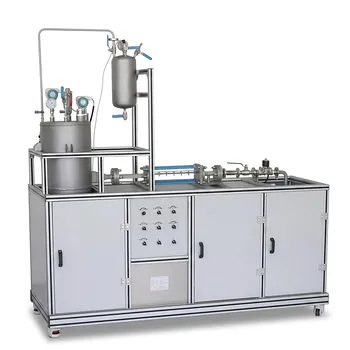
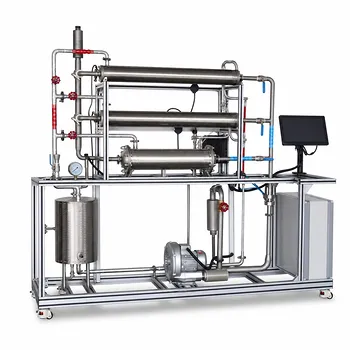
The difference between a process sensor and analyzer is not about one being "small" and the other "large"—it's about how directly they deliver insight without demanding a supporting cast of utilities and infrastructure.
A process sensor is a self-contained, compact device that can be clamped directly onto a pilot plant pipe or vessel. It carries most of its own power and signal conditioning on‑board. A process analyzer, by contrast, is a larger analytical system—often a 19‑inch rack‑mount instrument—that requires a permanent location, multiple external utilities (stable power, plant air, gas cylinders), and carefully routed sample lines or fiber optics. For a laboratory engineer configuring a unit‑operations pilot plant, the choice defines not just what you measure, but how you teach process control or advance research, how much floor space you sacrifice, and how many hours you’ll spend on maintenance.
The core distinction is that sensors trade ultimate measurement selectivity for mobility and simplicity, while analyzers trade mobility for precision, accuracy, and the ability to tackle complex process chemistry. In a vocational lab, sensors enable students to quickly grasp distributed control concepts. In a research lab, analyzers unlock the high‑resolution data needed to validate novel processes. The right choice always starts with your educational or research goal, not a spec sheet.
The Physical Footprint: Integration and Installation
Sensors: Skid‑Ready Simplicity
Sensors are lightweight and inherently portable. They can be swapped between unit ops skids in minutes without re‑routing utilities. This skid‑ready nature keeps pilot plants tight and modular—critical when lab space is at a premium and multiple teaching or research modules must coexist.
Analyzers: Fixed, Utility‑Hungry Systems
Analyzers demand a dedicated, vibration‑free footprint with access to clean power, instrument air, cooling water, and sometimes flammable gas supplies. Sample conditioning systems add further bulk. In a typical academic pilot plant, a single mass spectrometry analyzer might consume an entire utility wall, forcing the lab engineer to rethink skid layouts and safety zones.
Cost and Complexity: From Purchase Price to Long‑Term Operation
Upfront Investment
Sensors typically cost $20k–$100k per point. Analyzers range from $50k–$200k, and that figure balloons once you add sample probes, heated transfer lines, and safety infrastructure. For a vocational lab outfitting five different unit operations, the sensor route often frees budget for additional experiments.
Maintenance and Operational Overheads
Sensors have fewer moving parts and simpler calibration protocols. Many modern MEMS‑based spectrometers, for example, are sealed and factory‑calibrated. Analyzers, especially those with optical benches or complex sampling trains (like a traditional process gas chromatograph), demand regular preventive maintenance, consumable gas supplies, and trained personnel—a non‑trivial burden in a teaching environment where the operator changes every semester.
Measurement Capability: What You Can (and Cannot) Achieve
Selectivity and Sensitivity
Analyzers win when you need to discriminate between chemically similar species—think distinguishing ethanol from isopropanol in a reactive distillation. Process sensors, while improving, still tend toward broader measurement classes (e.g., total hydrocarbons, moisture, pH). If your research pilot plant generates a soup of isomers, a high‑selectivity analyzer is non‑negotiable.
Accuracy and Precision in Dynamic Streams
A critical insight often overlooked: in the flowing, noisy environment of a pilot plant, precision is usually about ten times better than accuracy. That’s because accuracy is limited by calibration model errors, sample inhomogeneity, and reference lab error, while precision is primarily limited by instrument noise and drift.
For a sensor like a MEMS‑NIR spectrometer, you might get excellent repeatability (good precision) but struggle to match a certified lab result (lower accuracy). For teaching purposes, that repeatability often suffices. For research publication, the high accuracy of a properly maintained analyzer may be compulsory.
Qualitative vs. Quantitative Demands
Define your requirement clearly. If the goal is to detect the moment a reaction endpoint is reached (qualitative trend), a sensor can provide a robust, low‑cost trigger. If you need to report exact concentration numbers for a regulatory filing or kinetic model (quantitative), an analyzer’s calibration regime and sample handling become vital.
Pedagogical vs. Research Goals: Matching the Tool to the Task
Vocational Teaching Labs: Distributed Control and Simplicity
In vocational labs, the learning objective is how to control a process, not how to interpret a complex spectrum. Sensors can be placed at multiple points on a pump‑around loop, letting students see the immediate impact of valve adjustments on temperature, pressure, and composition in real‑time. The minimal utility footprint also means less distraction from the core lesson: feedback loops, cascade control, and safe operation.
Advanced Research: High‑Resolution Data at a Cost
A research pilot plant investigating a new catalyst or membrane separation needs data density that justifies a fixed analyzer system. Here, the ability to run online mass spectrometry with rapid multi‑component quantification can make or break a publication. The lab engineer must accept the higher utility demand and the need for a designated analyst, but the scientific return justifies it.
Understanding the Trade‑offs
Choosing between sensors and analyzers is a classic performance vs. simplicity trade‑off, with no universal winner.
- Sensors offer mobility and low overhead at the cost of lower specificity and, often, limited certified accuracy. They may drift over long campaigns, requiring more frequent gross checks.
- Analyzers deliver high‑fidelity data but chain you to a fixed location, a complex supply chain, and a higher skill ceiling for troubleshooting. A failed sample pump on a Saturday morning can stall an entire experimental week.
There is also a blending of categories: some modern compact devices (e.g., fiber‑optic spectrometers with a small wall‑mounted base) sit between traditional definitions. However, the operational line remains clear—when the instrument ships in a 19‑inch rack and demands its own power distribution panel, you’re in analyzer territory with all the attendant rules.
A common pitfall is treating “nice‑to‑have” specifications like extreme accuracy as must‑haves. In a teaching pilot plant, perfect accuracy may be irrelevant if the process is inherently variable. Conversely, in a research lab, a cheap sensor that cannot resolve the target analyte is a wasteful compromise.
How to Apply This to Your Pilot Plant Design
To navigate the sensor‑analyzer decision, align your selection with the primary purpose the pilot plant must serve.
- If your primary focus is vocational training and fundamental process control: Deploy self‑contained sensors at multiple points. This keeps skids modular, reduces utility demands, and ensures students spend time on loops, not on instrument maintenance.
- If your primary focus is advanced research requiring high‑selectivity, quantitative data: Invest in a fixed process analyzer with proper sample conditioning. The higher cost and infrastructure commitment are justified by the need for definitive chemical identification.
- If your pilot plant must serve both teaching and advanced research in stages: Design a hybrid approach—use sensors as standard on educational skids but build in sample ports and utility stub‑ups so an analyzer can be temporarily connected for research campaigns.
The real skill of the laboratory engineer is not to pick the “best” technology in the abstract, but to select the instrumentation that makes your specific pilot plant the most effective teaching or discovery tool it can be.
Summary Table:
| Feature | Process Sensor | Process Analyzer |
|---|---|---|
| Footprint & Installation | Compact, skid-ready, clamp-on | Fixed 19-inch rack, requires utilities/gas |
| Cost Range | $20k – $100k | $50k – $200k+ (excluding infrastructure) |
| Selectivity & Accuracy | Broader classes, high repeatability | High selectivity, high quantitative accuracy |
| Maintenance | Low, minimal moving parts | High, requires calibration & consumables |
| Primary Application | Vocational labs & process control loops | Advanced research & complex kinetic modeling |
Optimize Your Pilot Plant Configuration with LABPARK
Choosing the right instrumentation is critical to the success of your laboratory. LABPARK provides premium Educational and Vocational Unit Operations Pilot Plants tailored for universities, research institutes, and enterprises. We specialize in solutions for:
- Chemical Engineering
- Bioprocess & Biotech
- Environmental & Water Treatment
Whether you need simple, sensor-driven setups for vocational training or complex analyzer integration for advanced research, our experts are here to design the perfect system for your goals.
Contact LABPARK Today to get a custom solution for your lab!
Related Products
- Cavitation Phenomenon Demonstration and Analysis Educational Unit Operations Pilot Plant
- Comprehensive Heat Transfer Coefficient Determination Educational Unit Operations Pilot Plant
People Also Ask
- How do pilot plants teach U-tube manometers? Master Differential Pressure Calculations
- How to teach pump cavitation vs. gas binding? Interactive pilot plant teaching guide.
- What factors should be considered when selecting float valve types? F1 vs. V-4 vs. T-type Guide
- How does an FIA biosensor improve fermentation monitoring compared to HPLC? Speed & automation.
- What are key parameters for stable biosensor FIA in bioprocess training? Achieve optimal performance.