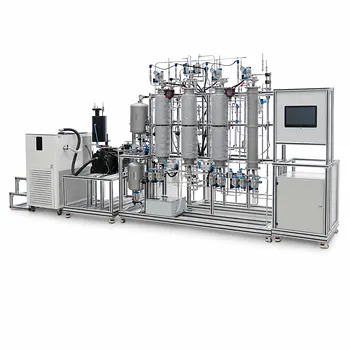
The key differentiator between a PLC-based safety system and a Triple Modular Redundancy (TMR) architecture isn’t just cost—it’s how each treats faults and system availability. A safety PLC can meet rigorous SIL 2 to SIL 3 requirements through built-in diagnostics and flexible programming. A TMR system goes further, using triple-redundant hardware and 2-out-of-3 voting to keep your pilot plant running safely even when a component fails, virtually eliminating spurious trips. For most vocational training setups, the PLC delivers the necessary safety with superior flexibility and affordability; for advanced, long-running research campaigns where every uninterrupted hour matters, TMR becomes the definitive choice.
While a well-implemented PLC safety system can achieve up to SIL 3 at a fraction of the cost, a TMR system’s 2-out-of-3 voting and hot-swappable modules make it indispensable when you cannot tolerate a spurious shutdown that might ruin a months-long catalytic experiment or a critical student thesis run.
The Architecture Face-Off: PLC vs TMR
Understanding how each system handles faults is the foundation of your decision.
How a PLC-Based Safety System Works
A safety PLC uses a single or dual processor with sophisticated self-diagnostics.
It continuously monitors its own hardware and the integrity of connected sensors and actuators.
If a critical fault is detected, the system executes a pre-defined shutdown, bringing the process to a safe state.
For pilot plants, PLCs offer two valuable deployment forms.
Integrated (compact) PLCs house the CPU, power supply, and a fixed number of I/O points in one chassis, perfect for small, dedicated unit operations skids.
Modular PLCs let you plug independent CPU, power, communication, and I/O modules into a backplane rack, enabling easy expansion up to thousands of points.
This modularity is especially powerful in educational settings.
You can add new temperature, pressure, or flow sensors and integrate complex cascade control loops without replacing your core safety hardware.
The combination of high flexibility, straightforward ladder-logic programming, and SIL 2–3 capability makes a safety PLC the standard, cost-effective backbone for most vocational pilot plants.
Inside Triple Modular Redundancy
TMR takes fault tolerance to a different architectural level.
It triplicates the critical components—processors, I/O modules, and power supplies—and uses 2-out-of-3 (2oo3) voting logic to determine the true state of the system.
If one leg of the architecture fails or gives a false reading, the other two outvote it, allowing the process to continue operating safely.
This design delivers two game‑changing operational benefits.
Online hot‑swapping means you can replace a faulty module while the pilot plant is still running, entirely removing the need to shut down for single‑point hardware repairs.
Dramatic spurious trip reduction ensures that a single sensor anomaly or a transient hardware glitch no longer forces an unnecessary and costly process halt.
TMR systems typically carry higher safety integrity claims out of the box because the redundancy is baked into the hardware.
However, they come with significantly higher capital costs, larger physical footprints, and greater engineering complexity—factors that demand strong justification in a training‑focused environment.
Why This Choice Matters for Your Pilot Plant’s Goals
Your surface question is about architecture, but the deeper need is protecting your plant’s true mission: training or research.
When Training Objectives Drive the Decision
In a vocational chemical engineering pilot plant, the control system itself is a teaching tool.
PLC‑based safety systems align naturally with this goal because they are widely used across the process industry.
Giving students hands‑on time with the same architecture they will encounter in their future workplaces is an immense pedagogical value.
A modular safety PLC also supports the constantly evolving nature of a teaching plant.
As new experiments are designed, you can quickly reconfigure I/O, add new instrument types, and modify shutdown logic without epic engineering effort.
This keeps the plant fresh and maximizes equipment utilization across multiple student cohorts, all while staying within a typical academic budget.
When Research Integrity and Uptime Are Non‑Negotiable
If your pilot plant is running a sensitive, long‑duration catalytic synthesis or a distillation study that has been weeks in the making, an unexpected trip is more than an inconvenience—it’s a data‑destroying event.
Here, the deep need shifts from cost‑effective safety to maximum process availability.
TMR’s 2oo3 voting directly answers this challenge.
A single instrument drift or a failing I/O channel will not shut you down; the system simply flags the fault and keeps running on the majority vote.
This architecture is standard in commercial processes where downtime can cost millions per day, and it should be seriously considered for advanced research pilot plants where the experiment’s continuity is the primary asset.
Understanding the Trade-offs
Building trust means being honest about what you sacrifice with each path.
The Hidden Cost of Spurious Trips
The most under‑estimated factor in selecting a safety architecture is the true cost of a false shutdown.
For a teaching plant running a three‑hour batch distillation, a spurious trip is a minor annoyance that students can learn from.
For a research plant processing a valuable precious‑metal catalyst over four weeks, that same trip can mean months of wasted preparation and lost grant funding.
PLC‑based systems, even with good diagnostics, cannot eliminate the risk of a single failure causing a trip.
TMR eliminates that single‑point vulnerability for most hardware faults, effectively trading higher upfront capital for long‑term experimental continuity.
Complexity and Maintenance Overhead
TMR’s redundancy is a double‑edged sword.
It requires specialist knowledge to configure, commission, and maintain.
The triple‑redundant I/O wiring and synchronization can lead to more complex troubleshooting when something goes wrong—and a technician accustomed only to PLCs will face a steep learning curve.
For a vocational teaching environment, this complexity can work against your training objectives.
You risk spending more time explaining the safety architecture itself than the unit operation it’s protecting.
A modular safety PLC, in contrast, keeps the maintenance barrier low and the learning focus squarely on the chemical process.
Making the Right Choice for Your Goal
Align your architecture with what your pilot plant must deliver every day.
If your primary focus is hands‑on operator training: Choose a modular safety PLC. It delivers SIL 2–3 safety, mirrors real‑world industrial practice, and provides the flexibility to reconfigure experiments quickly without breaking your budget.
If your primary focus is protecting high‑value, long‑duration research runs: Invest in a TMR system. The 2oo3 voting and hot‑swap capability will shield your experiment from spurious trips and allow maintenance without shutdown, directly preserving the continuity of your data.
If your pilot plant spans both missions: Segment the control system. Deploy a modular safety PLC on the general unit operations skids, and reserve a TMR safety controller for the single, critical reactor or continuous process unit where downtime is unacceptable. This hybrid approach optimizes both cost and research integrity.
Your goal is not to buy the most redundant hardware, but to buy the exact level of fault tolerance that keeps your people safe and your plant’s true mission—whether it’s teaching the next generation or making a breakthrough discovery—on track.
Summary Table:
| Feature | Safety PLC | Triple Modular Redundancy (TMR) |
|---|---|---|
| Fault Tolerance | Executes safe shutdown on fault detection | Continues operation via 2-out-of-3 voting |
| Spurious Trips | Higher risk of false shutdowns | Minimized; tolerates single-point hardware faults |
| Cost & Footprint | Budget-friendly & compact | High capital cost & larger physical footprint |
| Maintenance | Standard programming, low overhead | Complex wiring, requires specialist knowledge |
| Best Suited For | Vocational training & flexible skids | Long-duration, high-value research campaigns |
Equip Your Pilot Plant with the Right Safety Architecture
At LABPARK, we design and manufacture industry-grade Educational and Vocational Unit Operations Pilot Plants in chemical engineering, bioprocess & biotech, and environmental & water treatment for universities, research institutes, and enterprises.
Whether you need flexible, safety-PLC-controlled training skids or fault-tolerant TMR systems for continuous research, we customize our platforms to align with your academic, research, and budget requirements.
How LABPARK brings value to your institution:
- Industrial-Grade Learning: Prepare students with hands-on experience using the exact control architectures they will face in the field.
- Custom Integration: Tailor safety systems, I/O modules, and process controls to your specific curriculum or research criteria.
- Built for Safety & Durability: Certified, reliable hardware designed to protect your students, researchers, and experimental data.
Ready to design a safe, reliable, and high-performing pilot plant? Contact LABPARK today to discuss your custom project requirements!
Related Products
People Also Ask
- How does Pressure Swing Adsorption (PSA) technology operate? Optimize gas separation with pilot plants.
- How to demonstrate physical vs chemical absorption using a pilot plant? A practical lab guide.
- How is moisture removal managed in an adsorption unit operations pilot plant? Dew Point Control Guide
- How do physical vs chemical adsorption impact pilot plant design? Key operational & regeneration strategies.
- What are the key differences between PSA and TSA? Choosing the Right Adsorption Pilot Plant