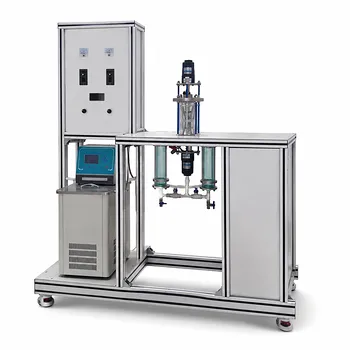
Reagentless acoustic-wave detectors revolutionize chromatography training by turning a complex, multi-step post-column process into a single, direct measurement. Unlike traditional enzyme reactor detectors that require a cascade of added reagents and reaction chambers to indirectly sense an analyte, these sensors measure physical changes—like mass-loading or viscosity—directly on the sensor surface in real time. The result is a dramatically simpler flow path, zero continuous reagent consumption, and a non-destructive detection principle that leaves the sample intact.
Traditional post-column enzyme reactors force you to manage chemical additives, multi-cell plumbing, and indirect signal generation—adding cost, waste, and system complexity to an educational setup. Reagentless acoustic-wave detection strips all that away, delivering a clean, continuous signal directly from the eluant without altering the analyte. For a training system, this means students learn separation science, not reagent troubleshooting.
The Core Advantage: Eliminating the Reagent Cascade
A reagentless acoustic-wave detector—such as a Surface Transverse Wave (STW) sensor—operates on a fundamentally different principle than post-column enzyme reactors. It removes the entire chain of reagent addition, mixing, and byproduct detection that burdens traditional training setups.
Direct Physical Detection, Not Indirect Chemical Reporting
Traditional enzyme reactors rely on the analyte reacting with an oxidase to produce a detectable byproduct like hydrogen peroxide. This is an indirect measurement that only works for analytes compatible with specific enzymes. An acoustic-wave sensor, by contrast, detects the mass-loading and viscoelastic changes that occur when the analyte binds to or accumulates on the sensor surface. The signal is a direct physical consequence of the analyte’s presence, not a secondary chemical reaction.
A Single-Cell System That Simplifies the Flow Path
Post-column reactors demand a multi-cell configuration: one reactor to generate the byproduct, maybe a second to remove interfering species, and often a reference cell. The reagentless sensor collapses this into a single sensing cell placed directly in the eluant stream. There is no need to split the flow, add make-up reagents, or install extra reaction columns. For a training system, the plumbing becomes vastly simpler, reducing the time students spend tracing fluid paths and increasing the time they spend understanding chromatographic principles.
Zero Ongoing Reagent Consumption and Reduced Waste
Because the acoustic-wave sensor does not require any post-column reagents, there is no need to continuously pump enzyme solutions, co-factors, or fluorescent labels into the system. This eliminates the recurring cost of consumables and dramatically cuts chemical waste generation. Educational labs, which often operate on tight budgets and with growing sustainability mandates, benefit immediately from a cleaner, cheaper, and more environmentally friendly detection method.
Non-Destructive Detection Preserves the Sample
Enzyme-based methods chemically alter the analyte—oxidations consume the target molecule, and fluorescence labeling blocks active sites. This makes the sample unusable for downstream applications. Acoustic-wave detection is non-destructive; the analyte passes over the sensor, generates a signal, and exits the system intact. In a training context, this enables recovery of purified fractions for further study, connecting chromatographic separation to preparative goals without sacrificing material.
Why Traditional Post-Column Reactors Fall Short in a Training Environment
Understanding what the reagentless sensor replaces highlights its practical value for educators and students.
Indirect Detection Limits the Scope of Experimentation
Enzyme reactor systems can only detect molecules that serve as substrates for the chosen oxidase. This narrow focus constrains the curriculum—you can’t easily switch to studying a new class of compounds without changing the entire enzyme-based detection chemistry. The acoustic-wave sensor is detection-agnostic: it responds to any mass change on its surface, whether through affinity capture or simple adsorption, making it far more versatile for teaching a range of separation principles.
Multi-Cell Complexity Obscures Core Learning Objectives
A typical post-column setup includes a mixing tee, a reaction coil, and sometimes a second column to remove excess tags. Troubleshooting this network—bubble formation, gradient mixing, reagent depletion—steals valuable lab time. Students often end up troubleshooting the detection hardware rather than focusing on the separation column and mobile phase optimization. A reagentless single-cell sensor reduces the number of failure points and keeps the learning focused on chromatography.
Chemical Handling and Safety Overhead
Post-column reagents like fluorescently-labeled antibodies or enzyme solutions require careful handling, refrigeration, and disposal. In an academic lab, this adds a layer of safety training and compliance that distracts from the core chromatography curriculum. Eliminating these chemicals makes the training system cleaner, safer, and easier for instructors to manage.
Understanding the Trade-offs of Reagentless Detection
While the advantages are clear, no technology is a universal solution. It’s important to recognize where reagentless acoustic-wave sensors may require careful consideration.
Sensitivity Depends on Analyte Mass and Surface Affinity
Acoustic-wave sensors detect mass changes. For very small molecules with low binding affinity—where the mass added to the surface is minimal—the signal-to-noise ratio can be inferior to an enzyme-coupled amplification cascade that generates thousands of detectable byproduct molecules per binding event. In training demonstrations that require detection of trace-level analytes, a reagentless system might not provide sufficient sensitivity without a tailored surface chemistry.
Specificity Must Be Engineered onto the Sensor Surface
Enzyme reactors achieve specificity through the biological enzyme itself. An acoustic-wave sensor, by default, responds to anything that sticks to its surface. To differentiate analytes, you must functionalize the sensor with a selective coating—an antibody, a molecularly imprinted polymer, or a specific affinity ligand. Developing and maintaining that coating requires upfront effort and can introduce a new layer of assay development complexity.
Matrix Effects Can Introduce Non-Specific Signals
In complex sample matrices, non-target components can adsorb onto the sensor surface and generate a drifting baseline or false response. While the same can happen with reactor systems (enzyme fouling), reagentless sensors demand careful buffer selection and surface passivation to maintain reliable performance over many injections. Students may need to spend time learning about surface chemistry and fouling, which could be an added learning objective or a distraction, depending on your curriculum goals.
Making the Right Choice for Your Training Goals
Choosing between a reagentless acoustic-wave sensor and a traditional post-column reactor boils down to what you want your students to walk away with.
-
If your primary focus is teaching core separation principles with minimal system complexity: A reagentless detector is the clear winner. It removes reagent-related variables so students can focus on column performance, mobile phase effects, and retention mechanisms inside a nearly maintenance-free flow path.
-
If your primary focus is demonstrating methods that amplify a weak signal or teach enzymatic detection principles: A traditional enzyme reactor may still have a place. It shows students how indirect detection works and how reagent chemistry can be coupled to chromatography, but be prepared for the additional time spent on reagent preparation and troubleshooting.
-
If your primary goal is to minimize cost per analysis and chemical waste in a high-throughput teaching lab: Reagentless detection offers a compelling operational advantage. Without continuous reagent flow, consumable costs plummet, and waste handling becomes trivial—a practical selling point for budget-conscious departments.
-
If your objective is to integrate chromatography with downstream preparative recovery or further analysis: The non-destructive nature of acoustic-wave sensing makes it indispensable. You preserve the purified analyte, bridging the gap between analytical and preparative chromatography in a single educational exercise.
A reagentless acoustic-wave detector removes the reagent burden from liquid chromatography training, shifting the emphasis back to where it belongs—the separation itself.
Summary Table:
| Feature | Reagentless Acoustic-Wave Detector | Traditional Post-Column Enzyme Reactor |
|---|---|---|
| Detection Principle | Direct physical measurement (mass/viscosity) | Indirect chemical reaction (byproduct detection) |
| Flow Path | Simple single-cell design | Complex multi-cell setup (mixing tees, coils) |
| Reagent Use | Zero ongoing consumption | Continuous reagent/enzyme feeding required |
| Sample Integrity | Non-destructive (analyte preserved) | Destructive (analyte chemically altered) |
| Waste & Maintenance | Minimal waste, low maintenance | Chemical waste generation, frequent troubleshooting |
Upgrade Your Laboratory Training with LABPARK
Are you looking to modernize your laboratory curriculum with efficient, low-maintenance technology? LABPARK provides premium Educational and Vocational Unit Operations Pilot Plants in chemical engineering, bioprocess & biotech, and environmental & water treatment. Designed specifically for universities, research institutes, and enterprises, our training systems help students focus on core scientific principles rather than equipment troubleshooting.
Ready to elevate your training outcomes and reduce operational overhead? Contact LABPARK today to find the perfect pilot plant solution for your institution!
Related Products
People Also Ask
- Why Compare Membrane-Reservoir Models with Pilot Plant Data? Ensure Successful Process Scale-Up
- How does column packing affect absorption intensification, and how is it evaluated experimentally?
- What key factors influence the rate of diffusion in liquids? Optimize Mass Transfer Pilot Plant Design
- What are the limitations of the Wilke-Chang correlation? Avoid critical mass transfer errors.
- What is the role of the Sherwood number ($Sh$) in pilot plants? Master mass transfer scale-up