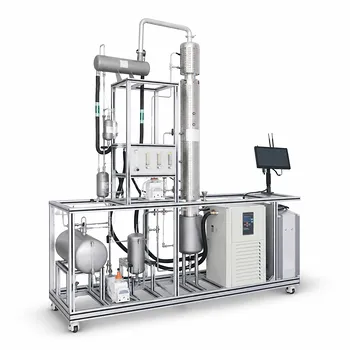
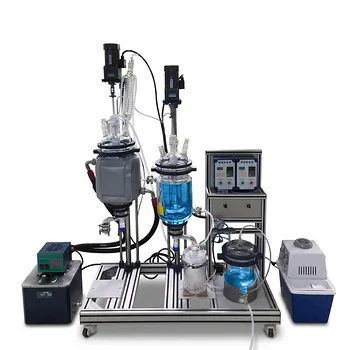
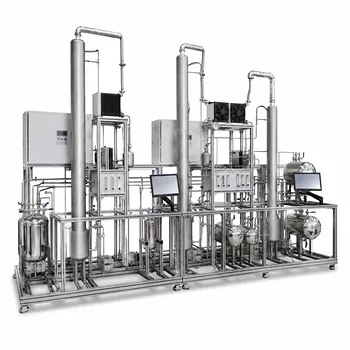
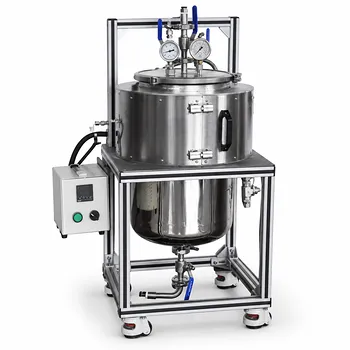
Salt-effect distillation is a brilliant but demanding technique to demonstrate in a chemical engineering training environment. Its core advantages lie in dramatically reducing the energy and equipment needed to separate hard-to-handle mixtures like ethanol-water, achieving 20-25% energy savings and slashing the required column trays by up to 45. However, these gains come with formidable engineering headaches: recovering and recycling the salt is notoriously difficult, while pipe clogging, scaling, and corrosion demand robust, often costly system design.
Salt-effect distillation offers a uniquely visual, high-impact lesson in vapor-liquid equilibrium modification. Yet it is a double-edged sword—the very salt that makes the separation so thermodynamically efficient also introduces operational complexities that can dominate the maintenance conversation if not designed with extreme care.
The Dual Advantage: Lower Energy and Sharper Separation
The magic of salt-effect distillation is that it injects a non-volatile, inorganic salt directly into the liquid phase. Unlike a liquid solvent in traditional extractive distillation, the salt does not vaporize. This means it stays in the column, continuously altering the relative volatility of the mixture without the energy penalty of solvent regeneration. For a training pilot plant, this delivers two convincing wins.
Dramatic Reductions in Energy and Required Stages
When you add a salt like calcium chloride to an ethanol-water mixture, it disrupts the hydrogen bonding that gives ethanol its azeotropic behavior. The salt ions preferentially attract water molecules, making water less volatile. The result: you can break the azeotrope completely.
This thermodynamic shift translates directly into hard operational savings. The primary reference confirms that salt-effect distillation can cut energy consumption by 20% to 25% compared to conventional azeotropic separation. Even more striking for a pilot plant, the number of required theoretical stages can drop by up to 45 trays. For an educational setup, this means you can demonstrate a complete separation in a relatively short column—making the entire process more visible and understandable.
Superior Selectivity Without a Liquid Solvent
Traditional extractive distillation uses a high-boiling liquid solvent to extract one component. That solvent must then be boiled off and condensed in a separate regeneration column, adding significant capital and energy costs. With a salt, there is no solvent loop. The salt remains in the liquid phase throughout, providing a high selectivity that is purely ionic in nature.
This not only simplifies the flow sheet for students but also highlights a fundamental chemical principle: ionic strength directly governs molecular interactions. The salt’s effect on activity coefficients makes abstract thermodynamic concepts tangible. Students can measure VLE curves with and without salt to see the azeotrope disappear—a lesson that sticks.
A Clear Window into Phase Equilibrium Engineering
From a pedagogical standpoint, the greatest advantage is visibility. In an educational pilot plant, the salt’s presence forces trainees to confront what happens inside the column at a molecular level. They see firsthand how a non-volatile additive can permanently reside in the liquid phase, altering vapor-liquid equilibrium without an extra distillation step. This makes salt-effect distillation a rallying point for discussing ionic strength, activity coefficients, and advanced separation strategies.
The Engineering Headaches: Salt Doesn’t Just Sit Still
For all its thermodynamic elegance, salt-effect distillation introduces a cascade of practical problems. The very salt that delivers the separation threatens to choke the system. In a training environment, these challenges can become the dominant learning experience—sometimes too dominant.
The Salt Recovery and Recycling Conundrum
You can’t just dump the salt-laden bottoms down the drain. Recovering and recycling the salt is the single biggest engineering hurdle. Once water is removed, the salt solution must be concentrated, which typically means an energy-intensive evaporation or crystallization step. If this step isn’t optimized, you lose a large chunk of the energy advantage you just gained at the column.
For a training unit, the recovery train adds complexity. It may require additional vessels, heat exchangers, and solid-handling equipment that distract from the core distillation lesson. Poor salt recovery also means continuous salt make-up, turning an elegant closed-loop idea into a logistics problem.
Clogging, Scaling, and Corrosion: The Plumbing Nightmares
Solid salts and saturated solutions have a nasty habit of precipitating where you least want them. As the primary reference warns, pipe clogging and scaling are real threats. A slight temperature drop at the wrong place can cause salt crystals to form, blocking valves and fouling heat transfer surfaces. A pilot plant with small-diameter tubing is especially vulnerable.
Then there’s the corrosion monster. Many effective salts, like calcium chloride, are highly corrosive to standard stainless steel. You must spec corrosion-resistant materials such as high-grade alloys or specialty plastics, which drives up capital cost. In a teaching lab, a pin-hole leak from a corroded flange becomes an immediate safety and shutdown issue.
System Complexity and Maintenance Overhead
A salt-effect distillation rig is not a set-and-forget system. Operators must carefully monitor concentration profiles, manage salt slurry flows, and periodically clean out deposits. For an institution, that translates into higher maintenance hours and a steeper learning curve for lab technicians. The risk is that the system becomes known more for its downtime than for its thermodynamic lessons.
Understanding the Trade-offs in a Training Environment
You must weigh the pedagogical bang against the operational buck. Salt-effect distillation is a phenomenal tool for teaching advanced separation concepts, but it is a high-maintenance demonstration. It demands meticulous material selection, regular cleaning, and a recovery strategy that may itself be energy-intensive.
In a unit operations lab, the ideal system often balances conceptual clarity with robustness. Salt-effect distillation tilts heavily toward conceptual power. If your students can afford the time to investigate clogging mechanisms alongside VLE theory, the rig becomes a dual lesson in process chemistry and real-world operations. But if the goal is to run a tightly scheduled lab with minimal technician intervention, the salt-related headaches may outweigh the thermodynamic elegance.
How to Apply This to Your Training Objectives
Your decision to incorporate a salt-effect distillation unit should hinge on what you want your students to learn most. Here is how to match the system’s strengths to your goals:
- If your primary focus is demonstrating azeotrope breaking and VLE modification: Salt-effect distillation is an unrivaled, high-visibility choice—just pair it with a simple, pre-designed salt-recovery demonstration rather than a fully integrated loop.
- If your primary focus is minimizing equipment maintenance and maximizing uptime: Consider a conventional extractive distillation or pressure-swing distillation rig; you will sacrifice the ionic strength lesson but gain operational simplicity.
- If your primary focus is giving students a true troubleshooting experience: Embrace the challenges of salt handling, specify corrosion-resistant materials upfront, and treat the salt recovery and anti-clogging design as part of the curriculum.
Every engineering trade-off is itself a powerful lesson. A carefully designed salt-effect distillation unit can teach that lesson with unparalleled clarity.
Summary Table:
| Aspect | Key Advantages | Engineering Challenges |
|---|---|---|
| Energy & Equipment | 20–25% energy savings; reduces column trays by up to 45 | Salt recovery/recycling is energy-intensive and complex |
| Separation Efficiency | Breaks azeotropes completely without a liquid solvent loop | High risk of pipe clogging and scaling from salt precipitation |
| Pedagogy & Materials | Offers a clear, visual lesson in VLE and ionic strength | Demands corrosion-resistant materials and high maintenance |
Build a High-Performance Chemical Engineering Lab with LABPARK
Are you looking to teach advanced separation processes safely and effectively? LABPARK provides state-of-the-art Educational and Vocational Unit Operations Pilot Plants in chemical engineering, bioprocess & biotech, and environmental & water treatment.
Designed specifically for universities, research institutes, and enterprises, our pilot plants feature robust, corrosion-resistant engineering to minimize downtime and simplify maintenance while maximizing learning outcomes.
Optimize your training curriculum—contact LABPARK today to customize your pilot plant system!
Related Products
- Multi-Functional Special Distillation Educational Pilot Plant
- Multi-Modal Distillation Unit Operations Training Pilot Plant
- Continuous Sieve-Plate Distillation Pilot Plant for Unit Operations Laboratory Education
- Continuous Batch Extractive Distillation Educational Pilot Plant
- Potassium Salt Thermal Dissolution and Crystallization Separation Educational Unit Operations Pilot Plant
People Also Ask
- Why does simple distillation yield higher efficiency than flash distillation? Key thermodynamic differences.
- How does double temperature difference control improve distillation pilot plants? Stabilize purity.
- Why is the acentric factor important in pilot plants? Fluid property prediction.
- How to Integrate Spectroscopy in Distillation Pilot Plants for Advanced Process Control
- How to Verify Distillation Boundary Lines & Composition Regions with Pilot Plants