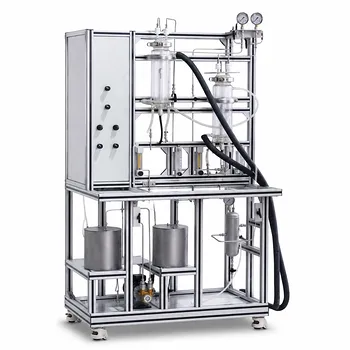
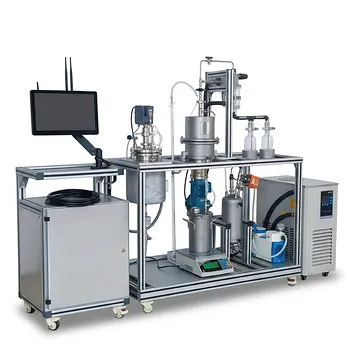
Pseudoannular photoreactors give you the best balance of thermal control and multiphase versatility at lab scale, while multilamp-multitube designs are the undisputed choice for pilot-scale production—as long as you're not dealing with a multiphase system. The pseudoannular configuration excels at managing heat in low-to-medium-pressure reactions with medium-to-long residence times, and it can handle both gas and liquid phases seamlessly. The multilamp-multitube reactor, by contrast, brings high-pressure tolerance and flexible optical adaptation to pilot plants, making it the superior scaling platform—but its inability to process multiphase streams efficiently is a hard stop that reserves it for single-phase service.
Both reactors solve the classic photoreactor scaling dilemma differently: the pseudoannular reactor prioritizes thermal resilience and phase versatility for in-depth process development, while the multilamp-multitube design sacrifices multiphase capability to deliver the high-pressure, high-throughput performance pilot facilities demand. Your selection hinges on whether you need multiphase flexibility or pilot-ready throughput.
Understanding the Photoreactor Landscape
Photochemical processes promise high selectivity, minimal side reactions, and the ability to drive reactions at low temperatures that would be thermodynamically impossible with heat alone. Yet taking these benefits from a beaker to a pilot plant is far from trivial. Historically, the lack of standardized design models and scarce quantitative data on light-path dynamics have made photoreactor scale-up a black art. Today, dedicated unit-operations pilot plants that quantify radiation and kinetic parameters bridge that gap—and the choice of reactor geometry is where the rubber meets the road. Two workhorse designs dominate this space: the pseudoannular and the multilamp-multitube photoreactor.
The Core Challenge: Light, Heat, and Residence Time
Photoreactors must deliver uniform photon flux while tightly controlling temperature and allowing enough reaction time. Each geometry handles this trio differently. Pseudoannular reactors wrap the reaction zone around a central light source, creating a cylindrical fluid film that maximizes heat transfer to the walls. Multilamp-multitube designs distribute multiple lamps among an array of tubes, illuminating from all sides for intense, customizable photon delivery. The decision between them is a direct lever on your process's scalability, pressure limits, and phase compatibility.
Pseudoannular Photoreactors: Versatile and Thermally Robust
The pseudoannular design is the go-to for reactions that need careful heat management without high pressure. Its annular channel places the reacting medium in close contact with both the lamp and the external cooling jacket, giving it exceptional thermal regulation. This makes it ideal for exothermic gas- or liquid-phase reactions where a temperature spike would ruin selectivity.
Heat Transfer and Residence Time Control
Because the entire reaction volume is a thin annulus, heat removal is rapid and uniform. The geometry also naturally produces plug-flow characteristics, giving you precise control over medium-to-long residence times. These traits combine to suppress side reactions that would otherwise flourish under thermal gradients, making the pseudoannular reactor perfect for sensitive lab-scale syntheses.
Pressure Capabilities and Phase Flexibility
A pseudoannular reactor is built for low-to-medium operating pressures, which aligns well with most laboratory research and small-scale process validation. Crucially, it is not restricted to a single fluid phase. Whether you're running a homogeneous liquid reaction, a gas-liquid mixture, or a slurry, the open annular pathway tolerates multiphase flow with far fewer clogging or maldistribution risks than a multitubular system. That phase tolerance is the reactor’s hidden superpower.
Limitations at Larger Scale
Heat transfer and residence-time control remain excellent as you increase throughput, but the single-lamp, single-channel geometry becomes a bottleneck. Pseudoannular reactors cannot easily add light-emitting surface area in the way a scaled-up process demands—there is only so much volume you can wrap around one lamp before photon gradients create dark zones. This makes them less suitable when the immediate goal is a high-throughput pilot campaign under intense illumination.
Multilamp-Multitube Photoreactors: The Pilot-Scale Powerhouse
When your objective shifts from exploring chemistry to proving it can run at production rates, the multilamp-multitube reactor becomes the optimal configuration. By bundling multiple tubes, each surrounded by its own lamp, this design multiplies the photon flux while keeping individual tubes at manageable diameters. The result is a reactor that can mimic lab conditions at pilot scale, with performance you can mathematically model and confidently project upward.
Superior Scalability and Operational Flexibility
Each tube in a multilamp array acts as an independent irradiated unit. You can vary the number of tubes and the lamp intensity to tune overall throughput and light delivery, adapting to different optical properties without redesigning the reactor. This modularity also means you can systematically study the radiation field parameters that control scale-up, directly addressing the quantitative data gap that plagues many photochemical processes.
High Pressure and Heat Management Excellence
Unlike the pseudoannular design, multilamp-multitube reactors are built for high-pressure operation. The small-diameter tubes inherently withstand greater stress, and the distributed lamp arrangement prevents severe thermal hotspots. Combined with external cooling between tubes, the configuration delivers the excellent heat transfer needed to keep exothermic reactions safe and stable at pilot-plant flow rates.
The Multiphase Blind Spot
This design has one fatal flaw: it cannot efficiently handle multiphase reactions. Multiple fluid phases in a tube array lead to flow maldistribution, gas holdup, and severe light scattering that destroys uniformity. The primary reference states unequivocally that this limitation renders the multilamp-multitube reactor unsuitable for multiphase service. If your process involves gas bubbles, solid slurries, or immiscible liquid streams, you must look elsewhere—and the simpler pseudoannular design is the standard remedy.
The Critical Trade-offs in Photoreactor Selection
Choosing between these two platforms isn't about which is “better.” It's about what your process physically demands. A side-by-side look at their trade-offs unlocks the right decision for both lab and pilot work.
When Phase Compatibility Overrides Throughput
Multiphase reactions inherently couple chemistry with fluid mechanics and light distribution. The pseudoannular reactor’s single annular channel minimizes maldistribution and allows gas or solid phases to pass without blocking light paths. The multilamp-multitube reactor’s parallel narrow tubes immediately amplify the complexity, often leading to erratic residence times and dark zones that ruin conversion. For any multiphase system, the pseudoannular geometry is the safer, more reliable foundation.
When Pressure and Photon Flux Dominate the Decision
Single-phase processes that need high pressure and intense, uniform illumination tip the scales toward the multilamp-multitube array. The elevated pressure tolerance reduces compressor capital and opens chemistries that require supercritical or high-density gas states. Meanwhile, the ability to pack multiple lamps around each tube guarantees a high photon flux density that scales linearly with the number of tubes—something the single-lamp pseudoannular reactor cannot match.
Balancing Research Depth and Pilot Throughput
In early-stage process research, you often need to explore residence time, temperature, and phase effects broadly. A pseudoannular reactor’s plug-flow precision and multiphase tolerance give you the experimental freedom to map parameter spaces. However, once the chemistry is locked and the goal becomes producing kilograms per day for customer sampling or toxicology studies, the multilamp-multitube reactor’s scalability and high-pressure performance become non-negotiable.
Making the Right Choice for Your Process
Selecting a photoreactor is a strategic step in your scale-up roadmap. Use the following criteria to align the hardware with your immediate goals.
- If your primary focus is multiphase reaction development or low-pressure lab studies: Lean on the pseudoannular reactor. Its thermal control, plug-flow behavior, and inherent phase flexibility will give you reliable data across a broad parameter space.
- If your primary focus is scaling a single-phase reaction to pilot throughput under high pressure: Invest in a multilamp-multitube system. Its modular tube-and-lamp design delivers the photon flux and pressure tolerance that translate directly to production-scale projections.
- If you anticipate a future need for both multiphase flexibility and high-pressure piloting: Start with a pseudoannular design to de-risk the chemistry, then plan a split-stream pilot campaign once you reach single-phase optimization—recognizing that a single reactor platform cannot do it all.
The right photoreactor doesn't just illuminate your reaction; it illuminates the path from discovery to production. Match the geometry to the phases and the operating envelope, and you'll avoid the dark zones of failed scale-up.
Summary Table:
| Feature | Pseudoannular Photoreactors | Multilamp-Multitube Photoreactors |
|---|---|---|
| Primary Scale | Lab & small-scale validation | Pilot-scale production |
| Phase Compatibility | Multiphase (gas, liquid, slurry) | Single-phase only (homogeneous) |
| Pressure Tolerance | Low-to-medium | High pressure |
| Thermal Control | Excellent (thin fluid film) | Good (distributed cooling) |
| Key Advantage | High phase & thermal versatility | Modular scaling & high photon flux |
| Main Limitation | Scaling bottleneck for photon area | Clogging & maldistribution in multiphase |
Optimize Your Process Scale-Up with LABPARK
Choosing the right reactor geometry is a critical step in transitioning from lab research to pilot production. LABPARK provides state-of-the-art Educational and Vocational Unit Operations Pilot Plants in chemical engineering, bioprocess & biotech, and environmental & water treatment. Designed to meet the precise needs of universities, research institutes, and enterprises, our systems deliver the thermal control, phase versatility, and scaling predictability required for cutting-edge process development.
Ready to elevate your research and training capabilities? Contact LABPARK today to discuss your pilot plant requirements!
Related Products
- Photocatalytic Membrane Separation and Degradation Unit Operations Pilot Plant
- Supercritical High-Gravity Flash Evaporation Educational Unit Operations Pilot Plant
- Rising and Falling Film Evaporation Educational Unit Operations Pilot Plant
- Educational Unit Operations Pilot Plant for Intraparticle Diffusion Effective Factor Measurement
People Also Ask
- What are the key differences in membrane configurations? Choose the Right Unit Operations Pilot Plant
- How Do Pervaporation, Vapor, and Gas Permeation Differ in Pilot Plants? Key Comparison
- What are the structural & performance trade-offs of flat-sheet, spiral-wound, & hollow-fiber membrane modules?
- How do PEI, PVDF, and PSU membranes compare in pilot plants? Find the best fit.
- Pervaporation vs. Vapor Permeation: Handling Suspended Solids in Membrane Pilot Plants