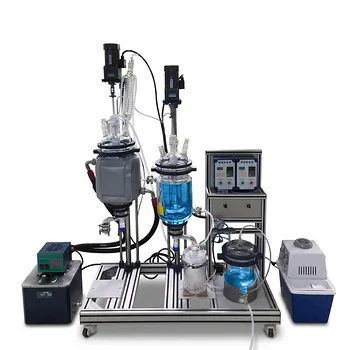
In crystallization, agitation speed is not just a mixing parameter—it’s a particle design tool. Selecting an inappropriate speed has immediate, measurable consequences on the particle size distribution. If the speed is too low, you get stratification and growth dispersion, resulting in an unacceptably broad, non-uniform crystal product. If the speed is too high, crystal attrition and breakage dominate, creating a damaging bimodal distribution full of broken fragments.
The core consequence of poor agitation control is a loss of particle size integrity: under-agitation sacrifices uniformity, while over-agitation shatters crystals into an unwanted fines-and-chunks mixture. The operational sweet spot is where full suspension meets minimal mechanical stress, and finding it is the central challenge of pilot-scale crystallization.
The Direct Consequences of Poor Agitation Control
The immediate output of a stirred-tank crystallizer is a population of particles. Agitation speed dictates whether that population is predictable and functional or severely flawed. The effects are binary but equally harmful.
Under-Agitation: Stratification and Growth Dispersion
When the impeller speed is too low, solid crystals no longer remain uniformly suspended. Heavier, larger particles settle to the bottom, while fines linger near the top or in low-flow zones.
This vertical segregation, or stratification, exposes crystals to vastly different local supersaturation levels. Some grow fast in rich solution; others starve and grow slowly. The result is a broad, non-uniform particle size distribution (PSD) caused by growth dispersion.
A broad PSD means poor control over downstream properties. Dissolution rates, filtration times, and bulk density all become inconsistent. You lose the ability to guarantee product quality.
Over-Agitation: Attrition and Crystal Breakage
Turning the speed too high introduces excessive shear and violent particle collisions. Crystals strike the impeller, the vessel walls, and each other with damaging force.
This leads to crystal attrition and breakage, fracturing the primary particles. The broken fragments and dust-like fines create a distinct bimodal PSD: a peak of large, surviving crystals alongside a troubling peak of micronized debris.
A bimodal distribution is notoriously difficult to filter, washes poorly, and often causes caking during storage. The fines can also promote uncontrolled secondary nucleation, further degrading purity and yield.
Why Particle Size Distribution Matters Beyond the Reactor
The consequences of a ruined PSD reach far downstream. This is the deep need behind the question—agitation speed isn't just an operational setting; it’s a risk multiplier for the entire process.
A broad PSD from under-agitation translates to uneven dissolution profiles. In pharmaceuticals, this can mean compromised bioavailability. In fine chemicals, it leads to unpredictable reactivity and blending problems.
A bimodal PSD from over-agitation creates filtration nightmares. Fines blind filter media, drastically increasing cycle times and solvent usage. The dust also poses handling hazards and can cause product rejection on visual appearance alone.
Finally, the mechanical damage from over-agitation often roughens crystal surfaces, promoting agglomeration and caking. Your once-ideal powder may arrive to the customer as a solid, unusable block.
Navigating the Trade-Offs: The Challenge of the Sweet Spot
Achieving the perfect balance between suspension and protection is not trivial. The “sweet spot” is a narrow window that shifts with particle size, concentration, and vessel geometry.
The Perils of “Just Enough” Suspension
Simply dialing in the minimum speed for off-bottom suspension is rarely enough. It may only suspend the fine fraction, leaving a stagnant heel of larger crystals in dead zones.
These unsuspended banks can grow uncontrolled and later slough off into the product stream as oversized agglomerates. You may also see encrustation on the walls above the liquid level, reducing yield and cleanability.
Amplified Effects at Pilot and Production Scale
Scale-up magnifies the pain. The tip speed that works in a 1-liter vessel can shatter crystals in a 100-liter vessel because local shear rates do not scale linearly with impeller RPM.
Pilot plants are critical for mapping this relationship. They allow you to decouple bulk flow (for suspension) from local energy dissipation (for breakage) before you commit to an expensive full-scale error.
Making the Right Choice for Your Goal
The optimal agitation strategy is not one-size-fits-all. It must be dialed in based on what your product demands most.
- If your primary focus is a narrow PSD for consistent dissolution: Target the lowest speed that guarantees complete suspension of the largest, most erosion-prone crystals. Use pilot-scale trials to confirm no population of fines is generated.
- If your primary focus is maximizing crystal yield and avoiding fines: Favor gentleness. Start with just-suspension conditions and incrementally increase only if segregation becomes visible. Consider using a hydrofoil impeller that provides high flow with low shear.
- If your primary focus is scaling up a bench-top process: Do not trust a direct RPM match. Focus on equal tip speed or, better, on equal mass transfer coefficients. Use pilot experiments to identify the breakage threshold and design your full-scale mixer to operate safely below it.
Your impeller is a silent crystal sculptor—its speed either builds the particle distribution you need or tears it apart.
Summary Table:
| Agitation State | Primary Phenomenon | Impact on PSD | Downstream Consequences |
|---|---|---|---|
| Under-Agitation | Stratification & solids settling | Broad, non-uniform distribution | Uneven dissolution, inconsistent product quality |
| Over-Agitation | Attrition & crystal breakage | Bimodal distribution (excess fines) | Filtration blockages, product caking, dust hazards |
Optimize Your Crystallization & Scale-Up Processes with LABPARK
Finding the operational sweet spot for crystallization reactor agitation requires precise, reliable, and scalable equipment. LABPARK provides premium Educational and Vocational Unit Operations Pilot Plants in chemical engineering, bioprocess & biotech, and environmental & water treatment designed specifically for universities, research institutes, and enterprises.
Our pilot scale systems enable you to accurately model agitation dynamics, prevent crystal breakage, and master scale-up challenges before moving to commercial production.
Ready to elevate your research and training capabilities? Contact LABPARK today to find the perfect pilot plant solution for your facility!
Related Products
- Multi-Stage Stirred Tanks in Series Residence Time Distribution and Mixing Performance Determination Educational Pilot Plant
- Multi-Reactor Educational Pilot Plant for Reaction Engineering Unit Operations
- Multi Functional Catalytic Reaction and Reactor Evaluation Educational Unit Operations Pilot Plant
- Multi Functional Membrane Crystallization Educational Unit Operations Pilot Plant
- Potassium Salt Thermal Dissolution and Crystallization Separation Educational Unit Operations Pilot Plant
People Also Ask
- How does MRF model impeller rotation in CFD? Key Boundary Conditions Explained
- How can a CSTR pilot plant demonstrate reactor staging? Visualize volume savings.
- How does steady-state multiplicity affect the operation and safety of exothermic reactions within a CSTR pilot plant? - Guide
- What parameters to monitor transitioning from Batch to CSTR? Master Pilot Plant Setup
- Why is temperature regulation via a cooling jacket a critical feature in CSTR pilot plants used for laboratory training?