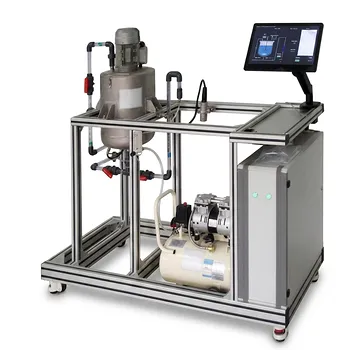
Mixing two immiscible liquids for mass transfer is a fundamental challenge in solvent extraction. Dynamic mixers address this directly by using mechanical agitation to create the large interfacial area and turbulence necessary for rapid component transfer. In a pilot plant, this controlled, high-efficiency environment is not just a processing tool—it’s a critical instrument for gathering data, optimizing parameters, and de-risking scale-up.
Dynamic mixers provide the intense dispersion needed for efficient solvent extraction, but their real power in a pilot plant is as a controlled, measurable system that lets researchers precisely quantify mixing performance, energy consumption, and process behavior before committing to full-scale design.
The Fundamental Advantage: High Mass Transfer Efficiency
The core strength of a dynamic mixer lies in its ability to generate and control the contact area between two immiscible phases. In solvent extraction, the rate of mass transfer is directly proportional to the interfacial area available, and this is where impeller-driven agitation excels.
How Impellers Create the Interface
A rotating impeller breaks up one liquid phase into tiny droplets dispersed through the other. This drastically increases the surface area across which the solute can transfer.
Without agitation, the two phases would quickly stratify, leaving only a flat, minimal interface. The mixer’s shearing action continually reforms this dispersion, keeping the mass transfer rate high throughout the operation.
Uniform Dispersion and Mass Transfer
High agitation also ensures the droplets are uniformly distributed throughout the vessel. This prevents stagnant zones where extraction would slow down.
The result is a consistent, predictable mass transfer rate—an essential requirement for gathering reliable pilot plant data that can be modeled and reproduced at larger scales.
Beyond Mixing: The Pilot Plant as an Optimization Platform
A dynamic mixer in a pilot plant is not simply a “big mixer”—it’s a dedicated test bed. The controllable nature of the impeller system turns the vessel into a precise scientific instrument.
Quantifying Agitation Parameters
Researchers can systematically vary the rotational speed and impeller geometry to map exactly how mixing intensity affects extraction efficiency. This direct correlation between a measurable input (rpm, power draw) and process output (stage efficiency, mass transfer coefficient) is invaluable.
This approach moves the team away from guesswork and toward a set of defined, replicable operating conditions.
Energy Consumption Evaluation
The primary reference highlights that pilot plants allow teams to evaluate energy consumption parameters. With a dynamic mixer, you can measure the power input required to achieve a given degree of extraction.
This data is critical for calculating the process’s operating cost and sustainability profile, well before the full-scale plant is built. It allows engineers to optimize for both performance and energy efficiency, not just one at the expense of the other.
Reproducibility and Data Quality
A well-characterized dynamic mixer provides a reproducible flow field. This means that experiments run today will yield results comparable to those run months later, as long as the set agitation speed is maintained.
This reproducibility is the bedrock of sound process development, enabling robust kinetic studies and reliable scale-up correlations.
Understanding the Trade-offs
While dynamic mixers offer excellent control and mass transfer, they are not a blanket solution. An objective assessment requires considering the downsides.
The intense agitation can create very fine, stable emulsions that are difficult to separate downstream, potentially destroying the process’s economic viability. The energy input is inherently higher than that of gravity-driven or static mixer-extractors. Additionally, a dynamic mixer comes with mechanical complexity: seals, shafts, and motors require more maintenance and present a higher risk of leakage compared to a simple packed column.
Therefore, the use of a dynamic mixer is a deliberate choice to pay a premium in energy and equipment for gains in controllability and high-intensity mass transfer. It is the right tool when you need to study or deploy rapid extraction kinetics.
Making the Right Choice for Your Pilot Plant Goal
Your specific objective will determine whether a dynamic mixer is the correct apparatus for your solvent extraction pilot study.
After a brief introductory sentence, use a bulleted list to provide specific recommendations based on different user goals.
- If your primary focus is process research and development: Choose a dynamic mixer. Its ability to precisely control and measure agitation allows you to map the complete operating space and find the true optimum for mass transfer.
- If your primary focus is generating data for scale-up: A dynamic mixer is the superior choice. The quantifiable power-per-volume and tip-speed data are standard inputs for the scale-up correlations that will govern your full-scale plant design.
- If your primary focus is educational demonstration: A dynamic mixer provides students with a hands-on, visible way to connect the physics of fluid mechanics, drop breakage, and mass transfer, reinforcing core chemical engineering principles in a single experiment.
- If your primary focus is minimizing energy cost for an easy separation: Reconsider. A dynamic mixer might over-disperse the phases and consume excess power; a static mixer or a pulsed column might be a simpler, cheaper alternative.
A dynamic mixer pilot plant is ultimately a decision to invest in deep, quantitative process understanding, turning a unit operation into a powerful tool for optimization.
Summary Table:
| Key Advantage | Impact on Pilot Plant Operations |
|---|---|
| High Mass Transfer | Creates large interfacial areas for rapid component transfer. |
| Parameter Mapping | Allows precise control over RPM and geometry to optimize extraction. |
| Energy Evaluation | Measures exact power consumption to predict full-scale operating costs. |
| Data Reproducibility | Ensures consistent flow fields for highly repeatable kinetic studies. |
Ready to optimize your process development? LABPARK provides premium Educational and Vocational Unit Operations Pilot Plants in chemical engineering, bioprocess & biotech, and environmental & water treatment. Tailored for universities, research institutes, and enterprises, our systems ensure precise scaling and efficient mass transfer. Contact us today to discover the ideal pilot plant solution for your goals!
Related Products
People Also Ask
- How do cost-capacity exponents vary across chemical equipment? Scaling insights.
- What are the primary considerations when managing and scaling up shear rates in pilot plant mixing operations? Guide
- What are the differences between set-point, servo, and program control? Master unit operations training.
- Evaluate Tablet Compaction: Force, Density & Porosity in Unit Operations Pilot Plants
- Why Switch Unit Operations Flow Configurations? Impact on Experimental Measurements