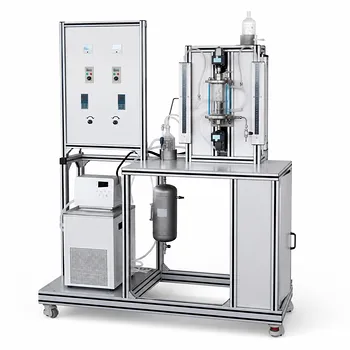
Mass spectrometry (MS) transforms off-gas analysis from a delayed, averaged measurement into a real-time, molecular-level narrative of your process. In pilot plants for chemical engineering and bioprocesses, integrating an MS gives you the ability to track process dynamics with high sensitivity and speed, while distinguishing individual chemical components across a wide concentration range—often from low ppm all the way to percentage levels—without the need for complex multivariate calibration models.
The true advantage lies in MS’s unique combination of molecular selectivity, rapid response, and a linear dynamic range that directly connects ion current to concentration. This makes trend analysis remarkably straightforward, enabling students and researchers to correlate real-time off-gas composition changes directly with process phenomena like metabolic shifts or drying endpoints.
The Core Analytical Advantages of Mass Spectrometry
Unmatched Molecular Selectivity in Real Time
A mass spectrometer identifies and quantifies individual chemical species based on their mass-to-charge ratio. Unlike non-selective gas sensors or even gas chromatography (which can take minutes per sample), MS provides immediate differentiation between, for example, nitrogen, oxygen, carbon dioxide, ethanol, and volatile organic compounds in a single stream.
This means you don’t need to rely on a slow separation step, and you avoid the ambiguity that can arise when overlapping signals in spectroscopic methods. The result is a direct, unambiguous view of what is leaving your reactor or dryer at any given moment.
Extreme Sensitivity and a Wide, Simple-to-Use Dynamic Range
Off-gas streams can swing dramatically—from trace side-products at parts-per-million levels to bulk gases at tens of percent. MS handles this span natively, often using the same detector without switching ranges. Because the relationship between ion current and partial pressure is fundamentally linear over orders of magnitude, you can monitor trends by reading raw signal changes directly, without building extensive calibration models.
This contrasts sharply with near-infrared spectroscopy (NIR) or UV-Vis methods, which require complex, sample-specific multivariate calibration sets and struggle with large concentration swings. For educational and research pilot plants, this ease of interpretation is a game-changer: students can immediately see the effect of a parameter change on oxygen uptake or ethanol production without wrestling with chemometrics.
The Speed to Capture Fast Dynamic Events
Process transients—like a sudden onset of oxygen limitation or a rapid exothermic reaction—can happen in seconds. MS delivers analysis in milliseconds to seconds, enabling you to capture these fast dynamics. This is critical for understanding reaction kinetics, optimizing feed strategies in fed-batch fermentations, or ensuring safety in drying operations where off-gas composition may signal a developing hazard.
The immediate feedback loops this creates also make MS an ideal teaching tool for closed-loop process control, where students can link gas composition signals to automated actions in real time.
Off-Gas as the Real-Time Storyteller of Your Process
Revealing Metabolic and Kinetic Signatures Without Intrusion
In a fermentation pilot plant, off-gas analysis with MS can directly measure oxygen consumption and carbon dioxide production, giving a real-time respiratory quotient. But the selectivity of MS goes further: you can simultaneously track ethanol, volatile acids, or other metabolites that are early indicators of metabolic state. This transforms the off-gas stream into a non-invasive window into the health and productivity of the culture, without the lag time of liquid sampling and offline assays.
Mapping Drying and Reaction Progress Instantaneously
In unit operations like fluidized-bed drying, the moisture content of the exhaust gas relates directly to the drying rate. MS can continuously monitor water vapor alongside other components to pinpoint the transition from constant-rate to falling-rate drying, or detect the completion of a drying cycle. In reaction engineering, off-gas composition can confirm complete conversion of a volatile reactant or signal the onset of unwanted thermal decomposition, enabling immediate process adjustment.
Complementing Other Process Analytical Technologies (PAT)
While supplementary references highlight the role of inline UV-Vis for liquid-phase monitoring (like tracking chemical oxygen demand or biological growth), MS excels in the gas phase. A truly comprehensive PAT strategy often combines both: UV-Vis or NIR for the liquid stream and mass spectrometry for the headspace or exhaust. This holistic approach provides a multidimensional picture of the process, where gas-phase composition reflects the mass balance and reaction extent, and liquid-phase data provides the remaining context.
Understanding the Trade-offs and Practical Pitfalls
While the advantages are profound, integrating MS into a pilot plant is not a simple plug-and-play exercise. You must navigate sample conditioning (removing particulates, moisture control), vacuum system maintenance, and the initial capital cost, which can be higher than simple electrochemical or thermal conductivity detectors.
Miniaturized, field-portable mass spectrometers have drastically reduced these barriers, making MS viable in teaching labs and pilot-scale settings. However, they still require a level of operator understanding beyond that of a basic sensor. Interferences (such as overlapping fragments in complex mixtures) can occur, though the direct mass-to-charge monitoring still typically demands far less calibration effort than multivariate optical methods.
It’s also crucial to remember that MS identifies components it has been set up to detect. For complex unknown off-gas mixtures, a scan over a mass range can reveal unexpected compounds, but you’ll need reference spectra to assign identities. Paired with a complementary technique like process gas chromatography, it can cover both targeted real-time monitoring and occasional detailed composition analysis.
How to Apply This to Your Pilot Plant
Your decision to integrate MS for off-gas analysis should align with your primary educational or development goal.
- If your primary focus is teaching real-time process dynamics and PAT principles: A portable quadrupole or ion-trap MS with straightforward trend-logging software is ideal. Students can learn to correlate direct ion current changes with process events immediately, without drowning in multivariate statistics.
- If your primary focus is optimizing a specific fermentation or reaction with multiple volatile components: Leverage the molecular selectivity to track several key species simultaneously. Use the fast response to implement automated feeding or endpoint detection based on exhaust gas composition.
- If your primary focus is a QbD-driven development requiring multiparametric product release: Combine off-gas MS with inline liquid-phase PAT (e.g., UV-Vis or NIR). The MS gives you a rapid, continuous material balance on gases and volatiles, while the spectroscopy completes the quality attribute picture of the liquid product.
- If you have severe budget constraints or only need a single bulk measurement: A simpler dedicated analyzer (paramagnetic O₂ sensor, NDIR CO₂ sensor) may suffice. But recognize you lose the ability to see unexpected byproducts or subtle metabolic shifts that MS would reveal.
Ultimately, integrating mass spectrometry into your pilot plant off-gas line turns a waste stream into one of your most information-rich, actionable data sources—enabling deeper understanding, faster troubleshooting, and a truly modern engineering education experience.
Summary Table:
| Key Advantage | How It Works | Impact on Pilot Plants |
|---|---|---|
| Molecular Selectivity | Identifies species by mass-to-charge ratio | Distinguishes gases/volatiles without slow chromatography |
| Wide Dynamic Range | Linear signal from ppm to % levels | Simplifies trend tracking without complex calibrations |
| Rapid Response | Delivers analysis in milliseconds | Captures fast kinetic dynamics for closed-loop control |
| Non-Invasive Tracking | Monitors exhaust and headspace | Safely tracks metabolic shifts and drying endpoints |
Elevate Your Engineering Programs with LABPARK
Integrating advanced analysis like mass spectrometry into your workflows requires robust, scalable pilot systems. LABPARK designs and supplies industry-grade Educational and Vocational Unit Operations Pilot Plants in chemical engineering, bioprocess & biotech, and environmental & water treatment.
We help universities, research institutes, and enterprises bridge the gap between theory and industrial practice with hands-on, high-performance training systems.
Ready to transform your laboratory or training facility? Contact us today to find the perfect pilot plant solution for your needs!
Related Products
People Also Ask
- How does column packing affect absorption intensification, and how is it evaluated experimentally?
- Why Compare Membrane-Reservoir Models with Pilot Plant Data? Ensure Successful Process Scale-Up
- Why is pilot plant gas absorption lower than isothermal model predictions? Interfacial heating explained.
- Which interphase forces dominate gas dispersion in stirred reactors? Master Gas Holdup Models
- What key factors influence the rate of diffusion in liquids? Optimize Mass Transfer Pilot Plant Design