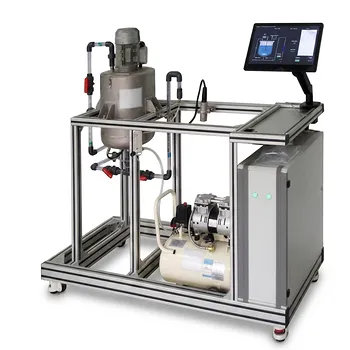
The choice between a mixer-settler and a tower extractor isn’t about which is "better"—it’s about matching equipment characteristics to your educational goals. Put simply, a mixer-settler excels at teaching discrete, stage-by-stage extraction calculations, while a tower-type column is unmatched for demonstrating continuous, differential contact and fluid dynamics. The mixer-settler offers high stage efficiency and robustness, but demands more floor space and energy; the tower saves space and simplifies internals, yet suffers from axial backmixing that can muddy separation performance.
Both equipment types can be effective teaching tools, but they illuminate completely different core chemical engineering concepts. Your choice hinges on whether you want students to perform McCabe-Thiele stage calculations (mixer-settler) or visualize continuous-phase mass transfer and fluid mechanics (tower), with the attendant trade-offs in footprint, energy cost, and tolerance for solids.
Understanding the Two Contactor Types
Before weighing trade-offs, it’s essential to recognize the fundamental operating differences that drive all other characteristics.
Stage-wise vs. Differential Contact
A mixer-settler operates as a discrete stage-wise device. Each stage combines a mixing chamber (for intimate phase contact) and a settling chamber (for phase separation), allowing you to count equilibrium stages directly.
Tower columns, by contrast, are differential contactors. The two liquid phases flow countercurrently through a packed bed or series of perforated plates, creating a continuous composition gradient rather than a series of discrete equilibrium steps.
Operational Characteristics
Mixer-settlers typically deliver stage efficiencies above 80% because the mechanical agitation creates intense mixing. They can also handle feeds with suspended solids that would clog a packed tower.
Tower extractors rely on gravity (or gentle pulsation) for countercurrent flow. Their simpler structure consumes less auxiliary power but is more prone to axial backmixing—the unwanted movement of one phase in the wrong direction—which erodes the overall separation.
Advantages of Mixer-Settlers in Education
For teaching the core distillation/extraction analogy, the mixer-settler is uniquely transparent.
High Efficiency and Visual Simplicity
With mechanical agitation in each stage, efficiency is high and stable operation is easy to maintain. Students can physically see the mixing and settling zones, making the stage concept tangible.
This visual clarity directly reinforces graphical design methods like the McCabe-Thiele construction. Each physical stage corresponds almost one-to-one with an equilibrium stage on the diagram, bridging the gap between theory and hardware.
Robustness with Challenging Feeds
The ability to process slurries or feeds with suspended solids is a distinct laboratory advantage. It means you can use safe, nontoxic but messy organic-aqueous systems without risking column plugging.
This robustness reduces downtime and maintenance in a teaching lab setting, where experimental reliability is often more critical than maximizing throughput.
Advantages of Tower-Type Extractors
When floor space is at a premium and the curriculum emphasizes transport phenomena, towers come into their own.
Compact Footprint and Lower Energy
A vertical tower occupies significantly less horizontal space. In a crowded unit ops lab, this can be the deciding factor.
Moreover, the absence of individual stage agitators and pumps (in simple packed or sieve-plate columns) translates to lower capital and operating costs, especially for multistage separations.
Versatility for Advanced Demonstrations
Simple gravity columns illustrate continuous mass transfer, but the real power lies in advanced variants. Pulsed columns or rotating disk contactors introduce external agitation without discrete stages, providing a platform to study backmixing coefficients, flooding phenomena, and dispersion dynamics.
This makes towers the preferred platform for senior-level experiments in advanced transport phenomena and non-equilibrium thermodynamic analysis, far beyond the reach of a simple mixer-settler.
Key Trade-offs and Limitations
Every educational choice involves compromises. Here are the critical trade-offs to consider.
The Hidden Cost of Stage-wise Operation
While a single mixer-settler stage is simple, multistage configurations multiply quickly. Each stage needs its own mixing agitator and interstage pump, leading to escalating energy consumption and hardware costs.
For a 5-stage extraction, the mixer-settler assembly can become a sprawling, energy-intensive setup compared to a single 5-meter packed column.
The Backmixing Penalty
In tower columns, axial backmixing can reduce mass transfer efficiency to a fraction of ideal plug flow predictions. A column that theoretically provides the equivalent of multiple equilibrium stages may deliver far less due to recirculating eddies.
This makes it harder for students to directly relate column height to equilibrium stages, as they must apply correction factors or more complex NTU-HTU methods.
Space and Infrastructure Constraints
A mixer-settler’s large horizontal footprint may be incompatible with the bench-space realities of many teaching labs. Conversely, a tower’s verticality may require high ceilings or special support structures.
Both options also demand different peripherals: multiple metering pumps for mixer-settlers versus precise flow control for countercurrent towers, with the latter often requiring more sophisticated pressure management.
Making the Right Choice for Your Lab
The decision ultimately aligns with your course objectives and physical constraints. Use these goal-oriented recommendations as a guide.
- If your primary focus is teaching equilibrium-stage design and graphical methods: Choose a mixer-settler. Its discrete stages and high efficiency make McCabe-Thiele analysis intuitive and visually observable.
- If your primary focus is continuous mass transfer, fluid dynamics, or advanced non-equilibrium modeling: Opt for a tower column, especially a pulsed or rotating disk variant that can vividly demonstrate backmixing and flooding limits.
- If floor space is severely limited but your curriculum is flexible: A compact tower column might be the only viable choice, even though you sacrifice the clarity of stage-wise contact.
- If you need robust equipment for messy yet pedagogically valuable systems (e.g., solid-laden feeds): The mixer-settler’s tolerance for solids can prevent dozens of hours of cleaning and troubleshooting over a semester.
Ultimately, the best teaching extraction unit is the one that transparently connects theory to observable behavior while fitting comfortably into your lab’s infrastructure.
Summary Table:
| Feature | Mixer-Settler Unit | Tower-Type Column |
|---|---|---|
| Contact Type | Stage-wise (Discrete) | Differential (Continuous) |
| Stage Efficiency | High (>80%) | Lower (affected by backmixing) |
| Footprint | Large horizontal | Compact vertical |
| Solid Handling | High tolerance (slurries) | Poor (clogging risk) |
| Pedagogical Focus | McCabe-Thiele & equilibrium stages | Mass transfer & fluid dynamics |
Bring Theory to Life in Your Unit Operations Lab
Equipping your laboratory requires the right balance of pedagogy, safety, and physical footprint. LABPARK provides premium Educational and Vocational Unit Operations Pilot Plants in chemical engineering, bioprocess & biotech, and environmental & water treatment, specifically designed for universities, research institutes, and enterprises.
Whether you need a stage-wise mixer-settler to teach graphical design methods or a continuous column to demonstrate advanced mass transfer dynamics, we have the ideal system tailored to your educational goals.
Contact LABPARK today to customize your pilot plant and elevate your hands-on training experience!
Related Products
People Also Ask
- Why is the Reynolds number ($Re_M$) critical in mixing? Master N_P for pilot plants.
- What are the four guiding principles of process intensification? Educational Equipment Guide
- How do educational unit operations pilot plants support process analysis? Connect theory with real data
- How does the pseudobinary diffusion approximation simplify mass transport equations in educational pilot plants?
- Why is post-implementation performance evaluation and gap analysis critical when deploying educational unit operations pilot plants?