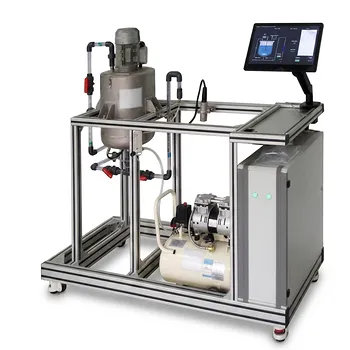
Continuous exothermic reactions demand an immediate and relentless removal of heat. In a pilot plant configured for such processes, an in-line static mixer first blends the reactants into a homogeneous stream, triggering the reaction and causing a sharp temperature spike. The mixture then flows directly into a series of jacketed shell-and-tube heat exchangers, where a constant-temperature coolant circulating through the shells rapidly removes the generated heat. This integrated setup prevents thermal runaway and keeps the reaction within safe, optimal temperature boundaries as it reaches completion.
The static mixer ensures instantaneous, uniform mixing that kick-starts the heat release, while the staged shell-and-tube exchangers provide the high surface area and controlled, multi-stage cooling required to hold temperatures steady. Together they decouple mixing from heat removal, transforming an inherently dangerous temperature surge into a manageable continuous thermal profile.
The Static Mixer: Where the Reaction Ignites
Why Homogeneous Mixing Matters
In highly exothermic reactions, poor mixing creates localized hot spots where reaction rates accelerate uncontrollably. A static mixer containing helical elements forces the fluid stream to repeatedly split, rotate, and recombine. This produces a radially homogeneous mixture at the molecular level in a very short pipe length. Uniform composition means the reaction starts evenly everywhere, preventing dangerous point-source heat generation.
The Heat Surge at the Mixer Outlet
Because the mixing is so rapid, the reaction begins almost instantly upon contact of the reactants. A significant fraction of the total heat of reaction is released inside the mixer or immediately after it. Without immediate cooling, this would cause a temperature spike large enough to degrade products, trigger unwanted side reactions, or even cause runaway. The mixer, therefore, acts as the ignition point—efficient but thermally demanding.
The Thermal Management Challenge in Exothermic Continuous Processes
From Adiabatic Spike to Controlled Cooling
Under adiabatic conditions, an exothermic reaction can see a temperature rise of over 100°C, as noted in laboratory-scale studies of oxidation reactions. In a continuous pilot plant, the goal is to transition quickly from that initial heat surge to a near-isothermal state. Simply slowing the reaction is not an option; instead, you must match the rate of heat removal to the rate of heat generation, and do it while the reacting fluid is in motion.
Staged Shell-and-Tube Heat Exchangers: The Temperature Control Backbone
How Jacketed Cooling Works
Downstream of the static mixer, the hot reaction stream enters the tube side of a jacketed shell-and-tube heat exchanger. A cooling fluid—often water, glycol, or a thermal oil maintained at a constant temperature—flows through the shell side. The large surface area of the tubes and the counter-current or cross-flow arrangement provide high heat transfer coefficients, quickly pulling the excess enthalpy out of the process fluid. The constant coolant temperature simplifies control and ensures a predictable driving force for heat exchange.
Why Use a Series of Exchangers?
A single shell-and-tube unit would face a steep temperature drop, potentially leading to thermal stresses, inefficient cooling, or an impractically large heat transfer area. By placing several exchangers in series, the overall temperature gradient is broken into smaller steps. Each unit handles a portion of the heat load, maintaining a more stable thermal profile. This staging mirrors the principle of interstage cooling used in multi-bed reactors, where cooling between stages optimizes both reaction rate and thermodynamic conversion. In a continuous flow setup, it allows the process to approach a tight temperature band (±20°C or better) required for selectivity and safety.
The Synergy Between Static Mixers and Shell-and-Tube Exchangers
The true power of this design lies in the sequential decoupling of mixing and heat removal. The static mixer does not attempt to provide cooling; it focuses solely on creating the perfect reaction mixture. The shell-and-tube exchangers then take over, handling the thermal consequences. This specialization means:
- The mixer can be optimized for short residence time and high shear, not for heat transfer surface.
- The exchangers can be designed with large area, optimized flow velocities, and staged temperature drops without worrying about initial mixing quality.
- The entire system becomes inherently safer, as any disturbance in coolant flow instantly affects the temperature profile, providing a clear control signal to operators or automated loops.
Understanding the Trade-offs
Pressure Drop and Pumping Costs
Static mixers and multiple shell-and-tube exchangers both add significant pressure drop to the system. The helical elements in the mixer restrict flow, and the tube-side passes in each exchanger increase pumping requirements. For a pilot plant, this must be balanced against the benefits—higher flow resistance means larger pumps and higher operating costs, but the alternative (runaway or poor product quality) is unacceptable.
Limited Heat Recovery Potential
Using a constant-temperature coolant in the jackets is excellent for precise temperature control, but it discards the removed heat into the coolant circuit without recovering it for other processes. If energy efficiency is a priority, this configuration may need to be modified with a feed-effluent heat exchanger or heat integration loop. However, adding such heat recovery can violate the simple, decoupled control strategy and introduce a temperature cross, requiring a more complex exchanger network (e.g., multiple shells in series to avoid a very low F-correction factor). For pilot plants focused on kinetic studies and safety, the trade-off is often acceptable.
Fouling and Maintenance
The internal elements of a static mixer and the tube surfaces are prone to fouling if the reaction produces solids or very viscous fluids. Cleaning a static mixer often requires removal or high-velocity flushing. In shell-and-tube units, tube-side fouling can be managed by selecting an appropriate tube diameter and ensuring adequate flow velocity. Pilot plants must plan for easy disassembly and cleaning to maintain data quality and safety.
Making the Right Choice for Your Pilot Plant Goal
How you balance these components should align with your specific research or demonstration objectives.
- If your primary focus is isothermal kinetic data and runaway prevention: Use a static mixer immediately followed by a series of jacketed shell-and-tube exchangers with constant-temperature coolant. This gives you tight temperature control and decouples the mixing variable from heat removal.
- If your primary focus is studying scalability and pressure-drop effects: Characterize the pressure loss across each mixer and exchanger stage. Use the data to model the pumping requirements for a production-scale unit, and consider replacing the static mixer with a different contacting device if the pressure drop is too high.
- If your primary focus is heat integration and energy efficiency: Modify the cooling circuit. Place a feed-effluent heat exchanger before the first shell-and-tube unit to recover some heat, but be prepared for a more complex control strategy that compensates for the temperature cross and F-factor penalties.
- If your primary focus is multi-phase or fouling-prone reactions: Assess whether a static mixer can handle the solids or viscosity. You might opt for a different mixing technology (e.g., a driven in-line mixer) and ensure the shell-and-tube exchangers have accessible tube bundles for regular cleaning.
When you understand the distinct roles of mixing and staged cooling, you can tailor the pilot plant to deliver both safety and the process insights you need to scale up with confidence.
Summary Table:
| Component | Primary Function | Key Benefit | Operating Challenge |
|---|---|---|---|
| In-Line Static Mixer | Rapid, molecular-level reactant blending | Prevents localized hot spots | High pressure drop & fouling risk |
| Shell-and-Tube Exchanger | Staged, multi-pass cooling via jacketed tubes | Tight isothermal temperature control | Minimal energy recovery potential |
Optimize Your Process Scale-Up with LABPARK
Building a safe, efficient pilot system requires precise control over thermodynamics and fluid dynamics. LABPARK provides state-of-the-art Educational and Vocational Unit Operations Pilot Plants in chemical engineering, bioprocess & biotech, and environmental & water treatment tailored for universities, research institutes, and enterprises.
Ready to elevate your research, training, or development capabilities? Contact LABPARK today to design your custom pilot plant solution!
Related Products
People Also Ask
- Why is the Reynolds number ($Re_M$) critical in mixing? Master N_P for pilot plants.
- What are the four guiding principles of process intensification? Educational Equipment Guide
- How do educational unit operations pilot plants support process analysis? Connect theory with real data
- How does the pseudobinary diffusion approximation simplify mass transport equations in educational pilot plants?
- Why is post-implementation performance evaluation and gap analysis critical when deploying educational unit operations pilot plants?