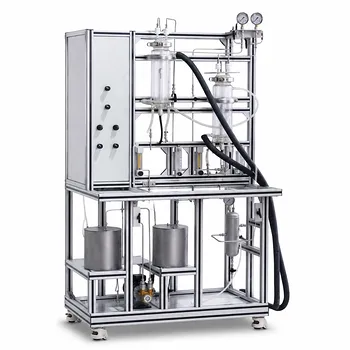
When your membrane’s fingerprints reveal gaping voids, it’s a sign that phase inversion kinetics have tipped out of balance. Suppressing macrovoids requires deliberately manipulating the casting solution and coagulation bath to strengthen the nascent polymer matrix, slow the violent inrush of nonsolvent, or reduce the local osmotic pressure that drives finger-like pore growth. In a teaching lab where students build pilot plants for water treatment, four reliable technical levers prevent these mechanical defects: raising polymer concentration, adding crosslinking agents, doping the casting dope with nonsolvent (or the bath with solvent), and selecting solvents that increase viscosity or accelerate gelation.
Macrovoids are not random imperfections—they obey thermodynamic and kinetic rules you can redirect. By controlling osmotic driving forces and polymer strength during the critical liquid–liquid demixing stage, you can systematically eliminate these defects. For student-run pilot plants, the most immediate interventions are increasing polymer content and carefully spiking the dope with a small amount of the coagulant.
The Root Cause: Why Macrovoids Appear
Macrovoids are large, elongated, finger-like cavities that compromise mechanical integrity and separation performance. They form in the early moments of phase inversion, before the polymer-rich matrix solidifies.
The Osmotic Imbalance That Opens Voids
When a cast film enters a nonsolvent bath (usually water), the nonsolvent diffuses inward while the solvent diffuses outward. A macrovoid nucleates when the inflow of nonsolvent far outpaces the outflow of solvent. This differential creates a local osmotic pressure that pushes open a polymer-poor phase—once the weak nucleus wall cannot resist the pressure, the tear propagates into a void.
Why the Nucleus Wall Matters
The fate of an incipient void is decided by the mechanical strength of the surrounding polymer-lean nucleus. If the polymer matrix is too dilute or too fluid, the osmotic pressure easily stretches it. Anything that stiffens that matrix—higher polymer density, crosslinking, fast gelation—will stop the void before it can grow.
Four Proven Suppression Strategies for the Laboratory
Each of the following tactics addresses either the driving force (osmotic pressure) or the resistance (wall strength). Students can implement them with standard lab equipment and minimal complexity.
Increase the Polymer Concentration in the Casting Solution
A more concentrated dope increases the polymer volume fraction in the nascent film. When nonsolvent enters, it encounters a denser, more entangled network that resists deformation. Even a modest jump—from 15% to 18–20% polymer—can dramatically suppress macrovoids. The trade-off is a potentially tighter, lower-flux skin, so students must balance this against permeability targets.
Add a Crosslinking Agent to Strengthen the Nucleus Wall
Incorporating a reactive crosslinker (such as amines) into the dope can chemically reinforce the polymer before it contacts the bath. The crosslinks bridge polymer chains, raising the elastic modulus of the growing nucleus wall so it withstands osmotic stress. The choice of agent is polymer-dependent; for instance, diamines work with certain polyimides or polyamides, while other systems may need different chemistries. In a teaching lab, this is best introduced when the polymer system is already well-characterized.
Reduce the Osmotic Driving Force by Altering the Solvent/Nonsolvent Equilibrium
You can shrink the chemical potential difference that pulls nonsolvent inward. Two simple ways:
- Add a small amount of nonsolvent (e.g., water) to the casting solution. This pre-loads the dope with coagulant, lowering the initial osmotic shock.
- Add some solvent to the coagulation bath. A bath that contains 10–20% solvent slows the outward diffusion of solvent and the inward rush of nonsolvent, softening the driving force.
Both techniques reduce the sudden pressure spike that spawns macrovoids, though they may also slow overall demixing and alter final pore size.
Choose Solvents That Boost Viscosity or Accelerate Gelation
High-viscosity solvents (like N-methyl-2-pyrrolidone (NMP) or dimethylacetamide (DMAc) at appropriate concentrations) create a thicker dope that resists deformation. Solvents that promote rapid gelation—by bringing the polymer close to its precipitation point upon water contact—quickly lock the matrix before voids can grow. The goal is to shorten the liquid–liquid demixing window, the vulnerable period when macrovoids are initiated.
Understanding the Trade-offs
Every suppression method reshapes the final membrane architecture. Ignoring this can turn a mechanically perfect membrane into a poorly performing one.
Higher Polymer Content Can Kill Permeability
While more polymer eliminates voids, it often produces a denser, less permeable selective layer. Students measuring pure water flux may see a significant drop. If the goal is high throughput in a pilot plant, they must find the narrow polymer range that stops macrovoids without over-densifying the skin.
Non-Solvent Additives May Induce Premature Gelation
Doping the casting solution with water or another nonsolvent can shift the ternary phase diagram so that cloud point is reached earlier. If not carefully controlled, this can cause local gelation even before the film enters the bath, creating a surface skin that freezes in defects. Students should add nonsolvent dropwise under vigorous stirring and monitor solution clarity.
Crosslinking Agents Are Not Universal
Amines and other crosslinkers work only with specific polymer chemistries. Introducing a crosslinker into a system that cannot react with it wastes materials and may cause precipitation or uneven gelation. This strategy requires a clear compatibility check before adoption in a teaching module.
Solvent Changes Alter Evaporation Steps
When switching to a more viscous or faster-gelling solvent, the evaporation time before immersion often must be shortened to avoid a prematurely dry film. Students should standardize their protocol with the new solvent system and not blindly carry over old evaporation profiles.
Making the Right Choice for Your Lab
Because a pilot plant membrane must survive handling, feed pressure, and cleaning cycles, reliability often outweighs a few points of flux. The ideal suppression strategy depends on your primary objective.
- If your primary focus is maximizing structural integrity immediately: Increase polymer concentration to the highest level that still yields a permeable film. This is the easiest, most repeatable intervention.
- If your primary focus is preserving high water flux while eliminating defects: Modify the nonsolvent/solvent equilibrium—add 2–5% water to the dope or 10–15% solvent to the bath—to calm osmotic shock without over-densifying the membrane.
- If your primary focus is demonstrating advanced chemical control: Introduce a crosslinking agent compatible with your polymer, and measure the change in mechanical properties. This connects membrane science to covalent network engineering.
- If your primary focus is process reliability for student operators: Choose a high-viscosity solvent and define a strict evaporation-casting protocol. Consistent viscosity reduces batch-to-batch variability in finger-like void formation.
Every defect-free asymmetric membrane produced in the lab becomes a tangible lesson that osmotic pressure and polymer mechanics are the twin levers of structural control. By dialing them in, your students will turn phase inversion from a black box into a predictable design platform.
Summary Table:
| Strategy | Mechanism | Key Trade-off / Consideration |
|---|---|---|
| Increase Polymer Conc. | Increases polymer density & network entanglement | May reduce membrane permeability/flux |
| Add Crosslinking Agent | Chemically reinforces the polymer matrix | Polymer-specific; requires compatibility check |
| Alter Solvent/Nonsolvent | Slows inward nonsolvent diffusion & osmotic shock | Can slow demixing and alter final pore size |
| Use High-Viscosity Solvents | Resists deformation & accelerates gelation | Requires strict control of evaporation times |
Elevate Your Chemical Engineering & Water Treatment Labs
Building reliable membrane separation systems requires the right educational foundation. LABPARK provides state-of-the-art Educational and Vocational Unit Operations Pilot Plants in chemical engineering, bioprocess & biotech, and environmental & water treatment designed specifically for universities, research institutes, and enterprises.
Empower your students and researchers with hands-on, industry-grade equipment. Contact LABPARK today to discuss your laboratory configuration and get a customized quote!
Related Products
- Multifunctional Membrane Separation Educational Pilot Plant with Ultrafiltration, Nanofiltration, Reverse Osmosis
- Multi-Functional Membrane Separation Educational Pilot Plant for Unit Operations Lab
- Photocatalytic Membrane Separation and Degradation Unit Operations Pilot Plant
People Also Ask
- How do PEI, PVDF, and PSU membranes compare in pilot plants? Find the best fit.
- Pervaporation vs. Vapor Permeation: Handling Suspended Solids in Membrane Pilot Plants
- What are the trade-offs of polymer vs inorganic membranes in teaching pilot plants? Key laboratory comparison.
- How can operators optimize operating conditions and cleaning protocols in membrane separation pilot plants to mitigate fouling?
- What are the advantages of membrane separation in pilot plants? Efficient Organic Vapor Recovery