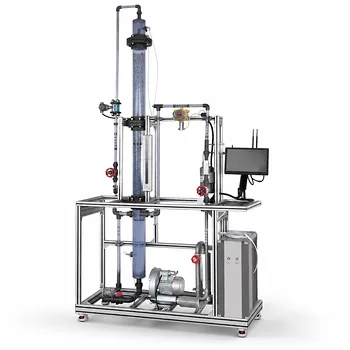
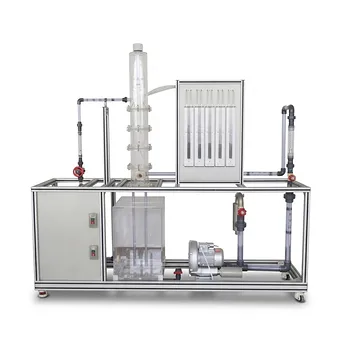
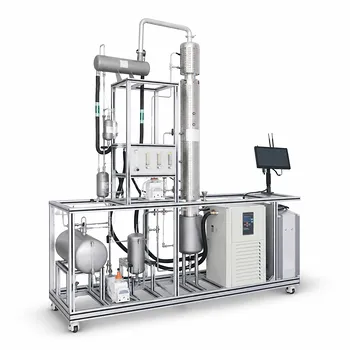
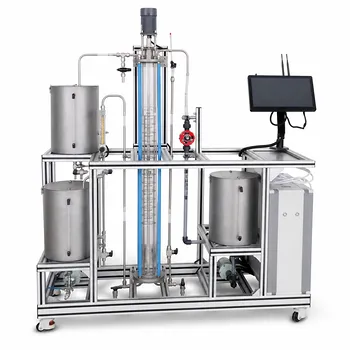
The core difference lies in how they facilitate mass transfer. Plate columns use discrete, stage-wise contact with high liquid holdup and stable turndown, making them the go‑to for teaching equilibrium stages and handling feed disturbances. Packed columns rely on continuous contact along packing surfaces, delivering higher separation efficiency per height and significantly lower pressure drops—ideal for studying mass transfer kinetics and vacuum distillation. In pilot plant selection, the choice is not about which is “better,” but which mass transfer mechanism aligns with your educational or research goals.
The decision between a plate and packed column pilot plant comes down to your primary teaching or research objective. Plate columns shine when you need to visualize discrete stage operations and ensure stability; packed columns excel for continuous‑contact demonstrations, low‑pressure‑drop separations, and high‑efficiency kinetics.
The Fundamental Divide: Stage‑Wise vs. Continuous Contact
Plate Columns: Discrete Steps and High Liquid Holdup
Plate columns operate through stage‑wise contact. Gas and liquid mix and separate on individual trays—sieve, valve, or bubble‑cap—creating discrete concentration steps along the column height.
This design gives them stable plate efficiency and a wide turndown ratio. They can handle fluctuating feed rates without losing separation performance, a critical advantage for student‑run experiments where conditions often drift.
Their high liquid holdup on each tray makes them naturally forgiving. It dampens disturbances, simplifies startup and stabilization, and even accommodates slow reactions that need longer residence time to reach equilibrium.
Maintenance is straightforward: plates are easy to inspect and clean. For education, this visibility allows students to directly observe hydraulic phenomena like weeping or flooding, grounding theoretical stage‑by‑stage calculations in tangible reality.
Packed Columns: A Continuous Gradient and Low Pressure Drops
Packed columns provide continuous, differential contact. Liquid flows as a film over structured or random packing while gas moves upward through the voids, yielding a smooth concentration gradient rather than step changes.
The standout benefit is lower pressure drop—typically 0.01 to 0.27 kPa per theoretical stage, compared to 0.4 to 1.1 kPa for a plate column. This makes them the natural choice for vacuum distillation demonstrations, where every Pascal counts.
Separation efficiency per unit height is often significantly higher in packed columns, sometimes exceeding 10 theoretical stages per meter (versus less than 2 stages per actual tray in a plate column). They also exhibit low liquid hold‑up, minimizing the inventory of chemicals in the system.
However, this performance comes with a condition: precise liquid distribution. Without uniform wetting, channeling sets in and transfer efficiency collapses, a phenomenon especially visible at low liquid loads where packing surfaces may remain partially dry.
Operational Characteristics at a Glance
Separation Efficiency and Height
Plate columns deliver a fixed number of equilibrium stages per tray, making it intuitive to count theoretical plates. Packed columns demand the concept of Height Equivalent to a Theoretical Plate (HETP), a direct link between physical packing height and separation power. Experimentally determining HETP is itself a valuable research exercise.
Pressure Drop and Energy Considerations
The order‑of‑magnitude difference in pressure drop directly impacts energy consumption and allows packed columns to simulate low‑pressure industrial separations. Plate columns, with their higher pressure drop, are better suited to atmospheric or pressure distillations where that penalty is acceptable.
Turndown Flexibility
Plate columns maintain efficiency over a broad range of vapor and liquid loads—the liquid seal on each tray prevents significant weeping until the load drops dramatically. Packed columns have a narrower efficient operating range; below their minimum wetting rate, efficiency falls sharply.
Liquid Holdup and Response Time
High holdup on plates means slower dynamic response, which simplifies manual control and keeps the system near steady state during transient student experiments. Low holdup in packed columns allows faster startups and reduces thermal degradation risks, but demands tighter process control.
Understanding the Trade‑offs
Plate columns’ high liquid holdup, a stability asset, becomes a liability with thermally sensitive materials—long residence times can cause decomposition. Their higher pressure drop also rules them out for vacuum processes that demand minimal column pressure loss.
Packed columns’ low holdup and low ΔP are beneficial, yet they struggle with solid‑laden streams or fouling services. Suspended solids or polymerizing substances plug the packing, and cleaning is far more labor‑intensive than with open trays. Their dependency on even liquid distribution means they are less forgiving of feed fluctuations, and incomplete initial wetting can mislead students until they master distribution techniques.
Finally, packing material cost can be a budget factor. While plate columns often have lower construction costs, high‑performance structured packings significantly increase a packed column’s price tag, a consideration for pilot plant procurement.
How These Differences Impact Pilot Plant Selection
When to Choose a Plate Column Pilot Plant
Plate columns are the natural fit when the curriculum centers on visualizing equilibrium stage operations. Students can literally count trays, measure temperature profiles at discrete points, and see how a tray hydraulically behaves—weeping, dispersion, entrainment. The system’s tolerance to varying reflux ratios and feed compositions reduces setup time and troubleshooting, letting instructors focus on step‑by‑step McCabe‑Thiele constructions and stage efficiency calculations.
When to Choose a Packed Column Pilot Plant
Opt for a packed column when the research or teaching goal is continuous mass transfer kinetics, absorption, or low‑pressure‑drop processes. Here, the experiment shifts to measuring concentration gradients, determining HETP, and exploring the impact of liquid distribution on efficiency. It is also the right choice for demonstrating vacuum distillation or handling corrosive fluids, as packings and column shells can be fabricated from a wide range of resistant materials.
The Hybrid Approach: Modular Configurations
Many modern educational pilot plants offer interchangeable column internals or dual‑column setups. This modularity lets a single skid run a distillation with sieve trays one week and with structured packing the next. The side‑by‑side comparison of pressure drop, efficiency, and hydraulic behavior cements the fundamental differences in students’ minds and doubles the experimental scope without doubling the footprint.
Making the Right Choice for Your Curriculum or Research Agenda
Every pilot plant selection should map to a specific learning outcome or experimental need. Use the following guide to align your column choice with your primary focus.
- If your primary focus is teaching stepwise equilibrium stage design and stable manual operation: A plate column pilot plant is the right foundation. Its visual stages, high turndown, and forgiving liquid holdup will reinforce theoretical tray‑counting methods while giving students the confidence to troubleshoot real distillation dynamics.
- If your primary focus is demonstrating continuous mass transfer kinetics, low‑pressure‑drop processes, or absorption fundamentals: Invest in a packed column pilot plant. It directly illustrates HETP concepts, highlights the critical role of liquid distribution, and provides the low‑ΔP environment needed for vacuum and modern energy‑efficient separation studies.
- If your primary focus is offering the maximum experimental flexibility in a single lab setup: Seek a pilot plant with modular, interchangeable internals or dual‑column capability. This approach empowers side‑by‑side comparisons of plate and packed performance, giving students and researchers the broadest analytical perspective.
Ultimately, the most effective pilot plant is the one that turns your specific learning outcomes into tangible, observable data—whether that’s a step on a tray or a gradient along a packing.
Summary Table:
| Feature | Plate Columns | Packed Columns |
|---|---|---|
| Mass Transfer Type | Stage-wise (discrete trays) | Continuous (packing surface) |
| Pressure Drop | Higher (0.4 to 1.1 kPa/stage) | Lower (0.01 to 0.27 kPa/stage) |
| Liquid Holdup | High (stable, slower response) | Low (fast startup, sensitive) |
| Turndown Ratio | Wide and flexible | Narrower (requires minimum wetting) |
| Best Suited For | Visualizing equilibrium stages | Vacuum distillation & kinetics |
Optimize Your Chemical Engineering Lab with LABPARK
Selecting the right column configuration is crucial for achieving your educational and research objectives. LABPARK designs and manufactures high-quality Educational and Vocational Unit Operations Pilot Plants in chemical engineering, bioprocess & biotech, and environmental & water treatment.
Whether you represent a university, research institute, or enterprise, we offer customizable, modular pilot plants tailored to your curriculum and testing needs.
Contact LABPARK today to discuss your laboratory requirements and get a custom solution!
Related Products
- Packed Bed Absorption Educational Unit Operations Pilot Plant
- Absorption and Desorption Educational Unit Operations Pilot Plant
- Multimodal Absorption and Desorption Pilot Plant for Unit Operations Training
- Plate Column Hydrodynamics Tray Demonstration Educational Pilot Plant
- Continuous Sieve-Plate Distillation Pilot Plant for Unit Operations Laboratory Education
People Also Ask
- How Do Flow Regimes Transition in Packed Bed Pilot Plants? Key Scale-up Insights
- How does reactant concentration determine absorption column control? Gas-film vs. dual-film.
- How is the packing height of an absorption column calculated? Master HTU & NTU Concepts
- How does static vs. operating holdup affect pilot plant calibration? Avoid Critical Scale-Up Errors
- Why is counter-current flow selected for gas absorption? Maximize Pilot Plant Efficiency