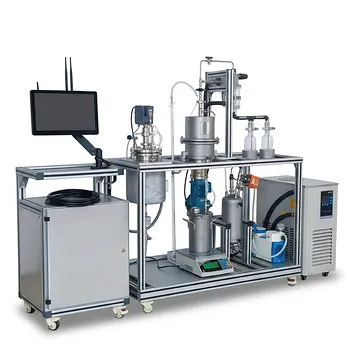
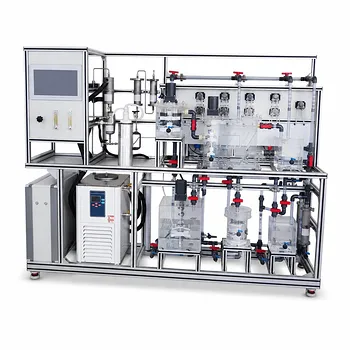
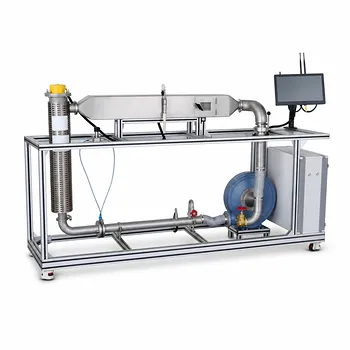
For a university laboratory, selecting an evaporator based on the overall heat transfer coefficient (Ko) is not about chasing the highest number—it’s about choosing the configuration that best illuminates core heat transfer principles. You should evaluate each evaporator type’s typical Ko range against your teaching goals: falling film (1,200–3,500 W/m²·°C) for short‑residence, high‑efficiency demonstrations; forced circulation (1,200–7,000 W/m²·°C) for handling viscous or scaling streams; and natural circulation (600–3,000 W/m²·°C) for fundamental gravity‑driven heat transfer. A reconfigurable pilot plant that lets students measure Ko across multiple types unlocks direct comparisons of film dynamics, thermal resistance breakdown, and fouling behavior.
The overall heat transfer coefficient is the synthesis of all thermal resistances—convective film, wall conduction, and fouling. In an educational pilot plant, Ko is not just a number for sizing; it is the measurable fingerprint of fluid dynamics, material properties, and operational cleanliness. Your selection must turn Ko into a teaching instrument that reveals how velocity, viscosity, and time degrade or enhance heat transfer performance.
The Role of Ko in Evaporator Selection for Teaching Labs
Ko is the engineering shorthand that captures an evaporator’s real‑world heat transfer capability. In a pilot plant, its value is both a selection criterion and a variable that students can manipulate, measure, and model.
Understanding the Ko Ranges
Different evaporator types operate in distinct Ko bands:
- Natural circulation evaporators (rising film, standard vertical tube): 600–3,000 W/(m²·°C). They depend on density differences, resulting in lower fluid velocity and less turbulence.
- Falling film evaporators: 1,200–3,500 W/(m²·°C). A thin, gravity‑driven film yields high heat transfer with extremely short residence time.
- Forced circulation evaporators: 1,200–7,000 W/(m²·°C). An external pump forces liquid through the tubes at 2–5 m/s, maximizing turbulence and suppressing fouling.
What a Higher Ko Actually Teaches
A high Ko is more than an efficiency badge. It creates an opportunity to teach how fluid velocity reduces the convective resistance (the 1/ho and 1/hi terms) and how turbulence delays scale formation. For example, comparing a natural circulation unit (low turbulence, Ko limited by film coefficients) with a forced circulation unit (high velocity, almost entirely governed by wall and fouling resistances) reveals the dominance of convective resistances in laminar vs. turbulent regimes.
Translating Ko into Educational Value: Experimental Determination and Analysis
A pilot plant becomes a true unit operations learning platform when students can measure Ko themselves and decompose it into its constituent resistances.
Measuring Ko from First Principles
The foundational equation is: $$Q = U_o A \Delta T_m$$ Under steady‑state conditions, students measure flow rates and inlet/outlet temperatures to calculate the heat duty Q. With the known heat transfer area A and the log mean temperature difference ΔTm, they solve for the overall coefficient Uo. Repeating this at different flow velocities shows how Uo climbs as the Reynolds number increases.
Using the Wilson Plot to Isolate Film Coefficients
Even more instructive is the Wilson plot technique. By varying the circulation rate (or stirring speed in a reactor‑style reboiler) and plotting 1/U versus the −2/3 power of the flow velocity, a straight line emerges. The intercept gives the sum of all velocity‑independent resistances (wall conduction, fouling, and the maximum‑side film coefficient). This method lets students experimentally separate the film coefficients from the wall and fouling contributions, directly verifying the resistance network: $$\frac{1}{U_o} = \frac{1}{h_o} + \frac{1}{h_{od}} + \frac{d_o \ln(d_o/d_i)}{2 k_w} + \frac{d_o}{d_i}\frac{1}{h_{id}} + \frac{d_o}{d_i}\frac{1}{h_i}$$
Quantifying Fouling Resistance Over Time
Fouling is the silent enemy of heat transfer. By operating the same evaporator on a mildly scaling solution and recording Uo at regular intervals, students can calculate the growth of the fouling factor (hod or hid). A forced circulation unit maintains a more stable Uo over time, while a natural circulation unit shows a steeper decline—a powerful visual lesson in the relationship between fluid shear, residence time, and scale deposition.
Beyond the Number: Practical Selection Criteria for Pilot Plant Design
Ko alone cannot dictate the final choice. The physical and chemical nature of the process fluid, and the physical footprint available, often override a simple coefficient comparison.
Fluid Properties Dictate Feasibility
- Low‑viscosity, non‑scaling, non‑corrosive fluids: A natural circulation evaporator is simple, safe, and perfectly illustrates the gravity‑driven mechanism.
- High‑viscosity, crystallizing, or heavily scaling liquids: Forced circulation is mandatory. The external pump maintains a wettable surface and prevents clogging, even if the Ko gains are partly offset by pump energy.
- Heat‑sensitive solutions: Falling film or scraped thin film evaporators are the only viable options. Their extremely short liquid holdup prevents thermal degradation, and the Ko remains high despite the low ΔT driving force.
Columnar and Residence Time Considerations
Falling film evaporators offer a high Ko in a compact vertical profile, but they demand uniform liquid distribution. Any maldistribution creates dry spots that dramatically lower the local Ko and risk product burning. In contrast, forced circulation units are bulkier but more forgiving—a trade‑off that teaches students the difference between film‑dependent and forced‑flow heat transfer.
Understanding the Trade‑offs
No evaporator type is perfect for every educational scenario. Transparently presenting the drawbacks builds critical thinking.
Power Consumption and Operating Cost
Forced circulation evaporators boast the highest Ko range, yet their circulation pump can consume as much as 10–15 % of the evaporator’s thermal duty. A teaching unit that includes an energy balance on the pump and steam shows that a high Ko does not automatically mean high energy efficiency.
Flexibility vs. Complexity
A reconfigurable pilot plant that can swap between natural circulation, falling film, and forced circulation modes maximizes the range of experiments. However, this flexibility comes with increased instrumentation, cleaning difficulty, and maintenance. A simpler, dedicated unit may be sufficient if the curriculum focuses only on basic heat transfer.
Film Stability and Dry Spots in Falling Film
Falling film evaporators are exquisitely sensitive to liquid distribution. Even small deviations in feed rate cause partial dry‑out, which simultaneously compromises heat transfer and damages heat‑sensitive materials. This instability is a powerful teaching tool but demands careful operational discipline.
Making the Right Choice for Your Educational Goal
Your selection should be guided by the specific learning outcomes you want to emphasize. Use this framework to align the equipment with your curriculum.
- If your primary focus is Demonstrating Fundamental Heat Transfer Principles: Choose a reconfigurable unit that includes a natural circulation tube bundle. Its moderate Ko range (600–3,000 W/m²·°C) allows clear measurement of buoyancy‑driven flow effects, and the Wilson plot method can be applied without a pump.
- If your primary focus is Handling Complex Industrial Fluids (high viscosity, scaling): Select a forced circulation evaporator with a variable‑speed pump. Its Ko range (up to 7,000 W/m²·°C) provides ample headroom to demonstrate how velocity suppresses fouling and how to calculate pump energy trade‑offs.
- If your primary focus is Compact Design and High Efficiency with Heat‑Sensitive Materials: Opt for a falling film evaporator. Its high Ko and near‑instantaneous evaporation let students study thin‑film hydrodynamics, residence time distribution, and the impact of feed distribution on local heat transfer.
- If your primary focus is Research Flexibility and Multi‑Variable Experiments: Invest in a fully instrumented, multi‑type evaporator rig. This setup allows students to directly compare Ko values—natural circular at 800 W/m²·°C versus forced at 4,500 W/m²·°C—in a single afternoon, cementing the link between fluid mechanics and thermal performance.
By treating Ko not as a static rating but as a dynamic property that students can probe and dissect, your pilot plant evolves from a simple evaporator into a comprehensive laboratory for heat transfer engineering. The best choice is the one that makes the invisible thermal resistances visible.
Summary Table:
| Evaporator Type | Typical $K_o$ Range ($W/m^2\cdot°C$) | Primary Educational Focus | Best Suited Fluids |
|---|---|---|---|
| Natural Circulation | 600 – 3,000 | Gravity-driven flow, buoyancy effects, basic Wilson plots | Low-viscosity, non-scaling, non-corrosive |
| Falling Film | 1,200 – 3,500 | Thin-film hydrodynamics, short residence time, thermal sensitivity | Heat-sensitive, low-viscosity solutions |
| Forced Circulation | 1,200 – 7,000 | High velocity, turbulence, fouling mitigation, pump energy trade-offs | High-viscosity, scaling, or crystallizing |
Build the Perfect Unit Operations Lab with LABPARK
Ready to transform your students' understanding of thermal dynamics? LABPARK designs and delivers premium Educational and Vocational Unit Operations Pilot Plants in chemical engineering, bioprocess & biotech, and environmental & water treatment for universities, research institutes, and enterprises worldwide.
Whether you need a flexible, multi-mode evaporator system or a dedicated pilot plant to demonstrate heat transfer coefficients in action, we customize solutions tailored to your curriculum.
Contact LABPARK today to discuss your laboratory requirements!
Related Products
- Rising and Falling Film Evaporation Educational Unit Operations Pilot Plant
- Supercritical High-Gravity Flash Evaporation Educational Unit Operations Pilot Plant
- Natural Product Extraction Unit Operations Training Pilot Plant
- Thermal Desorption Exhaust Gas and Tail Water Treatment Educational Pilot Plant
- Continuous Batch Extractive Distillation Educational Pilot Plant
People Also Ask
- How to Select Natural vs. Forced Circulation Evaporators by Feed Type
- How do educational unit operations pilot plants bridge theory and design? Bridge the Engineering Gap
- How do educational unit operations pilot plants address safety and waste management when scaling up?
- How is the heat transfer area calculated for an evaporation unit operations pilot plant during experimental design? Guide
- What role do educational pilot plants play in scaling green chemistry? Bridging the Lab-to-Industry Gap