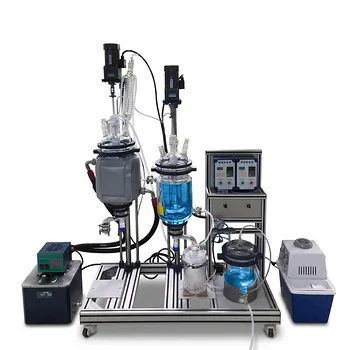
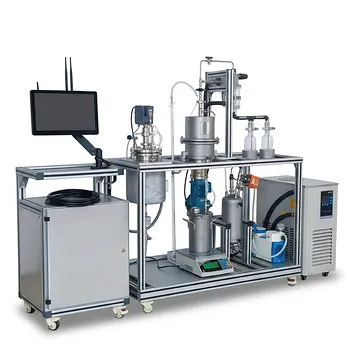
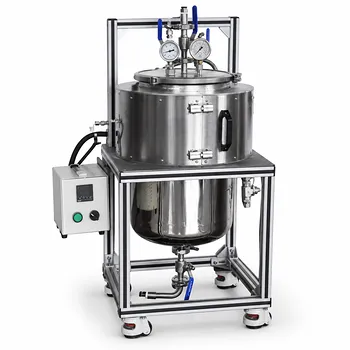
Solubility, more specifically the shape of its temperature-dependent curve, is the single most important factor that determines the category of crystallization equipment you’ll need. In a chemical engineering unit operations pilot plant, a solute with a steep positive solubility slope demands a jacketed cooling crystallizer, while a flat or inverse solubility curve pushes you toward a vacuum or evaporative crystallization system. The equipment configuration translates the solute’s thermodynamic behavior directly into a controllable method for generating supersaturation.
The core rule is simple: the mechanism for creating supersaturation must align with how solubility responds to temperature. A solute whose solubility drops sharply as the system cools requires a cooling-based hardware setup (jacketed vessel, precise temperature control). A solute whose solubility barely budges—or goes in the wrong direction—leaves you no choice but to remove solvent via evaporation or vacuum adiabatic cooling. Understanding this relationship prevents poor yield, wasted energy, and missed learning objectives in a pilot plant.
The Solubility Curve as Your Design Compass
Solubility data isn’t just a lab report number. It’s a direct instruction for engineering design. The curve’s slope dictates how you will force the solute out of solution, and that, in turn, defines the equipment you must install.
Slope and the Supersaturation Mechanism
Crystallization requires supersaturation. You get there by either reducing the solute’s solubility (typically through cooling) or by removing the solvent (evaporation).
A steep, positive solubility curve—where solubility at 80°C is 100+ mg/g and at 20°C is <20 mg/g—makes cooling a highly efficient trigger. The drop in solubility with temperature instantly creates supersaturation with minimal energy.
A flat curve, like that of sodium chloride, shows little thermodynamic reward for cooling. You’d need an enormous, impractical temperature drop to recover a meaningful amount of solid. For these solutes, removing the solvent is the only practical supersaturation driver.
The Three Classic Curve Shapes and Their Hardware
The pilot plant must physically embody the method dictated by the curve:
- Steep Positive Slope (e.g., potassium nitrate, potassium phosphate, copper sulfate): The plant needs a jacketed cooling crystallizer. This is a stirred tank with a utility jacket capable of precise, often linear, cooling ramps. The equipment must manage the heat transfer surface well to avoid excessive nucleation on cold walls.
- Flat or Shallow Slope (e.g., sodium chloride): A cooling jacket won’t help. The plant requires an evaporative crystallizer. At pilot scale, this is often a vacuum system that lowers the boiling point, or a forced-circulation evaporative unit that removes solvent to concentrate the solute.
- Inverse Slope (e.g., calcium sulfate, sodium sulfate at elevated temperatures): Here, solubility decreases as temperature increases, so heating a solution could cause crystallization. However, you can’t simply heat your way to product. These systems often rely on evaporative crystallization as well, or sometimes an antisolvent strategy, because cooling would actually dissolve the solid.
Pilot Plant Equipment Selection: Matching Physics to Hardware
A well-designed pilot plant isn’t just a single crystallizer. It’s a modular or multi-functional platform that can be reconfigured to demonstrate how solubility curves dictate industrial reality.
Cooling Crystallization in a Jacketed Vessel
When the curve is steep, the equipment is straightforward: a stirred, glass-lined or stainless steel vessel with a dimple or half-pipe jacket. The jacket must be connected to a heating/cooling unit with fast and smooth response. At the pilot scale, you’ll also include an in-line concentration sensor or turbidity probe to track the metastable zone.
The goal is not just cooling but controlled cooling. The equipment’s ability to follow a specific cooling profile directly translates the solubility curve into a supersaturation trajectory that avoids uncontrolled nucleation.
Evaporative Crystallization and Vacuum Systems
For flat-curve solutes, the pilot plant equipment looks very different. You’re now dealing with boiling, vapor handling, and condensation.
A typical setup includes a vacuum crystallizer—a vessel under reduced pressure so the solvent boils at a lower temperature. This generates supersaturation by removing the solvent. Attached to the vessel are a condenser, a condensate receiver, and a vacuum pump. The equipment can be rated for operation with corrosive materials if needed (as with sodium chloride brine). For educational purposes, this hardware starkly demonstrates why salt producers don’t simply chill seawater.
When Solubility Data Demands Hybrid Approaches
Real mixtures rarely fit cleanly into one box. A compound might have a moderately steep curve but be heat-sensitive. Or you may need additional yield after cooling.
- Vacuum adiabatic cooling: This combines evaporation and cooling. The pilot plant draws a vacuum over a heated solution; solvent flashes off, and the latent heat of evaporation cools the remaining liquid. This is equipment that functions like both an evaporator and a cooling crystallizer, essential for solutes that degrade if heated for too long but still require solvent removal.
- Antisolvent addition capabilities: If cooling alone can’t achieve high yield at a reasonable final temperature, the pilot plant may need a dosing system for a miscible non-solvent. The equipment then requires a second feed line, precise flow control, and rapid mixing. While not purely driven by the solubility curve of the pure solvent system, this is a direct answer to the curve’s limitation.
Understanding the Trade-offs
Selecting equipment based purely on solubility creates a clear flowchart, but you must manage hidden compromises.
The False Economy of Misapplied Cooling
Installing only a jacketed vessel in a teaching plant because it’s simple can misrepresent the science. A student trying to crystallize sodium chloride will see almost no yield, no matter how cold they go.
The equipment must be versatile enough to teach the principle. A pilot plant that can’t demonstrate evaporative or vacuum crystallization fails to connect the deep need: practical yield from real-world solubility profiles.
Energy Intensity and Heat Transfer Fouling
Evaporative crystallization consumes far more energy than cooling. For large-scale thinking, that’s a critical insight. At the pilot scale, the equipment may include an energy recovery preheater to show how industry optimizes steam usage.
Cooling crystallizers face scaling and encrustation on the cooling surfaces, especially with inverse-solubility salts like calcium sulfate. If your pilot plant handles these materials, you’ll need to demonstrate cleaning or scraping systems, highlighting that solubility data alone doesn’t guarantee operability.
Polymorph Control Adds Complexity
While the primary reference points to temperature-solubility curves for equipment selection, the supplementary references raise an important nuance: solvent choice and supersaturation control are critical for polymorph selectivity.
If your pilot plant’s purpose is to screen crystal forms, the equipment must go beyond simple cooling or evaporation. It needs precise supersaturation monitoring (via PAT tools like FBRM or Raman) and the ability to hold tight temperature and solvent composition profiles. A standard jacketed vessel might be perfect for yield but insufficient for preventing metastable polymorphs unless it includes this analytical suite.
Making the Right Choice for Your Pilot Plant Goals
Your decision framework should start with the solubility curve and then be refined by your educational or process development objectives.
- If your primary focus is teaching thermodynamic fundamentals: Choose a modular plant that includes a jacketed cooling crystallizer and a separate vacuum evaporative crystallizer, and run potassium nitrate vs. sodium chloride back-to-back experiments.
- If your primary focus is scaling up a new compound with a steep, positive solubility curve: Invest in a highly instrumented jacketed crystallizer with feedback-controlled cooling and in-line particle size monitoring to collect accurate nucleation and growth kinetics.
- If your primary focus is working with heat-sensitive or flat-curve solutes: Prioritize a vacuum adiabatic cooling crystallizer that combines evaporation and cooling, demonstrating gentle yet effective supersaturation generation.
- If your primary focus is polymorph screening: Ensure your pilot crystallizer allows for simultaneous antisolvent dosing and precise temperature ramps, with integrated real-time spectroscopy to track form transitions.
A pilot plant isn’t just a scaled-down factory; it’s a physical proof of how solubility curves become process designs. Align your equipment choice with that curve, and you’ll extract not just crystals, but the right lesson every time.
Summary Table:
| Solubility Curve | Supersaturation Mechanism | Recommended Equipment | Example Solutes |
|---|---|---|---|
| Steep Positive Slope | Cooling | Jacketed cooling crystallizer | Potassium nitrate, Copper sulfate |
| Flat / Shallow Slope | Solvent evaporation | Evaporative / Vacuum crystallizer | Sodium chloride |
| Inverse Slope | Solvent evaporation / Heating | Evaporative crystallizer | Calcium sulfate |
Bring Advanced Chemical Engineering to Your Lab with LABPARK
Choosing the right crystallization setup is critical for demonstrating thermodynamic principles in practice. LABPARK provides premium Educational and Vocational Unit Operations Pilot Plants in chemical engineering, bioprocess & biotech, and environmental & water treatment for universities, research institutes, and enterprises.
Whether you need cooling, evaporative, or hybrid crystallization systems, our modular equipment ensures precise process control and reliable outcomes. Contact LABPARK today to customize your pilot plant solutions!
Related Products
- Multi Functional Membrane Crystallization Educational Unit Operations Pilot Plant
- Potassium Salt Thermal Dissolution and Crystallization Separation Educational Unit Operations Pilot Plant
- Green Anhydrous Ethanol Refining Practical Training Pilot Plant
- Multi-Functional Special Distillation Educational Pilot Plant
- Multi-Functional Membrane Separation Educational Pilot Plant for Unit Operations Lab
People Also Ask
- Control Crystallization Pilot Plant Secondary Nucleation: 4 Key Adjustments
- Why is precise temperature control critical in crystallization pilot plants? Key to Scale-Up Success
- What key factors should be considered when configuring a crystallization unit operations pilot plant?
- What are the benefits of integrating online PAT tools like ATR-FTIR into crystallization unit operations pilot plants?
- How to use crystallization pilot plant agitation speed to identify diffusion vs reaction growth?