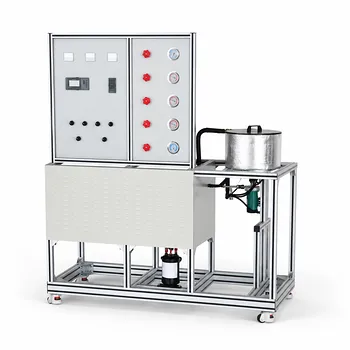
When utilizing pressure relief devices in a chemical engineering pilot plant, the primary educational goal is not just to prevent a catastrophic failure—it’s to provide students with a visceral, hands-on understanding of the 'layers of protection' concept. This is achieved by moving beyond theory on a slide. The pilot plant becomes a live case study where students must specify, calculate, and physically witness the consequences of selecting a non-reclosing device like a rupture disc versus a reclosing safety valve. The core lesson lies in understanding how these devices behave within a complete safety instrumented system during real operational scenarios, such as a runaway reaction or a blocked outlet.
The most powerful safety lesson a pilot plant can teach is inherent versus engineered safety. By using a non-reclosing rupture disc, students immediately grasp a critical plant reality: protection comes at the cost of operational continuity, forcing a full shutdown and batch loss. Conversely, a buckling pin valve makes the mechanical "decision point" of relief tangible, transforming an abstract setpoint into a physical, replaceable component. This teaches that safety devices are not magic—they are physical elements with strengths, weaknesses, and consequences.
Understanding the Device Physics: The First Lesson
Before any calculation, students must connect the physical device to its fundamental operational logic. This removes the "black box" mentality and builds an engineer's intuition for failure modes.
The "Non-Reclosing" Consequence
A rupture disc is a one-time-use sacrificial component. Once it bursts at its set pressure, the system is wide open and will not re-seal. This directly teaches students the link between process safety and operational continuity. The lesson is immediate: selecting a rupture disc forces a stop-work decision—shut down, depressure, purge, and mechanically replace the disc. The BS EN ISO 4126-3 standard is the guiding framework here, providing the rules for combining such discs with safety valves.
The Tangible Setpoint of a Buckling Pin
Unlike a spring-loaded valve, a buckling pin device makes the relief point a visible, structural failure. The pin is designed to buckle at a precise Euler load. When students hold a pin and calculate its buckling point, the abstract "set pressure" becomes a physical reality. This demystifies how mechanical systems can act as precise safety barriers and highlights the engineering required to manage combined stresses.
The Core Educational Module: Sizing and Configuration
The deep learning occurs when students design the relief system. They must stop looking up values in a table and start applying codes like ASME Section VIII and API RP 520 to a living, breathing process.
Calculating the Worst-Case Scenario
Students must be forced to identify the governing relief scenario. Is it an external fire? A runaway exothermic reaction? Thermal expansion in a blocked liquid line? For pilot plants, the runaway reaction scenario (linked to Stoessel criticality classes) is the most instructive. They learn to calculate the required orifice area to keep the vessel below 110% of MAWP (for standard scenarios) or 121% for fire cases, linking thermodynamics to mechanical design.
The Value of a Combined System
To teach defense-in-depth, have students specify a rupture disc in series with a safety valve (per BS EN ISO 4126-3). This setup provides four critical educational touchpoints:
- Corrosion Protection: The disc isolates the expensive safety valve from corrosive process fluids.
- Leak Tightness: It provides a zero-leak seal, essential for toxic media.
- Sizing Complexity: Students must apply the combination correction factor ($K_c = 0.9$) in their sizing calculations. This directly teaches that safety devices are not additive; their interaction introduces flow resistance that must be accounted for mathematically.
- Telltale Monitoring: The space between the disc and the valve inlet must be monitored. A pressure rise here signals a pinhole leak in the disc, transforming a catastrophic burst scenario into a controlled maintenance event.
Pipe Away from the Problem: Liquid Traps
The installation rules are as critical as the device. Inlet piping must be clean and free of liquid pockets. A small liquid trap can create a hydraulic hammer upon valve opening, physically ripping the relief pipework apart. This teaches students that a perfectly sized safety valve is useless if the piping fails first. The discharge must safely route to a containment system, teaching the complete lifecycle of an overpressure event.
Understanding the Trade-offs
An objective analysis of the downsides is essential. No perfect solution exists, and students must learn to make informed compromises.
The Operational Blindness of Rupture Discs
Rupture discs are susceptible to fatigue and corrosion thinning, which can lower their burst pressure over time without any visible external warning. This necessitates regular, invasive inspections. Furthermore, they do not reclose after a minor excursion, leading to a total release of contents—a stark contrast to a reclosing valve that can bring a plant back to a safe state with minimal loss.
The Total Cost of Batch Loss
In an educational setting, a rupture disc burst means more than just a loud bang. It means the entire experiment is ruined. The chemical batch, the analytical samples, and the data from a multi-hour run are vented. This visceral lesson in batch economics is far more valuable than any spreadsheet exercise, teaching students why process plants invest heavily in preventing spurious trips.
The Limitations of Buckling Pin Valves
While visually instructive, buckling pin valves must be carefully maintained. The pin itself is sensitive to corrosion or external mechanical damage. If the process fluid causes micro-pitting on the pin, the buckling point changes unpredictably. Additionally, a reset requires careful manual replacement of the pin, raising the risk of operator error if an incorrect pin is installed in a live plant environment.
Making the Right Choice for Teaching Goals
Using these devices effectively in education depends on the specific learning objective. Structure the exercise around the problem you want students to solve.
- If your primary focus is fundamental reaction safety: Use a small jacketed reactor protected by a rupture disc. Have students run a simulated runaway scenario, measure the Maximum Temperature of the Synthesis Reaction (MTSR) , and witness the disc burst. This creates an unforgettable link between thermodynamic calculations and physical plant protection.
- If your primary focus is piping design and code compliance: Specify a safety valve and require students to design its upstream and downstream piping entirely per ASME B31.3. The inspection of their work occurs when you check for liquid pockets and verify the inlet pressure drop is below the 3% rule.
- If your primary focus is advanced device integration: Install a rupture disc and safety valve combination (per BS EN ISO 4126-3) . The core student task is back-calculating the required orifice area using the $K_c$ (0.9) and $K_d$ (0.62) factors, proving they understand how a primary barrier degrades the performance of a secondary one.
The ultimate value of these pilot plant devices is that they fail. By allowing students to design, commission, and occasionally rupture these devices under controlled conditions, you are training engineers who intuitively grasp that process safety is not a checklist, but a dynamic, physical reality.
Summary Table:
| Device Type | Operational Behavior | Key Educational Focus | Relevant Standards |
|---|---|---|---|
| Rupture Disc | Non-reclosing (sacrificial) | Batch loss, process shutdown, and system isolation | BS EN ISO 4126-3, ASME Sec VIII |
| Buckling Pin Valve | Reclosing (mechanical pin failure) | Structural buckling physics and precise setpoint mechanics | API RP 520, ASME B31.3 |
| Combined System | Dual-barrier configuration | Flow resistance ($K_c$ factor), leak tightness, and monitoring | BS EN ISO 4126-3 |
Bring real-world process safety to life in your laboratory. LABPARK provides high-quality Educational and Vocational Unit Operations Pilot Plants across chemical engineering, bioprocess & biotech, and environmental & water treatment. Designed specifically for universities, research institutes, and enterprises, our pilot plants integrate standard safety devices to teach students the physical consequences of overpressure events.
Contact LABPARK today to discover how we can customize a safe, hands-on learning solution for your institution!
Related Products
- Constant Pressure Filtration Educational Unit Operations Pilot Plant
- Educational Pressure Swing Adsorption Ethylene Capture Unit Operations Pilot Plant
- Multi-Component Gas Pressure Swing Adsorption Pilot Plant for Unit Operations Education
- Low Concentration Carbon Dioxide Capture Pressure Swing Adsorption Educational Pilot Plant
- Bernoulli Equation Demonstration Unit Operations Pilot Plant
People Also Ask
- How do educational unit operations pilot plants bridge theory and design? Bridge the Engineering Gap
- How do educational unit operations pilot plants address safety and waste management when scaling up?
- Why splitting a filtration batch doesn't always reduce cycle time? Pilot Plant Insights
- Why Demo Constant-Rate to Constant-Pressure Filtration on a Pilot Plant? Key Practical Insights
- How can researchers identify and resolve filter medium blinding? Optimize Your Pilot Plant Runs