The stirrer design is the critical variable that transforms a simple mixer into a powerful teaching tool. When demonstrating gas-liquid dispersion in a chemical engineering pilot plant, you need a disk flat-blade turbine (often a Rushton turbine) to maximize shear and break gas into fine bubbles. For demonstrating solid suspension, you must switch to a pitched-blade turbine, which generates axial flow to lift and suspend particles. This fundamental distinction—radial shear vs. axial pumping—is the engineering principle you want your students to witness and measure directly.
Demonstrating gas-liquid dispersion demands a disk flat-blade turbine to focus energy on bubble breakup; demonstrating solid suspension requires a pitched-blade turbine to create axial flow that sweeps solids off the vessel bottom. The choice hinges on whether the educational objective is to show gas breakup and mass transfer enhancement or particle lifting and just-suspended speed, with liquid viscosity imposing a final constraint on impeller suitability.
Why Stirrer Geometry Matters for Multiphase Mixing
The impeller you select controls the flow pattern inside the tank, and that flow pattern determines whether gas is dispersed or solids are suspended. In a pilot plant, the right choice allows students to see cause and effect through clear, measurable engineering parameters.
The Physics: Shear vs. Axial Flow
Gas-liquid dispersion relies on high local shear stress to tear large gas bubbles into smaller ones. A radial flow impeller like a disk flat-blade turbine creates intense turbulence at the blade tips, delivering the shear needed to produce a high interfacial area for mass transfer.
Solid suspension depends on bulk fluid motion to lift particles from the vessel bottom. Axial flow impellers, such as a pitched-blade turbine, generate a strong downward or upward pumping action that scours solids off the floor and keeps them circulating throughout the liquid volume.
The Disk Flat-Blade Turbine: Built for Gas Breakup
The disk flat-blade turbine (Rushton turbine) is the gold standard for gas-liquid demonstrations. Its flat blades project radially, creating a high-shear zone at the blade edges where gas bubbles are reduced in size. The central disk also prevents gas from simply streaming up the shaft, forcing it into the shear field for efficient dispersion.
In a teaching lab, this impeller lets students directly observe how bubble size distribution, gas holdup, and the volumetric mass transfer coefficient ( k_La ) change with agitation speed. They can measure dissolved oxygen in a simulated fermentation and connect impeller physics to process performance.
The Pitched-Blade Turbine: Engineered for Particle Lifting
When the goal is to suspend solid particles—catalysts, crystals, or inert beads—the priority is vertical fluid motion. A pitched-blade turbine (typically with 45° blade angle) delivers a strong axial flow. In a down-pumping configuration near the vessel bottom, it creates a jet that lifts solids off the floor and distributes them through the tank.
This configuration teaches the concept of just-suspended speed (( N_{js} ))—the minimum agitation rate to keep all particles off the tank bottom for more than one to two seconds. Students learn that flow pattern, not just power input, determines whether a solid-liquid process succeeds.
Practical Considerations for the Teaching Laboratory
The ideal impeller selection must also account for fluid properties and the logistics of running multiple demonstrations in a single pilot plant.
Viscosity: The Hidden Decider
The primary reference sets clear viscosity limits: a disk flat-blade turbine works well in low-viscosity fluids up to about 10 Pa·s, typical of aqueous educational systems. For highly viscous media (up to 1000 Pa·s), only helical ribbon or anchor impellers can generate adequate mixing.
If your student experiments involve simulated polymer solutions or non-Newtonian fluids, highlight this transition. It’s a powerful lesson on how Reynolds number and rheology dictate impeller choice, directly linking fluid mechanics to equipment selection.
Modular Rig: The Best Teaching Investment
To maximize learning, equip your pilot plant with interchangeable impellers on a common shaft. A modular setup lets students run back-to-back experiments—first with a Rushton turbine for gas dispersion, then with a pitched-blade turbine for solid suspension—under otherwise identical conditions.
This side-by-side comparison isolates the effect of impeller geometry. For solid suspension, they can also compare a flat-blade turbine with a pitched-blade to see the dramatic reduction in ( N_{js} ) achieved by axial flow. The data they collect will solidify the difference between shear-dominated and flow-dominated mixing.
Understanding the Trade-offs
Every impeller choice brings compromises. Teaching these trade-offs builds the kind of practical engineering judgment that textbooks alone cannot provide.
The High Energy Cost of High Shear
A disk flat-blade turbine delivers exceptional gas dispersion, but at a significant power penalty. Its power number is typically 3–5 times higher than that of a pitched-blade turbine of the same diameter. Students can measure motor current or torque to quantify this energy efficiency gap—a critical scale-up consideration.
Flooding and Gas Handling Limits
The Rushton turbine itself can be “flooded” at excessive gas flow rates, losing its dispersing ability. The pitched-blade turbine, lacking both the radial shear and the stabilizing disk, is even more prone to flooding and is generally not recommended for gassed applications. Use this contrast to teach flow regime maps and the safe operating window of each impeller.
When Pitched-Blades Need Help
A pitched-blade turbine is excellent for off-bottom suspension, but achieving uniform suspension throughout the entire liquid volume often demands higher power. For very dense or large particles, even a pitched-blade turbine may need to be oversized or supplemented with additional impellers, introducing surface aeration and other complications. This reinforces the concept that “just suspended” is a practical engineering compromise, not a perfect state.
Making the Right Choice for Your Educational Goal
Select the impeller based on the specific concept you want your students to master. Align the hardware with the learning objective.
- If your primary focus is demonstrating gas-liquid mass transfer and bubble dispersion: Select a disk flat-blade (Rushton) turbine. It will clearly link shear, bubble size, and ( k_La ), while also visually demonstrating the onset of flooding.
- If your primary focus is teaching solid suspension principles and just-suspended speed: Choose a pitched-blade turbine. It immediately demonstrates axial pumping and the power efficiency of flow-directed mixing for particle lifting.
- If your primary focus is a comparative experiment on mixing fundamentals: Build a modular rig with both impellers. Let students measure power draw, ( N_{js} ), and bubble dispersion quality, then deduce why geometry governs function.
- If your experiments involve moderately high viscosity (beyond ~10 Pa·s): Move to a helical ribbon or anchor impeller, and use the shift to teach rheology-dependent equipment selection.
The stirrer you choose is not just a piece of hardware—it is the lens through which your students will see and understand the fundamental principles of multiphase mixing. Select it with purpose, and your pilot plant will become an unforgettably clear lesson in chemical engineering design.
Summary Table:
| Impeller Type | Flow Pattern | Primary Educational Use | Key Limitation |
|---|---|---|---|
| Disk Flat-Blade (Rushton) | Radial Shear | Gas-Liquid Dispersion & Mass Transfer ($k_La$) | High power draw; restricted to viscosity < 10 Pa·s |
| Pitched-Blade Turbine | Axial Pumping | Solid Suspension & Just-Suspended Speed ($N_{js}$) | High risk of flooding under gassed conditions |
Equip Your Lab with Advanced Unit Operations Pilot Plants
Enhance your students' hands-on learning with LABPARK’s high-performance Educational and Vocational Unit Operations Pilot Plants in chemical engineering, bioprocess & biotech, and environmental & water treatment.
Designed specifically for universities, research institutes, and enterprises, our systems offer the modular flexibility required to demonstrate complex multiphase mixing phenomena—from gas-liquid dispersion to solid suspension.
Ready to upgrade your teaching or research lab? Contact LABPARK today to customize your pilot plant setup!
Related Products
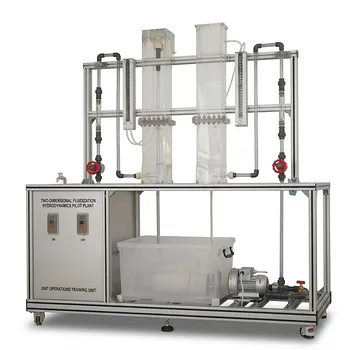
- Two-Dimensional Fluidization Hydrodynamics Educational Pilot Plant for Unit Operations Training
- Educational Unit Operations Pilot Plant for Intraparticle Diffusion Effective Factor Measurement
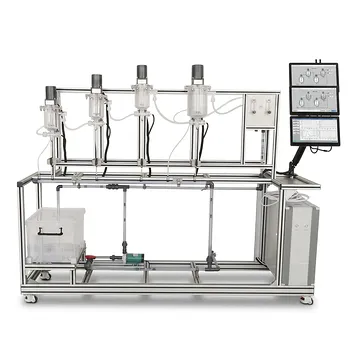
- Multi-Stage Stirred Tanks in Series Residence Time Distribution and Mixing Performance Determination Educational Pilot Plant
- Multi-Reactor Educational Pilot Plant for Reaction Engineering Unit Operations
- Multi Functional Catalytic Reaction and Reactor Evaluation Educational Unit Operations Pilot Plant
People Also Ask
- What pressure drop characteristics should students & researchers monitor in a fluidization pilot plant?
- How does active time pulsing mixing enhance fluid homogenization? Configuration Guide for Educational Pilot Plants
- How can acoustic chemometrics prevent reactor clogging in educational fluidized bed pilot plants?
- What is the operational significance of solids feed rate on emulsion phase dynamics in fluidized bed pilot plants?
- Why is UB/Ui critical in fluidized bed pilot plant modeling? Master Gas-Solid Contact