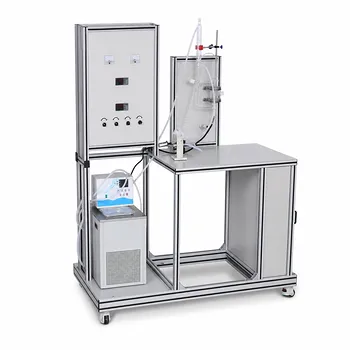
The definitive guide to vessel support selection starts with a single question: how much bending moment can your vessel's shell tolerate? For a vertical vessel in a chemical engineering pilot plant, the choice between lug and skirt supports is fundamentally a decision about eccentric loading. Lug supports bolt to the vessel's side and transfer weight through brackets, which imposes a local bending moment on the thin shell wall. Skirt supports, in contrast, carry the load axially from the bottom head into a base plate, distributing it evenly across a foundation. Engineers should select lug supports only for small, lightweight vessels mounted on an existing steel structure with negligible lateral forces. The moment the vessel becomes tall, heavy, or exposed to wind or seismic loads, a skirt support is mandatory to prevent localized shell overstress and catastrophic instability.
The support type must match the vessel’s susceptibility to overturning moments. Lugs introduce eccentric loads that demand careful reinforcement and are safe only for tiny, bench-scale units. Skirts provide uniform load distribution and are the only code-compliant, safe choice for any pilot-scale column that could tip or stress its own shell.
The Mechanical Heart of the Decision
How Lugs Work – and Their Critical Weakness
Lug supports are welded or bolted brackets attached to the vessel shell. They transfer the vessel’s weight and any operational forces directly into a supporting steel structure. Because the load is applied away from the vessel’s centerline, the lug imposes a bending moment on the shell wall. For thin-walled vessels common in pilot plants, this localized stress can rapidly exceed the material’s allowable limit unless the shell is heavily reinforced.
Without reinforcement, the shell can yield or buckle at the lug attachment — a failure mode prohibited by ASME pressure vessel code. This eccentric loading means lugs are only suitable when the overturning arm is short and the loads are light. In practice, that restricts lugs to small receiver tanks, test reactors, or buffer pots mounted indoors on rigid frames.
Why Skirts Dominate for Tall Columns
A skirt support is a cylindrical or conical shell welded to the bottom head of the vessel. It extends vertically downward to a base plate anchored to the floor. This design carries the entire weight of the vessel and its contents directly into the foundation without any eccentric load on the pressure shell.
Wind loads or seismic forces create global overturning moments, but the skirt resists them through tension and compression in the anchor bolts. Because the shell itself sees only axial membrane stresses at the junction, the risk of local buckling or yielding is virtually eliminated. That’s why any distillation column, absorption tower, or extraction column in a pilot plant will inevitably use a skirt.
The Pilot Plant Selection Matrix: When Lugs Make Sense
Rule of Thumb: Height and Load
If your vessel is shorter than about 2 meters and weighs less than a few hundred kilograms when filled, lugs can be considered. The vessel must also be situated in a low‑vibration, indoor environment where wind and seismic loads are absent. Even then, a formal local stress analysis per ASME BPVC Section VIII is required to verify the shell and lugs will not overstress.
The Elevation Factor: Structure vs. Foundation
Many pilot‑plant vessels are mounted on elevated steel platforms for process integration. Lugs are inherently compatible with this configuration — they bolt directly to the structure. However, a skirt demands a floor‑level foundation and cannot be easily placed on an upper deck without additional steelwork.
If your process layout forces the column to sit on the ground slab, the skirt becomes the natural, robust choice. For a column located high in a rack, you may prefer lugs but only after confirming that lateral forces (like pipe loads or platform vibrations) remain minor.
Safety and Code Compliance
ASME code governs all pressure vessels in pilot plants. The code explicitly requires that local stresses at support attachments stay below the allowable material limits. Lugs demand careful evaluation of bending‑plus‑membrane stress, often necessitating load‑bearing pads or stiffeners.
These reinforcements add fabrication cost and complexity, eroding the apparent simplicity of a lug support. A skirt, by contrast, separates the structural support from the pressure boundary and typically passes a code stress check with far less design effort. When laboratory safety is paramount, the lower engineering risk of a skirt is a strong decision driver.
Understanding the Trade-offs
The Hidden Cost of Lugs
A lug support may look cheaper on a vendor drawing, but the engineering and reinforcement requirements can quickly close the cost gap. Adding a full‑circumference pad under each lug increases material, welding, and inspection expenses. More critically, a poorly designed lug set can lead to local yielding of the shell — a failure that may not be obvious until the vessel is in service with operators nearby.
When a Skirt Might Be Overkill
For a truly benchtop‑scale vessel, such as a 5‑liter catalyst screening reactor sitting on a laboratory frame, a skirt adds unnecessary height and weight. It also forces you to design a dedicated base support instead of simply bolting the vessel to the structure. In these micro‑scale applications, properly reinforced lugs or legs are more practical, provided the static loads are negligible and the moment arm is only a few centimeters.
Making the Right Choice for Your Pilot Plant
Your decision should be guided by the failure modes you are defending against.
- If your primary focus is safety and code simplicity for any column over 3 meters: Choose a skirt support. Its uniform load distribution eliminates shell bending moments and ensures robust resistance to overturning.
- If your primary focus is mounting a small, lightweight vessel on an existing elevated structure: A properly reinforced lug support can work, but you must perform an ASME local stress analysis and reinforce the shell attachment points.
- If your primary focus is a floor-standing distillation or absorption column of any significant height: A skirt is mandatory. Do not risk lug supports — the eccentricity will almost certainly cause excessive local stress or instability.
- If your primary focus is rapid prototyping with a very small bench‑scale unit: Lugs or legs can be acceptable, but always verify with a simple load‑path check that the shell will not see damaging bending moments.
A support system that fails under your pilot plant’s own weight is not an option. By letting the overturning moment dictate your choice, you ensure your vessel stands safely — from the first test run to the final scale‑up.
Summary Table:
| Feature | Lug Supports | Skirt Supports |
|---|---|---|
| Load Distribution | Eccentric (local bending moment on shell) | Uniform axial load (distributed to foundation) |
| Best Suited For | Small, lightweight, elevated indoor vessels (<2m) | Tall, heavy columns (distillation, absorption) |
| Wind/Seismic Resistance | Poor (risks localized shell buckling) | Excellent (resisted via anchor bolts) |
| Installation | Mounted directly on elevated steel frames | Requires floor-level foundation slab |
| Code Compliance | Requires rigorous local stress analysis (ASME) | Easier compliance; separates support from pressure boundary |
Optimize Your Pilot Plant Design with LABPARK
Ensure maximum safety, code compliance, and operational efficiency in your facility. LABPARK provides state-of-the-art Educational and Vocational Unit Operations Pilot Plants in chemical engineering, bioprocess & biotech, and environmental & water treatment for universities, research institutes, and enterprises.
Whether you need robustly supported distillation columns or custom bench-scale reactors, our engineering team is here to help you select, design, and implement the perfect setup for your needs.
Contact LABPARK today to discuss your project requirements!
Related Products
People Also Ask
- How can pilot plants assist in validating VLE models? Bridge theory and physical reality.
- Why Collect Isothermal vs. Isobaric VLE Data? Key Pilot Unit Advantages
- How Do Equations of State Predict VLE in Pilot Plants? Optimize Your Separation Design
- How do intermolecular forces and molecular kinetic energy govern gas liquefaction and vaporization? Explore VLE pilot plants
- For VLE Experiments: Fugacity vs. Activity Coefficient Method Selection Criteria