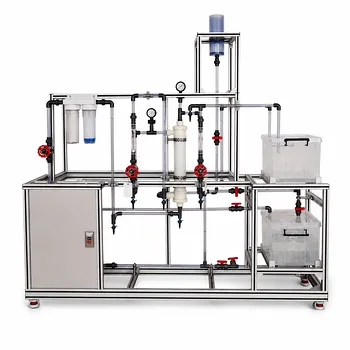
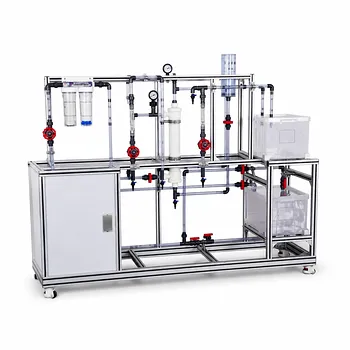
Your module choice is a pedagogical decision as much as it is a technical one.
For educational water-treatment pilot plants, the selection among plate-and-frame, spiral-wound, and hollow fiber modules should be driven by your primary teaching objective, the feed water quality you expect, and the hands‑on maintenance you can support. Plate-and-frame modules (160–500 m²/m³) are the most forgiving and teach fundamental filtration principles on dirty feeds. Spiral-wound modules (650–1 600 m²/m³) are the industrial standard for reverse osmosis and ultrafiltration, offering a realistic training platform for moderate‑fouling waters. Hollow fiber modules (16 000–30 000 m²/m³) deliver extreme packing density and flow‑configuration flexibility, but demand nearly particle‑free water and are impractical to clean once fouled.
The ideal educational module is not the one with the highest performance, but the one that best aligns with what your students need to learn and the water you will actually pump through it. Prioritize plate‑and‑frame for visibility and dirt tolerance, spiral‑wound for industrial relevance, and hollow fiber only when you can guarantee ultraclean feed water and an experienced operating team.
Why Module Geometry Dictates Your Teaching Scope
The Surface Need: What Each Module Delivers
A membrane module supplies the physical housing and packing arrangement of the membrane. The three geometries under consideration—plate‑and‑frame, spiral‑wound, and hollow fiber—differ dramatically in packing density, cleanability, and pretreatment requirements. These differences directly control what kinds of experiments you can run and how quickly a student‑generated mistake can foul a module.
The Deep Need: What Your Students Should Be Learning
Module selection shapes the entire learning experience. A well‑chosen module lets students observe flow dynamics, quantify mass‑transfer resistance, and diagnose real fouling events. A poor choice can turn every lab session into a frustrating battle with clogged membranes. The goal is to match the module’s inherent strengths to the curriculum—whether that means demonstrating the basics of cross‑flow filtration on a forgiving flat‑sheet rig or exploring advanced countercurrent configurations on a hollow‑fiber system.
The Three Modules in Detail
Plate‑and‑Frame: The Visual Teaching Tool
Packing density: 160–500 m²/m³.
Cleaning and replacement: Individual flat‑sheet membranes are easily removed and replaced. Manual scrubbing or high‑pressure washing is straightforward because the stack can be disassembled.
Feed water tolerance: Low pretreatment requirements; handles high‑fouling and turbid feeds robustly.
Teaching advantages: Students can see each membrane sheet, inspect fouling layers directly, and understand the basics of pressure‑driven filtration without the mystery of hidden flow channels. This makes it the superior choice when the learning objective is fundamentals of membrane separations and fouling control.
Spiral‑Wound: The Industrial Workhorse
Packing density: 650–1 600 m²/m³.
Structure: Flat‑sheet composite membranes supported by a microporous layer and nonwoven paper, wrapped around a central permeate tube with mesh spacers.
Anti‑fouling and reliability: Moderate; it resists fouling much better than hollow‑fine‑fiber designs and is the preferred configuration for industrial reverse osmosis and ultrafiltration. Still, feed water should meet a clogging index (FI) below 4.
Teaching advantages: Students learn about axial flow channels, concentration polarization, and the scale‑up economics of real‑world desalination plants. It is the module you choose when the goal is training for industry-standard water treatment operations.
Hollow Fiber: The High‑Efficiency Specialist
Packing density: 16 000–30 000 m²/m³, the highest of the three.
Structure: Self‑supporting fibers that can operate at high pressures but are impossible to clean once internal fouling occurs. Individual membrane replacement is not possible; the entire module must be discarded.
Pretreatment imperative: Requires a clogging index below 3, essentially particle‑free feed. Even minor upsets lead to irreversible clogging.
Teaching advantages: When operated with ultraclean water, these modules allow advanced study of cocurrent, countercurrent, and crossflow configurations, and can be fed on the bore or shell side. Ideal for simulating high‑efficiency polishing or gas separation, but only if you have disciplined operators and reliable pretreatment.
Understanding the Core Trade‑offs
A single table of numbers won’t guide an educator; the decision revolves around three inseparable tensions.
Packing Density vs. Fouling Tolerance
The more membrane area you pack into a given volume, the narrower the feed channels become and the less tolerant the module is to suspended solids. Plate‑and‑frame, with wide, open channels, forgives a poorly prepared feed. Hollow fiber, with its hair‑thin fibers, punishes it immediately. For a teaching lab where students frequently mix up feed tanks or skip a pre‑filter step, plate‑and‑frame is the safest bet.
Maintenance Transparency vs. Sealed Reliability
Plate‑and‑frame can be disassembled in minutes for inspection and cleaning—a powerful pedagogical moment. Spiral‑wound and hollow fiber modules are sealed units. Once fouled, you either chemically clean them in‑place or replace the entire module. Hollow fiber offers no practical manual cleaning path. If you want students to experience the reality of a long‑running industrial process, spiral‑wound is excellent; if you want them to see and touch the fouling layer, you need plate‑and‑frame.
Capital Cost vs. Operating Flexibility
At pilot scale, equipment cost differences shrink relative to downtime and consumables. Plate‑and‑frame units are mechanically complex and more expensive to build, but their membranes are cheap to replace individually. Hollow fiber modules can be low‑cost when purchased, but you must invest heavily in pretreatment infrastructure (multimedia filters, cartridge filters) to keep them running. Spiral‑wound sits in the middle—moderate equipment and membrane replacement costs, reasonable pretreatment requirements.
Common Pitfalls to Avoid
- Selecting hollow fiber without a 1 µm (or finer) pre‑filtration train. Any particle slip will rapidly clog the fibers, turning an expensive module into a paperweight.
- Choosing plate‑and‑frame but ignoring its low packing density. If you need high‑throughput experiments or want to simulate an industrial RO station, the sheer footprint and low flux may disappoint.
- Assuming spiral‑wound modules are inherently anti‑fouling. They still require solid pretreatment and will foul if students operate at excessively high recoveries or ignore pressure drops.
- Forgetting that even “clean” tap water contains silt. Without a proper FI measurement, “clear” water can still irreversibly clog a hollow fiber module within hours.
Making the Right Choice for Your Educational Goals
Match your module to the primary outcome you want students to achieve.
- If your primary focus is demonstrating fundamental membrane mechanics and fouling phenomena: Use a plate‑and‑frame module. Its visual accessibility and easy cleaning turn every experiment into a visible lesson.
- If your primary focus is preparing students for real‑world industrial water treatment: Equip the plant with spiral‑wound modules. They replicate the exact configuration used in >90 % of commercial RO plants.
- If your primary focus is advanced research on mass‑transfer coefficients or high‑purity polishing: Deploy hollow fiber modules, but only alongside a rigorous pretreatment system that guarantees a feed FI < 3.
- If your pilot plant must handle unpredictable or turbid feed waters (lake water, reuse membranes): Stick with plate‑and‑frame, or consider adding tubular modules as a robust alternative with even greater fouling resistance.
When you anchor your decision in learning objectives rather than spec‑sheet numbers, you build a pilot plant that transforms every experiment into a lasting engineering insight.
Summary Table:
| Module Type | Packing Density (m²/m³) | Fouling Tolerance | Primary Teaching Objective |
|---|---|---|---|
| Plate-and-Frame | 160–500 | High (Easy to clean) | Teaching membrane mechanics, fouling inspection, and filtration basics. |
| Spiral-Wound | 650–1,600 | Moderate | Industrial-standard operations (RO/UF) and scale-up economics. |
| Hollow Fiber | 16,000–30,000 | Low (Requires FI < 3) | Advanced flow studies (countercurrent) and high-efficiency polishing. |
Build Your Ideal Water Treatment Lab with LABPARK
Choosing the right membrane module is critical to creating an effective learning environment. LABPARK provides high-quality Educational and Vocational Unit Operations Pilot Plants in chemical engineering, bioprocess & biotech, and environmental & water treatment for universities, research institutes, and enterprises.
Whether you need a robust, visually clear plate-and-frame pilot plant to teach filtration basics or an industrial-grade spiral-wound system for advanced training, our customized systems are designed to meet your specific curriculum and research needs.
Contact LABPARK today to discuss your laboratory requirements and receive a tailored proposal!
Related Products
- Alkaline Membrane Water Electrolysis Educational Pilot Plant Unit Operations Training System
- Multifunctional Membrane Separation Educational Pilot Plant with Ultrafiltration, Nanofiltration, Reverse Osmosis
- Ultrafiltration Membrane Separation Educational Pilot Plant
- Multi Functional Membrane Crystallization Educational Unit Operations Pilot Plant
- Multi-Functional Membrane Separation Educational Pilot Plant for Unit Operations Lab
People Also Ask
- How do chemical engineering pilot plants demonstrate electrolysis? Bridge Theory & Industrial Scale
- How do composite membranes affect NaOH production? Key factors for high current efficiency.
- What are the core parameters of water electrolysis efficiency? Master them with pilot plants.
- Gap-Electrode vs. Zero-Gap Membrane: Key Design Choices for Water Electrolysis Pilot Plants
- How do alkaline and PEM electrolysis technologies differ in pilot plant operations?