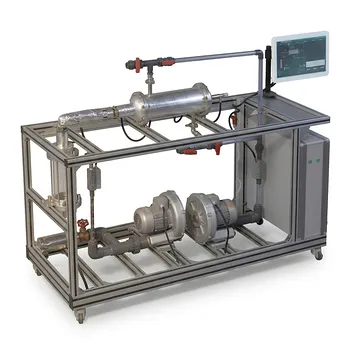
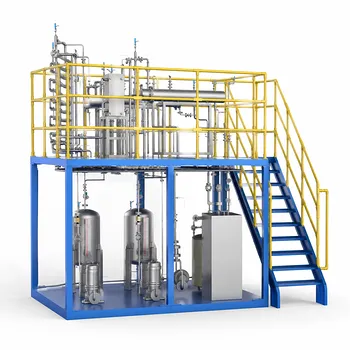
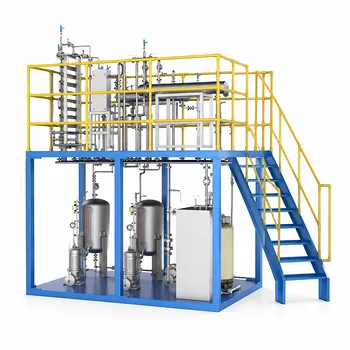
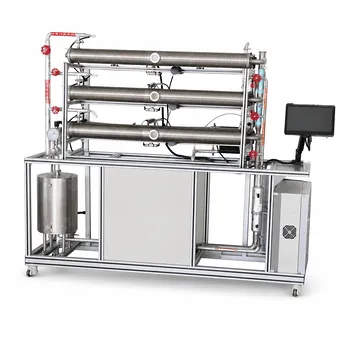
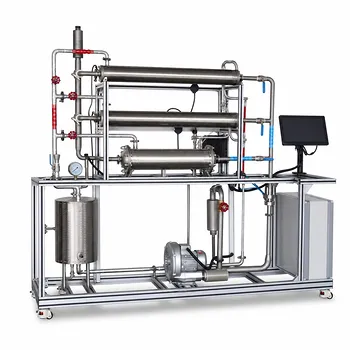
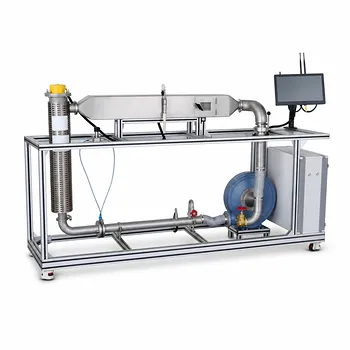
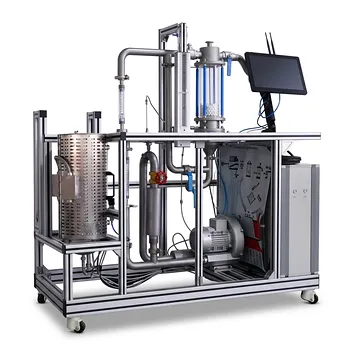
For a chemical engineering unit operations pilot plant, the primary selection criterion isn't just thermal performance—it's pedagogical intent. A double-pipe heat exchanger consists of two concentric tubes and is the superior choice for demonstrating fundamental heat transfer principles, co-current/counter-current flows, and basic calculations at lower flow rates. Conversely, a shell-and-tube heat exchanger, with its tube bundle and baffles, is essential when the primary goal is to expose students to a mainstream industrial configuration, teaching them about fluid pathway selection, thermal stress, and the efficiency improvements brought by baffles.
The core decision hinges on what you want your students to learn. Invest in a double-pipe exchanger to unpack fundamental theory and make calculations tangible. Invest in a shell-and-tube exchanger to build hands-on familiarity with the complexity and operational constraints of real-world industrial equipment. Most comprehensive pilot plants benefit from having both to bridge simple principles and applied complexity.
Deconstructing Core Capability: Double-Pipe vs. Shell-and-Tube
The physical design of each heat exchanger directly dictates its educational utility. The choice is not about one being better, but about which one foregrounds the right learning for a specific lab module.
The Double-Pipe Exchanger as a Fundamental Tool
A double-pipe heat exchanger is the ideal first building block. Its straightforward design makes heat transfer visible.
Because it consists of just one tube inside another, the flow pattern—whether co-current or counter-current—is easy for students to visualize. This direct observation is critical for ingraining the impact of the log mean temperature difference (LMTD) on the required heat transfer area.
It shines in labs where the heat transfer duty is small. It is assembled from standard pipe fittings, making it a cost-effective choice that matches the lower flow rates typical of early-stage experimentation. If a project grows in scope, multiple units can simply be connected in series to expand capacity, offering high flexibility for laboratory configurations.
The Shell-and-Tube Exchanger as an Industrial Simulator
A shell-and-tube heat exchanger is a laboratory for industrial complexity. Its multi-pass configuration and baffle system introduce students to the non-idealities of real machines.
The presence of tube bundles and shell-side baffles lets students investigate advanced phenomena like shell-side bypass flow and leakage. This is where learning moves from ideal equations to practical efficiency factors. The layout itself is a lesson; a triangular layout maximizes heat transfer for clean fluids, while a square or rotated square layout is chosen to allow mechanical cleaning when fouling is a concern.
This design is the industrial standard for high-temperature and high-pressure applications. It teaches students the critical engineering logic behind fluid path selection: directing corrosive or high-pressure fluids through the tube side to protect the costly shell, and sending viscous fluids to the shell side where baffles induce necessary turbulence.
Configuring a Compact Pilot Plant for Teaching
Physical layout space in universities is almost always limited. Adapting full-scale industrial designs into compact units requires intentional engineering trade-offs.
To fit a shell-and-tube unit into a smaller footprint, the design may use shorter tubes and more tube passes. For example, reducing tube length from 20 feet to 12 feet while increasing passes from 2 to 4 maintains the heat transfer duty in a smaller box. This change, while making the unit compact, introduces a measurable increase in tube-side pressure drop that students can directly observe and calculate, turning a constraint into a valuable learning point.
Understanding the Trade-offs and Pitfalls
Every design choice creates a learning opportunity and an operational limitation. Being clear about these trade-offs prevents a configuration from becoming a distraction rather than an educational tool.
The Limits of Simplicity
The double-pipe exchanger’s educational power fades in complex industrial scenarios. Its design is so simple that it fails to teach critical plant-level skills.
Students will never encounter baffles, experience tube layout optimization, or manage a multi-pass fluid stream with a double-pipe unit alone. Relying on it exclusively creates a knowledge gap between classroom principles and plant-floor reality.
From a maintenance perspective, it’s straightforward but not industrial-grade. While you can teach basic cleaning, you cannot demonstrate the mechanical cleaning strategies required for a large tube bundle or the real-world cost of material selection for a massive shell.
The Cost of Complexity
Shell-and-tube exchangers bring logistical burdens that must be planned for. They have a larger footprint and are not easily disassembled for a quick, 10-minute visual inspection.
Cleaning is a significant operational lesson. The best practice rule is that dirt-prone or scaling fluids must go through the tube side because tubes are accessible for mechanical cleaning. The shell side, with its baffles, is far more difficult to drain and clean. Beyond cleaning, the design must maintain adequate clearances—a recommended center-to-center tube pitch of 1.25 times the tube outer diameter is standard, with a 6.4 mm minimum clearance for square layouts.
Educationally, the unit's complexity can obscure fundamentals. If the unit is a noisy, opaque steel box, students may struggle to connect the calculated heat transfer coefficient to the physical flow they cannot see, an area where the glass or easily instrumented double-pipe excels.
Making the Right Choice for Your Educational Goals
The final selection must align with the specific module you are teaching. Use a staged approach to build a complete educational experience.
- If your primary focus is teaching foundational heat transfer theory: Select a double-pipe heat exchanger. Its transparency allows students to experimentally verify basic calculations, like determining heat transfer coefficients and pressure drops based on fluid properties such as viscosity and thermal conductivity.
- If your primary focus is simulating an industrial process environment: Select a shell-and-tube heat exchanger. It forces students to apply fluid path selection rules—like directing corrosive fluids or high-pressure streams through the tube side—and to analyze the impact of baffles on thermal efficiency.
- If your curriculum includes corrosion or material compatibility studies: Use the tube-side of a double-pipe unit, where a specialized material like graphite or Karbate can be used for a corrosive fluid, or ensure the shell-and-tube unit directs this fluid inside the tubes to prevent shell-side corrosion.
- If your physical lab space is highly constrained but you need industrial relevance: Configure a short-length, multi-pass shell-and-tube exchanger. Use this as a case study for students to measure the trade-off in pressure drop, transforming a space-related design compromise into a core learning objective.
Integrate both configurations strategically, using the double-pipe to build a rock-solid conceptual foundation before allowing the shell-and-tube unit to reveal how those concepts are applied, compromised, and engineered around in every real chemical plant.
Summary Table:
| Feature | Double-Pipe Exchanger | Shell-and-Tube Exchanger |
|---|---|---|
| Pedagogical Focus | Fundamental heat transfer theory | Industrial scale & system complexity |
| Flow Demonstration | Visualizing co-/counter-current flow | Multi-pass flow & baffle efficiency |
| Key Calculations | LMTD & basic heat transfer coefficients | Pressure drops, bypass flow & fouling |
| Lab Footprint | Small, flexible, and modular | Compacted industrial-grade scale |
Equip Your Chemical Engineering Lab with LABPARK
Building a high-performing pilot plant requires the right balance of educational value and industrial realism. LABPARK provides state-of-the-art Educational and Vocational Unit Operations Pilot Plants in chemical engineering, bioprocess & biotech, and environmental & water treatment.
Whether you are a university looking to enhance student learning, a research institute scaling up processes, or an enterprise training workforce, we design custom systems to meet your exact curriculum and space needs.
Ready to upgrade your laboratory? Contact LABPARK today to collaborate with our engineering experts on your pilot plant configuration.
Related Products
- Shell and Tube Heat Exchanger Heat Transfer Coefficient Determination Educational Pilot Plant
- Comprehensive Multi-Modal Heat Transfer Unit Operations Pilot Plant for Engineering Training
- Dual Mode Heat Transfer Pilot Plant for Unit Operations Training
- Three-Tube Heat Transfer Educational Pilot Plant for Unit Operations Training
- Comprehensive Heat Transfer Coefficient Determination Educational Unit Operations Pilot Plant
People Also Ask
- Why Apply LMTD Correction in Shell-and-Tube Pilot Plants & How to Determine It
- How is the fouling factor (Rd) evaluated? Key Pilot Plant Insights for Students
- How is fouling factor demonstrated using shell and tube pilot plants? Practical Lab Guide
- Why is simulating and calculating fouling factors crucial when operating educational heat exchanger pilot plants?
- Why Keep Shell-Side Reynolds Number Above 2100? Maximize Pilot Plant Heat Transfer