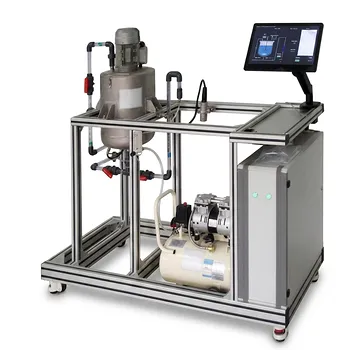
The choice between a mixer-settler and a centrifugal extractor hinges on your system’s physical properties, the number of stages you need, and your tolerance for footprint and residence time.
A mixer-settler is the clear winner for demonstrating multi‑stage counter‑current extraction with high stage efficiency and stable operation, even when solids are present. A centrifugal extractor becomes indispensable when your liquid pair has almost no density difference, is highly viscous, forms tenacious emulsions, or contains temperature‑ or time‑sensitive compounds that demand separation in seconds.
The decision is not about which extractor is “better” – it’s about which one solves your specific fluid‑handling problem while matching your educational or research goals. Mixer‑settlers shine in classical, visible stage‑wise separations; centrifugal extractors excel where gravity fails and speed is everything.
When Phase Separation Becomes the Critical Question
The physical properties of your two‑phase system often make the decision for you. If the phases separate easily, you have options. If they don’t, centrifugal force becomes a necessity.
Systems That Still Respond to Gravity
If you have a reasonable density difference (> 0.05 g/mL), low‑to‑moderate viscosity, and no persistent emulsification, a mixer‑settler pilot plant is a robust, pedagogically clear choice.
The gentle mixing and generous residence time let students observe the mass transfer and phase coalescence directly, reinforcing fundamental extraction principles.
When Emulsions Refuse to Break
Some systems – especially those with low interfacial tension, high viscosity, or surfactant‑like components – form stable emulsions that can take hours to settle by gravity.
A centrifugal extractor applies hundreds to thousands of g’s, crushing the emulsion and discharging two clear phases in seconds. For these fluids, a mixer‑settler would simply not work.
Extremely Small Density Differences
When the density difference drops below ~0.01 g/mL, gravity‑driven settling becomes impractical regardless of how long you wait.
Centrifugal extractors are designed specifically for such near‑density‑matched systems, sustaining the high‑g forces needed to drive separation where gravity cannot.
The Impact of Stage Requirements and Residence Time
Your experimental objectives around stage count and contact time heavily influence the equipment choice.
Multi‑Stage Separations Made Visible
Mixer‑settlers naturally mimic the classic stage‑wise extraction found in textbooks. You can physically stack or cascade multiple units to achieve 5, 10, or more theoretical stages.
For a pilot plant focused on rare earth separation or solvent extraction cascades, a mixer‑settler battery offers stable, interpretable data with stage efficiencies often exceeding 80%.
When Short Contact Time Is Everything
If your solute is chemically fragile, thermally labile, or subject to rapid degradation (common in bioprocesses and certain fine chemicals), a short residence time is non‑negotiable.
Centrifugal extractors achieve mixing and separation in seconds, minimizing product loss. Mixer‑settlers, with their large hold‑up volumes, would expose the material far longer, risking decomposition.
The Trade‑Off in Throughput and Scale
Centrifugal units are typically single‑stage devices (a single theoretical stage per machine), making multi‑stage cascading more complex and expensive.
Mixer‑settlers scale predictably by simply adding more units in series, making them the pragmatic choice when you need to explore processes with many equilibrium stages without skyrocketing costs.
Space, Solvent, and Simplicity
Even when both extractors could technically do the job, practical constraints in your laboratory may tip the balance.
Footprint and Headroom
Mixer‑settlers demand significant horizontal floor area, especially in multi‑stage arrangements. They also require a clear working space around each unit for sampling and maintenance.
Centrifugal extractors have a vertical, compact footprint – often a single skid – making them ideal when floor space is tight.
Solvent Inventory and Steady‑State Time
A mixer‑settler cascade holds a large volume of process liquid in piping, settlers, and mixers. This means longer start‑up times and a higher solvent purchase cost.
Centrifugal extractors have a much lower liquid hold‑up, allowing you to reach steady state faster and work with expensive or hazardous solvents in smaller quantities.
Operational Complexity and Maintenance
Mixer‑settlers are mechanically simple – pumps, agitators, and weirs. Students can easily adjust mixing speed, phase ratios, and inter‑stage flows, learning the basics of process control.
Centrifugal extractors involve high‑speed rotating seals and precision tolerances, leading to higher maintenance demands and a steeper learning curve. Their rotor assemblies can also be susceptible to solids erosion.
Understanding the Trade‑offs
No single device is perfect. Acknowledging their weaknesses builds a realistic lab curriculum and avoids project pitfalls.
- Mixer‑settler limitations: Large footprint, high solvent inventory, slow settling for difficult fluids, and potential for cross‑contamination if inter‑stage seals are poorly maintained.
- Centrifugal extractor limitations: Higher capital and maintenance cost, generally single‑stage per unit, sensitivity to abrasive solids, and a less transparent process that can obscure what is happening inside.
- Pedagogical blind spots: If you only teach one technology, students miss understanding when gravity separation fails and why centrifugation is used in industry. The richest educational experience comes from directly comparing the two.
Making the Right Choice for Your Pilot Plant
Map your specific priorities to the extractor that best fulfills them.
- If your primary focus is teaching multi‑stage extraction with visual clarity: Choose a mixer‑settler cascade. It provides stable, textbook‑style stage‑wise operation and allows direct observation of phase disengagement.
- If your primary focus is processing fluids that emulsify or contain temperature‑sensitive solutes: A centrifugal extractor is mandatory. Its rapid, high‑g separation protects product quality and ensures clean phase splits.
- If your primary focus is minimizing floor space and solvent inventory: Opt for a centrifugal unit. The compact design and low hold‑up volumes are unmatched in cramped or solvent‑sensitive settings.
- If your primary focus is building a flexible research platform that mimics many industrial processes: Install both. Side‑by‑side experiments let students and researchers quantify the influence of residence time, separation force, and equipment geometry on extraction performance.
The best pilot plant selection is one that transforms your most challenging separation into a reliable, teachable experiment. Match the extractor to the fluid’s behavior first, and your educational and research objectives will follow naturally.
Summary Table:
| Feature | Mixer-Settler | Centrifugal Extractor |
|---|---|---|
| Separation Force | Gravity | Centrifugal force (hundreds of g's) |
| Ideal Fluid System | Easy phase separation, stable density difference | Emulsions, high viscosity, near-density match |
| Residence Time | Long (minutes to hours) | Short (seconds) |
| Footprint | Large (horizontal layout) | Compact (vertical skid) |
| Solvent Hold-up | High (slower to reach steady state) | Low (fast steady state, lower solvent cost) |
| Best Used For | Visual teaching, multi-stage counter-current extraction | Temperature-sensitive solutes, fast separations |
Equip Your Lab with the Right Extraction Technology
Choosing the right pilot plant is critical for teaching and research success. LABPARK provides premium Educational and Vocational Unit Operations Pilot Plants in chemical engineering, bioprocess & biotech, and environmental & water treatment. Designed specifically for universities, research institutes, and enterprises, our systems—including custom mixer-settler cascades and centrifugal extraction units—ensure hands-on learning and precise research data.
Ready to upgrade your laboratory? Contact our engineering experts today to find the perfect extraction solution for your curriculum.
Related Products
People Also Ask
- How do cost-capacity exponents vary across chemical equipment? Scaling insights.
- What are the primary considerations when managing and scaling up shear rates in pilot plant mixing operations? Guide
- What are the differences between set-point, servo, and program control? Master unit operations training.
- Evaluate Tablet Compaction: Force, Density & Porosity in Unit Operations Pilot Plants
- Why Switch Unit Operations Flow Configurations? Impact on Experimental Measurements