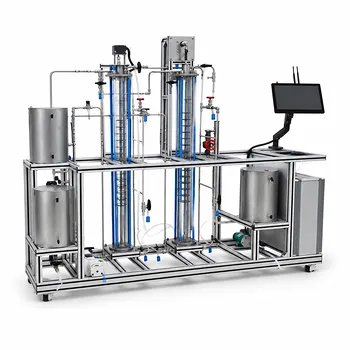
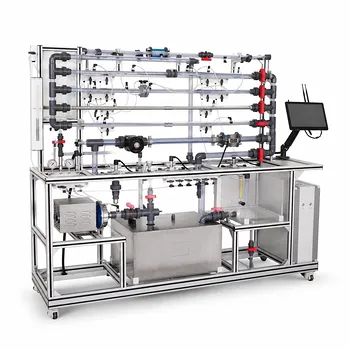
Lead lining in the lead-chamber process is a perfect illustration of passive corrosion protection, a core material selection principle. When lead contacts sulfuric acid, it instantly forms a tenacious, insoluble layer of lead sulfate (PbSO₄) that clings to the surface and stops further attack. In vocational unit operations pilot plants, this same principle is taught through hands‑on experience, where students see how industrial‑grade materials like borosilicate glass, PTFE, and corrosion‑resistant alloys are chosen based on process conditions, safety, and long‑term integrity.
The lead‑chamber process shows that the best material for a corrosive fluid is not the one with the lowest cost, but the one that reacts in a way that protects itself. Modern pilot plants turn this historical insight into a living lesson, letting technicians evaluate material compatibility under real process conditions while embedding safety, transparency, and industrial durability into every component.
How the Lead‑Chamber Process Became a Masterclass in Material Selection
The Chemistry of Self‑Defense
When sulfuric acid meets metallic lead, a rapid surface reaction forms a dense, impermeable crust of lead sulfate (PbSO₄).
This passive layer is chemically stable and mechanically robust, effectively sealing the underlying metal from further corrosion.
The process does not rely on an external coating or inhibitor—it is an innate, self‑healing property of the material itself.
From Empirical Rule to Systematic Principle
Early chemical engineers may not have had modern corrosion diagrams, but they understood that lead “held up” in acid chambers.
Today, we recognise this as a thermodynamically driven passivation mechanism, where the corrosion product becomes a protective barrier rather than a source of continued degradation.
It illustrates a core tenet of material selection: choose a material whose reaction with the process fluid yields a stable, adherent solid, not a soluble or friable one.
Why This Example Still Resonates in Education
The lead‑chamber case is easy to visualise and hard to forget, making it an excellent teaching tool.
It demonstrates that material selection is not about finding an “inert” substance—often no truly inert option exists—but about managing the inevitable interaction between the material and its environment.
That mindset directly transfers to today’s challenges, where engineers must select alloys, polymers, or ceramics based on their specific passivation, leaching, or swelling behaviour.
Vocational Pilot Plants: Where Material Selection Principles Become Tangible
Replicating the Lead‑Chamber Lesson with Modern Materials
Vocational pilot plants are not built from lead, but they use the same principle of passive protection through carefully chosen industrial materials.
For acid streams, borosilicate glass, PTFE linings, and corrosion‑resistant alloys like Hastelloy or tantalum serve as modern equivalents—each chosen because of their specific surface chemistry and mechanical strength.
By running a sulfonation or esterification demonstration, students witness how the fluid composition, temperature, and concentration dictate which material survives.
Safety and Integrity as Primary Teaching Objectives
Pilot plant design explicitly mirrors industrial practice: material selection must guarantee mechanical integrity and personnel safety.
Components under pressure, such as reactors or heat exchangers, require certified pressure relief valves and burst discs, teaching students that material choice is meaningless without appropriate safety apparatus.
All wetted parts must withstand not only the test fluid but also prolonged exposure, cleaning cycles, and accidental excursions.
Learning Through Visual Observation
Modern pilot plants incorporate transparent sections—glass columns in distillation or absorption units—to allow direct observation of hydrodynamics.
This transparency teaches a material‑selection trade‑off: glass provides visibility and chemical resistance but cannot handle high pressure or impact, while steel offers strength but zero visibility.
Understanding this balancing act builds the same kind of engineering judgment required when historical plants chose lead for its self‑healing passivation layer while accepting its mechanical softness and toxicity.
Key Material Principles Reinforced by Pilot‑Scale Training
The Lattice Structure Determines Low‑Temperature Behaviour
Supplementary teaching in vocational plants often covers cryogenic or low‑temperature operations (below 10°C).
Carbon steel, with its body‑centered cubic (BCC) lattice, undergoes a ductile‑to‑brittle transition and risks catastrophic fracture.
Austenitic stainless steels (face‑centered cubic, FCC) and certain aluminium alloys do not embrittle, making them mandatory for cold‑process pilot plants—a selection principle as fundamental as choosing lead for acid containment.
Chemical Compatibility Beyond Simple Corrosion
Students learn that compatibility extends beyond weight‑loss corrosion.
Heptane can generate static charge in glass vessels; certain polymers leach plasticisers that contaminate product streams; jacket heat‑transfer fluids can corrode external surfaces.
These subtleties parallel the lead‑chamber insight that a material’s entire reaction suite—not just its mechanical properties—dictates its suitability.
The Role of Industrial‑Grade Hardware
Unlike laboratory glassware, pilot‑scale units rely on glass‑lined steel, stainless steel grades 304 or 316, PTFE gaskets, and high‑nickel alloys.
Working with these materials drives home that process streams will interact with equipment over months or years, not minutes, so accelerated corrosion tests and long‑term data must back every choice.
This is the vocational embodiment of the lead‑chamber lesson: do not trust an overnight dip test; rely on the material’s proven, long‑term passive behaviour.
Understanding the Trade‑offs and Pitfalls
When a Passive Layer Is Not Enough
Lead’s sulfate layer is brilliant for dilute to moderately concentrated sulfuric acid, but it fails in hot, concentrated acid or in the presence of oxidising agents.
Vocational pilot plants expose students to similar limitations: even Hastelloy C has a useful temperature‑concentration window, and PTFE can cold‑flow under high pressure.
The lesson is critical: there is no universal material. Every choice has an operating envelope that must be respected.
The Price of Visual Transparency
Transparent borosilicate glass sections in pilot plants offer unparalleled insight but limit operating pressure and pose a fracture risk.
This mirrors the historical dilemma of lead chambers, where the ability to inspect the vessel’s condition had to be balanced against the risk of mechanical failure.
Modern safety protocols demand that transparent components be shielded and that pressure‑containing elements be metallic, teaching a hierarchical approach to risk management.
The Risk of Oversimplification
Some students might assume that if a material forms a protective layer, it is unconditionally safe—a dangerous misreading.
Vocational training counters this by making students measure corrosion rates under varying conditions and by confronting them with real‑world failures, such as crevice corrosion under gaskets even in corrosion‑resistant alloys.
This instills a mindset of continuous material surveillance, not one‑time selection.
Applying the Lead‑Lining Lesson to Modern Pilot‑Plant Material Choices
After absorbing these principles, choose materials for your pilot plant based on your specific educational or industrial goals.
Use the following focus areas to guide your selection process.
- If your primary focus is teaching corrosion fundamentals: Include a module with a glass‑walled vessel and interchangeable metal coupons (lead, carbon steel, stainless steel) exposed to dilute sulfuric acid. Students can measure weight loss and observe passive film formation directly.
- If your primary focus is process safety and transparency: Invest in pilot plants with certified pressure relief, burst discs, and transparent borosilicate sections. Ensure all pressure‑containing parts are metallic and that the transparent sections are properly guarded. This demonstrates that observation must never compromise protection.
- If your primary focus is handling low‑temperature or cryogenic fluids: Specify austenitic stainless‑steel vessels and piping, and supplement with Charpy V‑notch impact test data to prove the ductile‑to‑brittle transition temperature is well below your operating point. Avoid BCC metals entirely.
- If your primary focus is long‑term reliability with aggressive chemicals: Select wetted materials based on published corrosion‑resistance charts for the exact concentration and temperature. Include PTFE‑lined components for versatility, but teach students about cold‑flow and creep limitations. Always validate seal and gasket materials for both chemical attack and leaching.
The lead‑chamber process is not just a historical footnote—it is a living lesson that good material selection is about predicting and embracing the right reaction, not avoiding all reactions. By building that insight into every vocational pilot plant design, we equip the next generation of engineers with the judgment to choose materials that protect themselves, their processes, and the people who run them.
Summary Table:
| Aspect | Historical Lead-Chamber Process | Modern Vocational Pilot Plants |
|---|---|---|
| Primary Material | Metallic Lead (Pb) | Borosilicate glass, PTFE, Hastelloy, Stainless Steel |
| Protection Mechanism | Passive Lead Sulfate ($PbSO_4$) layer | Inert linings, corrosion-resistant alloys, passivation |
| Engineering Trade-off | Self-healing chemistry vs. toxicity & softness | Visibility (glass) vs. mechanical strength (steel) |
| Educational Value | Classic case of passivation chemistry | Hands-on assessment of material compatibility & safety |
Bring Industrial Reality to Your Lab with LABPARK
Ready to bridge the gap between chemical theory and modern engineering practice? LABPARK provides state-of-the-art Educational and Vocational Unit Operations Pilot Plants in chemical engineering, bioprocess & biotech, and environmental & water treatment.
We empower universities, research institutes, and enterprises with hands-on training platforms designed for safety, transparency, and real-world material selection experience.
Contact LABPARK today to customize your pilot plant solutions!
Related Products
- Comprehensive Liquid-Liquid Extraction Pilot Plant for Engineering Education
- Polymerization Granulation and Pellet Processing Educational Unit Operations Pilot Plant
- Electrolyte Distillation Purification and Formulation Educational Pilot Plant
- Natural Product Extraction Unit Operations Training Pilot Plant
- Multi-Functional Special Distillation Educational Pilot Plant
People Also Ask
- How do pilot plants differentiate physical vs chemical extraction? Enhance Chemical Engineering Training
- How are ternary phase diagrams and LLE data applied in extraction experiments? Optimize Pilot Plant Scale-up
- In a liquid-liquid extraction pilot plant, how is a ternary-phase diagram utilized to determine solvent feed requirements?
- How to Validate BIPs for LLE Pilot Plants? Steps to Align Simulations with Reality
- How Do Selectivity & Distribution Coefficients Influence LLE Pilot Plant Solvent Choice?