Predicting the solubility of a compound in binary solvent mixtures transforms solvent selection from an empirical guessing game into a rational, data-driven design process.
By computationally mapping solubility across temperature and composition space, engineers can identify the optimal solvent ratio for crystallization or extraction before ever stepping into the pilot plant. This approach screens out ineffective mixtures, avoids phase separation issues, and directly ties molecular-level thermodynamics to macroscopic process performance.
Solubility prediction in binary mixtures serves as a process compass. It removes the guesswork from solvent selection, prevents costly operational failures like oiling out, and aligns solvent properties with the chosen crystallization or extraction method—all while minimizing chemical waste and experimental iterations.
The Computational Advantage in Solvent Screening
Replacing Trial-and-Error with Thermodynamic Models
Traditional solvent selection relies on extensive trial-and-error, consuming time, materials, and pilot plant capacity. Computational thermodynamics, such as COSMO‑RS, calculates chemical potentials and estimates the free energy of fusion to predict solubility limits directly.
This allows researchers to screen dozens of binary compositions in silico, focusing physical runs only on the most promising candidates.
Mapping Solubility Landscapes Across Composition
A binary mixture’s solubility profile can exhibit peaks, plateaus, or sharp drops as the solvent ratio changes. Predictive models generate full solubility curves as a function of composition, revealing the maximum achievable concentration or the point where yield collapses.
Mapping these landscapes lets you visualize the entire design space of a crystallization or extraction step, making it easy to compare the thermodynamic sweet spot against practical constraints like solvent recovery cost.
Translating Predictions to Pilot Plant Decisions
Once the solubility landscape is known, concrete pilot‑scale decisions follow. For example, if the model shows that solubility drops steeply at a specific water‑to‑acetonitrile ratio, the plant operator sets that as the operating point for maximum yield.
This direct link between molecular‑scale activity coefficients and macroscopic unit operation settings is precisely what enables systematic process development and reduces the number of physical runs.
Optimizing Crystallization Operations with Solubility Data
Selecting the Right Crystallization Method
The shape of the solubility curve relative to temperature dictates the crystallization method. If solubility increases sharply with temperature (e.g., potassium nitrate), cooling crystallization is the most energy‑efficient route.
If the curve is nearly flat (e.g., sodium chloride), evaporative crystallization becomes a necessity. Predictive solubility data instantly classifies the solute‑solvent system, letting you choose the correct pilot plant configuration—cooling jackets versus vacuum systems—before hardware is assembled.
Preventing Liquid‑Liquid Phase Separation (Oiling Out)
One of the most disruptive failures in a crystallization pilot plant is liquid‑liquid phase separation, or oiling out, where the solute forms a viscous second liquid phase instead of crystals.
Solubility models can calculate the BETA parameter, where a value of 1 indicates a single homogeneous phase and a value less than 1 signals two liquid phases. By maintaining BETA=1 across the operating composition, you guarantee a clean crystallization pathway.
Controlling Polymorphism and Yield
The solvent composition directly influences which conformational polymorph nucleates and grows. Solubility prediction reveals the population of specific molecular conformations in the saturated solution, helping to steer the process toward the desired polymorph.
Moreover, linearized van't Hoff relationships allow you to compute theoretical yield from the solubility difference at the dissolution and isolation temperatures, balancing yield, purity, and solvent load in one integrated calculation.
Applying Solubility Prediction to Liquid‑Liquid Extraction
Identifying Optimal Extraction Solvent Ratios
In extraction pilot plants, the capacity of a solvent to pull a target compound from a feed stream depends on the activity coefficient in the mixture. Predictive models screen binary or ternary solvent systems to maximize the partition coefficient without requiring extensive shake‑flask tests.
This enables rapid selection of the best extraction medium for reaction‑separation sequences, tying the thermodynamic preference directly to pilot‑plant throughput.
Minimizing Waste and Maximizing Throughput
When extraction and crystallization steps are coupled, the same solubility prediction that guides crystallization also informs the solvent‑recovery loop. You can choose a binary composition that satisfies both the extraction’s capacity needs and the downstream crystallization’s yield requirements.
This holistic view drastically reduces solvent waste, as only the most efficient, recyclable mixtures ever enter the pilot plant.
Understanding the Trade‑offs
The primary trade‑off is between prediction speed and absolute accuracy. While computational models like COSMO‑RS greatly reduce experimental effort, they still rely on assumptions about ideal mixing and may deviate from reality, especially for complex, highly non‑ideal mixtures.
Experimental validation of solubility for the final candidate composition remains essential. Additionally, the models require reliable input parameters—melting point, enthalpy of fusion—that may not be available for novel compounds, limiting their immediate applicability without supplementary measurements.
Another pitfall is that solubility prediction alone does not guarantee crystal form purity. Even if the solubility landscape is perfectly mapped, kinetics and nucleation rates can override thermodynamic predictions, so always couple solubility modeling with supersaturation control strategies to avoid metastable polymorph formation.
Making the Right Choice for Your Pilot Plant Goal
- If your primary focus is rapid solvent screening: Use computational solubility models to rank dozens of binary compositions and shortlist only 2‑3 candidates for experimental verification.
- If your primary focus is preventing oiling out: Prioritize the BETA parameter from your model. Ensure the chosen binary composition stays in the single‑phase region throughout the entire temperature trajectory.
- If your primary focus is maximizing crystallization yield: Rely on van't Hoff solubility curves to calculate theoretical yield and select a solvent ratio where solubility drops steeply upon cooling or anti‑solvent addition.
- If your primary focus is controlling conformational polymorphism: Examine the model’s conformational population data for the saturated solution environment to steer nucleation toward the desired polymorph.
- If your primary focus is integrating extraction and crystallization: Use the same solubility predictions to balance the partition coefficient in the extractor with the downstream yield in the crystallizer, minimizing overall solvent inventory.
Effective solvent selection and optimization in pilot plants no longer need to be a blind search; solubility prediction provides the roadmap, bridging the gap between thermodynamic theory and practical process performance.
Summary Table:
| Pilot Plant Operation | Solubility Application | Key Benefit |
|---|---|---|
| Crystallization | Analyze curves & BETA parameter | Selects optimal method & prevents oiling out |
| Extraction | Screen partition coefficients | Maximizes throughput & solvent recovery |
| Process Design | Computational modeling (COSMO-RS) | Replaces trial-and-error, reducing waste |
Bring Thermodynamic Precision to Your Lab
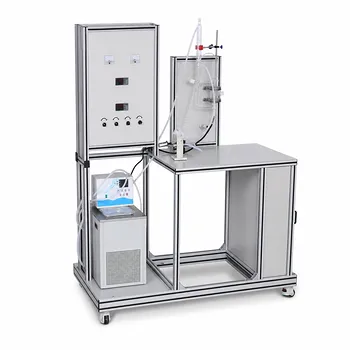
At LABPARK, we provide state-of-the-art Educational and Vocational Unit Operations Pilot Plants in chemical engineering, bioprocess & biotech, and environmental & water treatment. Designed specifically for universities, research institutes, and enterprises, our pilot plants empower you to seamlessly transition from computational solubility predictions to physical process validation.
Ready to scale up your crystallization and extraction processes with confidence? Contact LABPARK today to find the perfect pilot plant solution for your facility!
Related Products
People Also Ask
- How can pilot plants assist in validating VLE models? Bridge theory and physical reality.
- Why Collect Isothermal vs. Isobaric VLE Data? Key Pilot Unit Advantages
- How Do Equations of State Predict VLE in Pilot Plants? Optimize Your Separation Design
- How do intermolecular forces and molecular kinetic energy govern gas liquefaction and vaporization? Explore VLE pilot plants
- For VLE Experiments: Fugacity vs. Activity Coefficient Method Selection Criteria