The core modeling challenge with polar fluid mixtures isn’t a lack of theory—it’s a fundamental breakdown of convergence. Standard thermodynamic perturbation theory expands the Helmholtz free energy in a series, but for strongly polar molecules like water or ammonia, that series diverges when truncated at the third order. The Padé approximation solves this by recasting the divergent expansion as a rational function of the second- and third-order perturbation terms, delivering convergent, highly accurate predictions for vapor-liquid equilibria and configurational internal energy in mixtures with strong dipole and quadrupole moments.
Standard perturbation expansions fail for polar fluid mixtures because the series doesn’t converge; the Padé approximation replaces the expansion with a rational function that resums the divergent terms, directly enabling robust and accurate modeling of critical unit operation properties like phase equilibrium and energy balances.
Why Standard Perturbation Theory Fails for Polar Fluids
The accuracy of a process simulation hinges on the thermodynamic model’s ability to capture molecular interactions. For highly polar mixtures, the traditional approach falls apart precisely when it’s needed most.
The Illusion of a Convergent Series
Perturbation theories start with a simple reference fluid and add corrections as a power series in a perturbation parameter. Truncating after the third-order term works beautifully for weakly polar or nonpolar systems. But for strong dipole and quadrupole forces, the series is not convergent—each higher-order term can grow, making the truncated sum increasingly unreliable.
Why Polar Molecules Break the Mold
Polar molecules exert long-range, orientation-dependent forces that are orders of magnitude stronger than dispersion interactions. In water or acetone, dipole-dipole and quadrupole-quadrupole contributions dominate the fluid structure. A simple third-order truncation cannot capture the collective effect of these many-body interactions, leading to gross errors in predicted phase behavior and energetic properties.
How the Padé Approximation Rescues the Calculation
Instead of abandoning perturbation theory, the Padé method applies a clever mathematical transformation that captures far more physics from the same low-order terms.
A Rational Function That Tames Instability
The Padé approximation expresses the Helmholtz free energy as a ratio of polynomials built from the second-order (A₂) and third-order (A₃) perturbation coefficients. The most common form, a [2,1] Padé approximant, is:
[ A = A_0 + \frac{A_2}{1 - (A_3/A_2)} ]
This rational function effectively sums an infinite subset of higher-order terms in the divergent series, yielding a finite, well-behaved result even when the simple sum of A₂ + A₃ blows up.
From Divergence to Physical Convergence
By re-casting the series as a fraction, the Padé approximation captures the dominant physics of dipole and quadrupole alignment without needing explicit high-order terms. It naturally avoids the oscillatory or divergent behavior seen in truncated series, producing convergent free energies for fluids with dipole moments that would otherwise break the calculation. This mathematical sleight moves the model from “not usable” to “engineering-accurate.”
The Direct Impact on Unit Operation Modeling
This improved theoretical accuracy translates into reliable predictions for the properties that control equipment design and scale-up.
Precise Vapor-Liquid Equilibrium Prediction
Distillation, absorption, and stripping columns are designed around phase equilibrium curves. For a polar mixture like ammonia-water, a standard third-order model can mispredict the azeotropic composition or relative volatility. The Padé-based model corrects this, delivering VLE data that allows engineers to determine realistic stage counts, reflux ratios, and column diameters in pilot-plant studies.
Reliable Configurational Internal Energy
Reactor design and heat exchanger sizing require accurate configurational internal energies. This property captures the energetic contributions from molecular packing and orientation. By accurately modeling these for strongly polar mixtures, the Padé approach ensures that heat duties, temperature profiles, and reaction enthalpy balances are grounded in physically correct energy landscapes, not numerical artifacts.
Understanding the Trade-offs and Limitations
While the Padé approximation dramatically improves accuracy, it’s not a universal panacea. Deploying it effectively requires awareness of its boundaries.
Dependence on the Quality of A₂ and A₃
The Padé approximant is only as good as the second- and third-order terms fed into it. If the reference potential or the perturbation treatment is poorly chosen, the rational function can still yield incorrect results—it will just converge to the wrong answer. The accuracy of the input coefficients remains a critical prerequisite.
Potential Singularities in the Rational Form
A [2,1] Padé approximant can exhibit a spurious pole if the denominator approaches zero (when A₃ ≈ A₂). For most physical fluids this does not occur, but in some regions of the phase diagram—especially near critical points or for extreme dipole strengths—the approximation may break down or require a more robust functional form. Monitoring the denominator is essential.
Not a Substitute for Full Non-Perturbative Methods
For the very strongest polar interactions or for systems where the reference fluid is a poor match, even the Padé-resummed perturbation theory may not be sufficient. In those cases, fully non-perturbative approaches like integral equation theory or molecular simulation might be necessary for ultimate fidelity.
Making the Right Choice for Your Modeling Goal
Applying this knowledge in a research or pilot-plant setting boils down to matching the modeling tool to the specific unit operation need.
- If your primary focus is designing a distillation or absorption column for a polar mixture: Use a thermodynamic model that incorporates the Padé approximation. It ensures the vapor-liquid equilibrium data driving your column simulations is physically converged, avoiding costly over- or under-design.
- If your primary focus is sizing a reactor or heat exchanger involving highly polar fluids: Rely on a Padé-based model for configurational internal energy to generate accurate heat duty predictions. Standard third-order truncations can lead to significant errors in temperature-dependent reaction rates and energy balances.
- If your primary focus is early-stage screening of polar solvent candidates: A Padé-enhanced perturbation theory offers a computationally light but physically reasonable way to rank solvents by relative volatility or mixture enthalpy, much faster than full-blown molecular simulation.
The Padé approximation doesn’t merely tweak a number; it transforms a broken mathematical series into a convergent, engineering-grade prediction that aligns your process design with the true thermodynamic behavior of polar mixtures.
Summary Table:
| Feature / Aspect | Standard Perturbation Theory | Padé Approximation [2,1] |
|---|---|---|
| Mathematical Form | Power series truncation (e.g., $A_0 + A_2 + A_3$) | Rational function: $A_0 + \frac{A_2}{1 - (A_3/A_2)}$ |
| Convergence | Diverges for strongly polar fluids (water, ammonia) | Resums divergent terms to achieve physical convergence |
| VLE Prediction | High error in relative volatility and azeotropes | Precise vapor-liquid equilibrium for column design |
| Energy Calculations | Unreliable configurational internal energy | Accurate heat duties and reactor energy balances |
| Limitations | Fails completely for strong dipole/quadrupole forces | Dependent on quality of $A_2, A_3$; potential spurious poles |
Bridge Advanced Thermodynamics with Hands-On Validation
Translating complex thermodynamic theories like the Padé approximation into practical engineering skills requires robust physical systems. LABPARK provides state-of-the-art Educational and Vocational Unit Operations Pilot Plants in chemical engineering, bioprocess & biotech, and environmental & water treatment.
Specifically engineered for universities, research institutes, and enterprises, our pilot plants allow students and researchers to validate phase equilibria, mass transfer, and energy balances in real-time.
Contact LABPARK today to find the perfect pilot plant system to elevate your academic curriculum or research capabilities!
Related Products
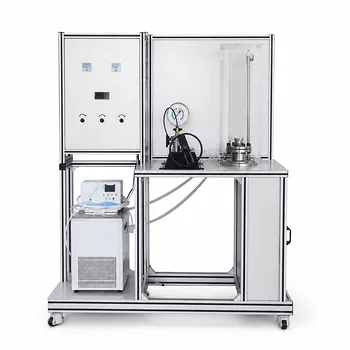
- Carbon Dioxide PVT Curve Determination Educational Unit Operations Pilot Plant
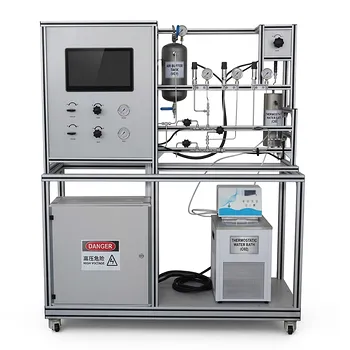
- Throttling Effect Determination Educational Unit Operations Pilot Plant
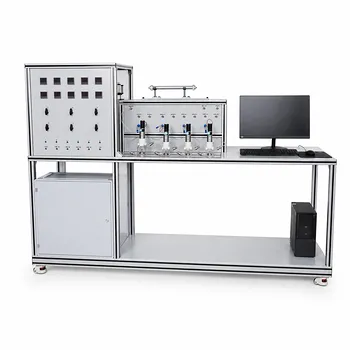
- Gas Phase Mixing and Residence Time Distribution Determination Educational Unit Operations Pilot Plant
People Also Ask
- How do temperature variations affect CO2 transport models in pilot plants? Model vs Reality
- What unit operations are critical for CCUS training pilot plants? Build hands-on engineering expertise.
- What are the applications and limitations of the Virial EOS? Enhance Your Pilot Plant Lab
- What precautions prevent sample loss when volatilizing silica with HF? Crucial Steps for Safe Lab Training
- Why is selecting the correct EOS critical in pilot plants? PR vs. SRK compared.