The minimum temperature approach is the single most critical parameter that defines the economic boundary between energy recovery and equipment size. When you reduce ΔT_min, you recover more heat internally, which slashes the amount of expensive steam and cooling water you need—but the smaller temperature driving force forces you to build much larger, costlier heat exchangers. Conversely, choosing a larger ΔT_min keeps equipment compact and affordable, yet it pushes your utility bills higher because you must rely more on external heating and cooling. The art is to find the ΔT_min that minimizes the sum of those two opposing costs.
ΔT_min is a design lever that directly trades operating expenses (hot and cold utilities) against upfront capital (heat exchanger area). Lowering it reduces utility costs but drives up equipment size and investment; raising it does the opposite. The optimal choice isn’t the extreme—it’s the value that brings total cost to its lowest point, which for most chemical processes falls between 10°C and 30°C.
The Fundamental Role of ΔT_min in Heat Integration
What is the Minimum Temperature Approach?
The minimum temperature approach (ΔT_min) is the smallest temperature difference allowed between a hot stream and a cold stream at any point inside a heat exchanger or across an entire heat exchanger network. It sets the thermodynamic limit on how much heat can be shifted from one stream to another without violating the second law—meaning you can never bring the streams closer than this chosen threshold.
Driving Force and Heat Recovery
Heat flows only when a temperature gradient exists. A smaller ΔT_min allows streams to approach each other more closely, so you can extract more energy from the hot stream before discharging it. This directly raises the amount of internally recovered heat, which displaces hot utilities like high-pressure steam and cold utilities like cooling water—shrinking your plant’s energy bill. In a typical process, tightening ΔT_min from 20°C to 10°C can slash external heating demand by 20–30%, a huge operational saving.
The Capital Cost Consequence: Heat Exchanger Sizing
Why Smaller ΔT_min Demands Larger Equipment
The fundamental heat transfer equation, Q = U × A × ΔT_lm, reveals the penalty. When ΔT_min drops, the log-mean temperature difference (ΔT_lm) across the exchanger shrinks. To still transfer the same heat duty Q with a given overall heat transfer coefficient U, the area A must grow. That larger surface means more tube length, wider shells, and heavier structures—pushing capital cost upward, often non-linearly.
The Exponential Penalty of Narrow Approaches
Chasing an ultra-low ΔT_min is a classic trap. In air-cooled exchangers, for instance, trying to cool a process stream to within 5–10°F of the ambient air temperature can easily require more than half the total tube bundle just to capture those final few degrees. The area—and cost—climbs exponentially, making the unit physically enormous and economically irrational. That’s why practical design rules call for a minimum approach of at least 15°F (preferably 20°F or more) for air coolers; if deeper cooling is needed, a secondary water-cooled trim cooler becomes the sensible solution.
Understanding the Trade-offs
The Total Cost U-Curve
When you plot annualized utility cost and annualized capital cost against ΔT_min, they pull in opposite directions. Utility cost falls as ΔT_min shrinks, while capital cost rises steeply. Summing them gives a U-shaped total cost curve with a well-defined minimum. That optimum—often between 10°C and 30°C for many chemical processes—tells you where the incremental capital you’d spend on a larger exchanger would no longer be justified by the utility savings.
Practical Design Considerations for Pilot and Teaching Plants
In pilot-scale or educational unit operations, the economic optimum can be overshadowed by physical reality. An exchanger designed with a very tight ΔT_min may be proportionally enormous relative to the rest of the rig, making it expensive to fabricate and difficult to house. Designers therefore tend to select a more generous ΔT_min—such as 15–20°F for air-cooled services—and then supplement the system with small electric trim heaters or chilled-water trim coolers to hit the final target temperatures. This keeps the main exchangers realistically sized while still delivering the required process conditions.
Common Pitfalls to Avoid
Chasing Unrealistically Low ΔT_min
It’s tempting to view the tightest possible temperature approach as a mark of efficiency. But a design that pushes ΔT_min to 5°C or lower often produces a heat exchanger so large that it becomes mechanically fragile, sensitive to fouling, and hard to clean. Worse, any slight fouling reduces the effective temperature difference still further, potentially halting operations. Real plants need robustness and maintainability, not just perfect thermodynamics on paper.
Ignoring Utility Cost Fluctuations
An optimal ΔT_min calculated at one energy price may become obsolete when that price changes. Designing with a razor-thin ΔT_min to save steam that later becomes cheap can strand capital in oversized exchangers that never pay back. Conversely, if energy costs surge after the plant is built, a conservative, high ΔT_min can cripple profitability. A robust approach is to test the design against a range of energy scenarios and ensure that the chosen ΔT_min performs acceptably across them.
Making the Right Choice for Your Goal
Your choice of ΔT_min should directly support what matters most in your project—whether that’s low operational expense, tight capital control, or realistic pilot-scale feasibility.
- If your primary focus is minimizing long-term energy bills: Lean toward a smaller ΔT_min within practical limits (e.g., 10–15°C), accepting larger exchangers up front to maximize internal heat recovery and shrink utility consumption year after year.
- If your primary focus is controlling initial capital investment: Pick a larger ΔT_min (e.g., 20–30°C) to keep heat exchangers compact and purchase costs down, while budgeting for the higher ongoing steam and cooling water usage.
- If your primary focus is designing a pilot or teaching unit with manageable size and cost: Adopt a conservative ΔT_min of at least 15–20°F for air-cooled streams and integrate auxiliary trim heaters or coolers for the final temperature touch-up; this keeps the main exchangers realistically sized and the system easy to operate.
By treating ΔT_min not as a fixed number but as a strategic design variable, you can tailor your heat exchanger network to strike the exact balance between energy performance and capital outlay your project demands.
Summary Table:
| ΔT_min Selection | Heat Recovery (OpEx) | Exchanger Size (CapEx) | Operational Robustness | Typical Application |
|---|---|---|---|---|
| Low (5–10°C) | High (Lower utility bills) | Large (High upfront cost) | Low (Sensitive to fouling) | High energy-cost processes |
| High (20–30°C) | Low (Higher utility bills) | Small (Low upfront cost) | High (More robust) | Capital-constrained projects |
| Pilot / Teaching | Moderate | Compact (Saves lab space) | High (Easy to clean & run) | Educational & research labs |
Bring Practical Thermodynamics to Life with LABPARK
Designing chemical engineering curricula or research setups requires balancing thermodynamic principles like $\Delta T_{min}$ with physical space and budget constraints. LABPARK designs and manufactures premium Educational and Vocational Unit Operations Pilot Plants across chemical engineering, bioprocess & biotech, and environmental & water treatment.
We help universities, research institutes, and enterprises equip their labs with scaled, highly visible, and robust pilot systems that make complex heat transfer and unit operations concepts easy to teach and study.
Ready to upgrade your training or research facility? Contact LABPARK today to find the perfect pilot plant configuration for your goals!
Related Products
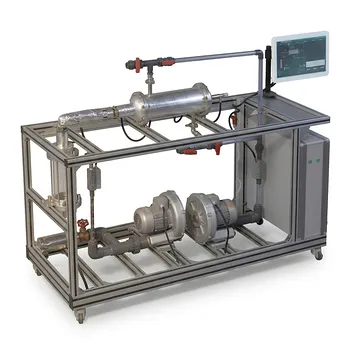
- Shell and Tube Heat Exchanger Heat Transfer Coefficient Determination Educational Pilot Plant
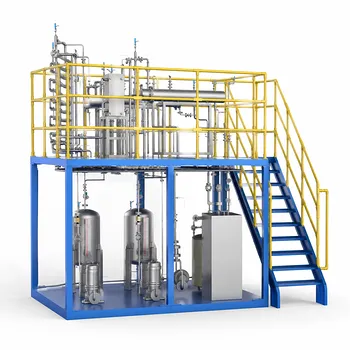
- Comprehensive Multi-Modal Heat Transfer Unit Operations Pilot Plant for Engineering Training
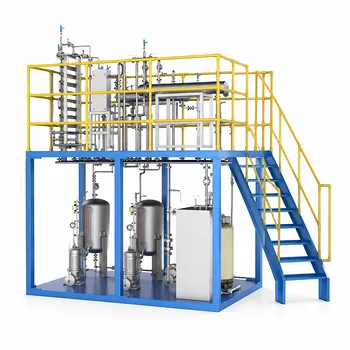
- Dual Mode Heat Transfer Pilot Plant for Unit Operations Training
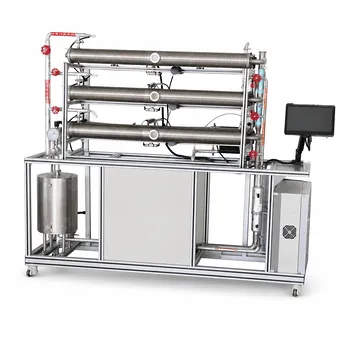
- Three-Tube Heat Transfer Educational Pilot Plant for Unit Operations Training
- Comprehensive Heat Transfer Coefficient Determination Educational Unit Operations Pilot Plant
People Also Ask
- Why Apply LMTD Correction in Shell-and-Tube Pilot Plants & How to Determine It
- How is the fouling factor (Rd) evaluated? Key Pilot Plant Insights for Students
- How is fouling factor demonstrated using shell and tube pilot plants? Practical Lab Guide
- Why is simulating and calculating fouling factors crucial when operating educational heat exchanger pilot plants?
- Why Keep Shell-Side Reynolds Number Above 2100? Maximize Pilot Plant Heat Transfer