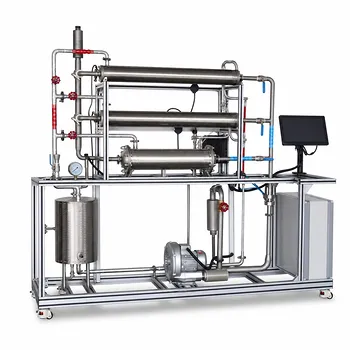
Fouling factor (RDT) acts as a direct throttle on thermal performance. When RDT increases in an air-cooled heat exchanger, it degrades the overall heat transfer coefficient, forcing the process outlet temperature to rise because less heat is being removed. For laboratory study, this isn't just an abstract concept—it's the critical variable that transforms a theoretical design equation into a living model of industrial decay, allowing operators to predict exactly when an exchanger will fail to meet its required process specifications.
The core insight is that fouling factor is not a static safety margin; it’s a dynamic resistance that controls the fate of your process temperature. In a pilot plant, manipulating RDT reveals the hidden relationship between tube-wall buildup and the exchanger’s ability to cool—showing exactly how much excess surface area (overdesign) is consumed before the system falls out of spec. This makes lab study essential for learning predictive maintenance and performance rating.
The Thermal Mechanism of Fouling
To understand why the outlet temperature creeps up, you must first see fouling for what it truly is: an unwanted insulating blanket on the heat transfer surface. This section breaks down the physics that connect a dirty tube to a failing process.
Fouling is an Added Resistance, Not Just Dirt
The fouling factor (RDT) is the quantified thermal resistance of the deposit layer. It has the inverse relationship of a heat transfer coefficient: a high RDT means a low fouling heat transfer coefficient (hd = 1/RDT).
In a clean exchanger, heat must only overcome the resistances of the process fluid film, the tube wall, and the air-side film. Adding fouling inserts a new, dominant resistance in series. This directly impedes the flow of energy from the hot process fluid to the cooling air.
How RDT Dictates the Overall Heat Transfer Coefficient (Ux)
The overall heat transfer coefficient (Ux) is a composite measure of an exchanger’s ability to transfer heat. The fouling factor directly attacks this value.
The fundamental relationship shows that the "dirty" overall coefficient (Ud) is always lower than the "clean" one (Uc). When you artificially increase RDT in a simulation—say, from 0.001 to 0.002—the resulting Ud drops sharply. This degradation means every square meter of tube surface becomes less effective at its job.
The Inevitable Consequence: Rising Process Outlet Temperature
If the exchanger’s surface area becomes less effective (lower Ux), it transfers less total heat (Q). Since the process stream’s mass flow and inlet temperature are fixed, a drop in heat transfer dictates a single outcome.
The process fluid must leave the exchanger hotter than designed. For example, practical data shows that a fouling factor shift from 0.001 to 0.004 can spike the process outlet temperature from 164°F to 187°F. The RDT doesn't just indicate fouling; it is the predictor of a process-temperature failure.
Why the Laboratory is the Critical Battleground
Calculating RDT on paper is a sterile exercise. The laboratory transforms it into a visceral lesson on industrial survival, bridging the gap between theoretical perfection and degraded reality.
Closing the Gap Between "Clean" and "Dirty" Design
Textbooks teach the clean overall heat transfer coefficient (Uc), but industrial exchangers never operate cleanly for long. The lab is the only place to safely observe this transition.
A pilot plant allows students to first calculate Uc from fundamental film coefficients (hi, ho) and tube geometry under controlled, clean conditions. They then run the system long enough to witness Ud decay in real-time. By calculating the fouling factor through Rd = (Uc - Ud) / (Uc * Ud), the abstract formula becomes a measured symptom of accumulating scale.
Mastering the "Rating" Analysis for Failure Prediction
The most critical engineering skill is not design, but rating: determining if an existing, fouled unit can still do its job. The primary purpose of a pilot plant is to simulate this forensic analysis.
By inputting a hypothetical fouling factor (e.g., RDT = 0.004) into the rating algorithm, students predict a new, dangerous process outlet temperature. They then compare this prediction against the actual process requirement. This teaches the concept of maximum allowable fouling—the exact point of thermal resistance at which the heat exchanger fails to cool the process fluid sufficiently and must be shut down for cleaning.
Linking Thermal Signals to Physical Reality
The process outlet temperature is a direct observable signal of the hidden fouling layer. The laboratory closes this control loop.
When standard operating data—flow rates and terminal temperatures—show the process outlet temperature consistently rising above the design point, it’s a diagnostic. The lab operator learns to interpret this thermal signal as a direct measurement of the RDT increase. They don't need to see the scale; they can calculate its thermal impact and make the operational decision to increase fluid velocity for mitigation or schedule a cleaning cycle.
Understanding the Trade-offs: The Overdesign Dilemma
The solution to fouling is not to eliminate it entirely; that’s often impossible. The solution is strategic overdesign, which comes with its own profound trade-offs that must be studied in the lab.
The High Cost of the Safety Margin
To compensate for a design fouling factor (like 0.001 for light distillates such as naphtha), engineers specify extra tube surface area. The lab visually demonstrates the consequence of this choice.
A higher RDT requires an exponentially larger, heavier, and more expensive exchanger. The pilot plant data shows that designing for massive fouling (an RDT of 0.02) results in a unit that is not only costly but also performs terribly under clean conditions, possibly cooling the process fluid too much. The core lesson is an economic one: you are trading capital cost (extra surface) against operational cost (cleaning frequency).
The Clean-Condition Performance Penalty
An exchanger heavily overdesigned for a dirty state will behave abnormally when clean. This is a nuanced truth often missed in theory.
In the lab, you can observe that a unit with a very large safety margin may initially overcool the process stream. This can lead to operational issues like increased fluid viscosity, wax precipitation, or thermal shock in downstream equipment. The study of fouling factor thus becomes a study in managing an aging system, not just building a static one, forcing students to balance the competing needs of end-of-run performance and start-of-run stability.
How to Apply This to Your Project
Whether you are designing an experiment or managing a full-scale asset, the focus must be on translating the fouling factor into a direct operational forecast.
- If your primary focus is predicting maintenance windows: Use your pilot plant to establish a direct correlation between RDT increase and process outlet temperature rise; this trend line is your maintenance trigger.
- If your primary focus is validating a new heat exchanger design: Calculate the required Uc, then apply your historical RDT value to find Ud, and verify in the lab that the resulting outlet temperature meets your process limit with an acceptable margin.
- If your primary focus is optimizing operational response: Use the pilot plant to demonstrate that increasing fluid velocity to promote turbulence can reduce the rate of RDT deposition, proving that you can manage fouling dynamically rather than just designing passively for it.
The fouling factor is the single most honest number in your heat exchanger’s lifecycle, translating the invisible, inevitable decay of the surface into the visible, actionable outcome of your process temperature.
Summary Table:
| Parameter / Metric | Clean Condition (Low RDT) | Fouled Condition (High RDT) | Laboratory & Practical Significance |
|---|---|---|---|
| Fouling Factor (RDT) | Minimal (RDT ≈ 0) | High (e.g., 0.004) | Represents the dynamic thermal resistance of tube scale buildup. |
| Overall Heat Transfer (Ud) | Maximum (Ud = Uc) | Significantly degraded | Demonstrates the decay from theoretical design to real-world operation. |
| Outlet Process Temp | Low / Design target | Elevated (e.g., 187°F) | Serves as the primary diagnostic signal to trigger maintenance. |
| Operational Strategy | Standard operation | Requires cleaning or higher velocity | Teaches predictive maintenance and the cost of equipment overdesign. |
Bridge Theory and Industrial Reality with LABPARK Pilot Plants
Teaching or researching heat transfer dynamics requires hands-on tools that simulate real-world challenges like fouling, scaling, and thermal degradation. LABPARK provides advanced Educational and Vocational Unit Operations Pilot Plants in chemical engineering, bioprocess & biotech, and environmental & water treatment tailored for universities, research institutes, and enterprises.
With our high-fidelity pilot scale systems, your students and researchers can dynamically manipulate parameters like the fouling factor ($R_{DT}$), analyze overall heat transfer coefficients, and master industrial predictive maintenance workflows.
Ready to upgrade your laboratory capabilities? Contact our experts today to find the perfect pilot plant solution for your institution!
Related Products
- Shell and Tube Heat Exchanger Heat Transfer Coefficient Determination Educational Pilot Plant
- Comprehensive Multi-Modal Heat Transfer Unit Operations Pilot Plant for Engineering Training
- Dual Mode Heat Transfer Pilot Plant for Unit Operations Training
- Three-Tube Heat Transfer Educational Pilot Plant for Unit Operations Training
- Circulating Wind Tunnel Drying and Convective Heat Transfer Coefficient Determination Educational Pilot Plant
People Also Ask
- Why Apply LMTD Correction in Shell-and-Tube Pilot Plants & How to Determine It
- How is the fouling factor (Rd) evaluated? Key Pilot Plant Insights for Students
- How is fouling factor demonstrated using shell and tube pilot plants? Practical Lab Guide
- Why is simulating and calculating fouling factors crucial when operating educational heat exchanger pilot plants?
- Why Estimate Tube Wall Temp in Heat Exchangers? Master Pilot Plant Thermal Resistance