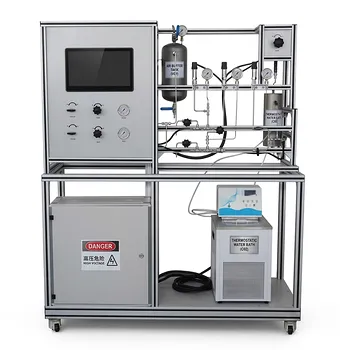
Radiant heating is generally more uniform and gentler than direct-contact platen heating in freeze-drying pilot plants. With radiant heating, hollow metal platens heated by circulating fluid transfer energy across the space between the platen and product tray, reducing the effect of tray surface irregularities. Direct contact can create localized hot spots where uneven tray surfaces touch the platen, increasing the risk of premature melting, scorching, discoloration, or thermal degradation.
Radiant heating separates heat delivery from imperfect physical contact, producing more consistent energy distribution, sublimation rates, and product temperatures. This makes it particularly advantageous for sensitive biological, pharmaceutical, and food materials.
Why Heating Uniformity Matters in Freeze-Drying
Sublimation requires controlled heat input
Freeze-drying removes water by sublimation: under deep vacuum, frozen water transitions directly from ice to vapor. The process operates at relatively low temperatures, but sublimation still requires a carefully controlled supply of thermal energy.
Too little heat can prolong the cycle and produce inconsistent drying. Too much heat can raise the product temperature beyond its safe limit, damaging the material or causing structural collapse.
Product temperature is not uniform by default
The product tray, frozen layer, and heating surface all have physical imperfections. Even small variations in flatness or surface contact can change how energy reaches different areas of the product.
A tray region with strong contact may receive substantially more heat than a region separated by a small gap. This creates temperature gradients across the batch.
Consistent heat improves reproducibility
Radiant transfer distributes energy across the tray without depending entirely on direct physical contact points. More consistent heating supports more reproducible sublimation rates from one sample location to another.
For pilot plants, this is important because the equipment is often used to compare formulations, test cycle parameters, and generate scale-up data. Variability caused by the heating interface can otherwise be mistaken for a product or process effect.
How Radiant Heating Differs From Direct Contact
Direct contact depends on surface quality
In direct-contact platen heating, the tray receives heat where it physically touches the heated platen. In an ideal system with perfectly flat, clean, and uniformly loaded surfaces, this can provide effective heat transfer.
Real trays almost always contain surface irregularities, warping, contamination, or imperfect loading. These conditions reduce the consistency of the contact interface and can create localized high-energy transfer points.
Radiant heating bridges small gaps
Radiant heating transfers energy from the heated hollow platen to the tray across small spaces rather than requiring complete surface contact. The tray therefore receives heat over a broader area, including regions that would otherwise be poorly coupled to the platen.
This reduces the influence of isolated contact points and helps avoid sharp local temperature increases.
Operators gain a wider operating margin
With direct contact, operators may need to limit platen temperature to protect the hottest contact areas. That restriction can slow sublimation in less-heated regions.
Because radiant heating reduces localized hot spots, the system can deliver the required thermal input with better control over maximum product temperature. The practical advantage is not simply higher temperature, but more predictable temperature distribution.
Why Sensitive Materials Benefit
Biological products can degrade thermally
Biological materials, pharmaceutical actives, and other delicate compounds may lose activity when exposed to excessive temperature. A localized hot spot can be damaging even when the average batch temperature appears acceptable.
Radiant heating lowers the likelihood that a small region will exceed its thermal limit. This helps preserve product potency, structure, and functional performance.
Food ingredients can lose quality
Sensitive food ingredients may suffer from scorching, discoloration, loss of volatile components, or degradation of active compounds when heating is uneven.
More uniform energy delivery helps maintain consistent appearance and composition across the tray. This is especially valuable when evaluating food formulations or active ingredients in pilot-scale experiments.
Product structure is better protected
Excessive heating during sublimation can cause melting or partial collapse of the frozen matrix. Once the structure collapses, vapor flow can become more restricted and the final dried product may have poorer reconstitution or handling characteristics.
By limiting localized overheating, radiant heating supports more stable control of the product temperature and reduces the risk of structural damage.
What This Means for Pilot-Plant Operations
Cycle development becomes more reliable
Pilot plants are used to determine how shelf temperature, chamber pressure, product load, and drying time interact. If heat transfer varies significantly across the tray, the resulting data may be difficult to interpret.
Uniform radiant heating gives researchers a more stable thermal input. This makes it easier to distinguish true process behavior from artifacts caused by uneven tray contact.
Sample comparisons become fairer
When multiple formulations or operating conditions are tested simultaneously, each sample should experience a comparable thermal environment. Uneven direct contact can introduce position-dependent differences that compromise the comparison.
Radiant heating improves the consistency of the heating environment across samples and trays, strengthening the value of experimental results.
Scale-up decisions improve
Reliable pilot data supports better estimates of energy requirements, sublimation behavior, and cycle duration. It also helps identify temperature limits before the process is transferred to larger equipment.
The closer the pilot plant comes to delivering controlled, repeatable heat transfer, the more defensible the resulting scale-up decisions become.
Understanding the Trade-offs
Radiant heating is not automatically a complete solution
Radiant transfer reduces contact-related variability, but it does not eliminate all sources of nonuniformity. Chamber geometry, tray spacing, product thickness, emissivity, fluid temperature, vacuum conditions, and load arrangement can still affect heat transfer.
A well-controlled process therefore requires appropriate instrumentation and cycle development rather than relying on the heating mode alone.
Direct contact can be effective under controlled conditions
Direct-contact heating is not inherently unsuitable for freeze-drying. It can provide efficient heat transfer when shelves and trays are flat, clean, properly loaded, and well matched.
Its limitation in pilot-plant work is that small physical imperfections can have a disproportionate effect on local heat transfer. The method is more sensitive to equipment condition and tray-to-platen contact quality.
Higher platen temperature still requires caution
Radiant heating may allow more consistent thermal input, but increasing platen temperature can still overheat the product if the cycle is poorly designed. Product temperature must remain within the material's safe operating range throughout primary and secondary drying.
Operators should validate the process using product temperature measurements, pressure control, and visual or analytical quality assessments.
Making the Right Choice for Your Goal
The best heating approach depends on whether the priority is maximum thermal throughput, experimental reproducibility, or protection of the product.
- If your primary focus is protecting heat-sensitive biological or food materials: Use radiant heating to reduce localized hot spots and maintain a more uniform product temperature.
- If your primary focus is reproducible pilot-plant data: Favor radiant heating because consistent energy distribution makes sublimation rates and cycle comparisons more reliable.
- If your primary focus is efficient heat transfer with highly controlled equipment: Direct contact can be effective, provided tray flatness, cleanliness, loading, and temperature uniformity are carefully maintained.
- If your primary focus is cycle optimization and scale-up: Choose the heating arrangement that gives the most measurable and repeatable product-temperature profile under representative operating conditions.
For sensitive materials, radiant heating is advantageous because it makes thermal energy delivery more uniform, predictable, and less dependent on imperfect physical contact.
Summary Table:
| Aspect | Radiant Heating | Direct-Contact Platen Heating |
|---|---|---|
| Heat transfer | Transfers energy across small gaps | Depends on physical platen-to-tray contact |
| Temperature uniformity | More consistent across the tray | More sensitive to gaps, warping, and contamination |
| Hot-spot risk | Lower risk of localized overheating | Higher risk at strong contact points |
| Sensitive materials | Helps protect biological, pharmaceutical, and food products | Requires stricter temperature and surface control |
| Pilot-plant value | Supports reproducible cycles, fairer comparisons, and reliable scale-up data | Can be effective when trays and platens are flat, clean, and well matched |
| Key controls | Product temperature, chamber pressure, tray spacing, load arrangement, and emissivity | Tray condition, loading, contact quality, and temperature uniformity |
Develop More Reliable Freeze-Drying Processes with LABPARK
Are you developing or scaling freeze-drying processes for sensitive biological, pharmaceutical, food, or other heat-sensitive materials? LABPARK provides Educational and Vocational Unit Operations Pilot Plants for universities, research institutes, and enterprises, including freeze-drying systems designed to support controlled heat transfer, cycle development, process comparison, and scale-up studies.
Our pilot plants help you:
- Reduce hot-spot risks and protect product quality
- Generate more consistent sublimation and product-temperature data
- Compare formulations and operating conditions more fairly
- Optimize shelf temperature, chamber pressure, loading, and drying time
- Build more reliable evidence for scale-up and production decisions
Contact LABPARK to discuss your freeze-drying pilot-plant requirements and find a suitable solution for your teaching, research, or industrial process-development goals.
Related Products
- Multi-Functional Drying Educational Unit Operations Pilot Plant
- Rising and Falling Film Evaporation Educational Unit Operations Pilot Plant
- Natural Product Extraction Unit Operations Training Pilot Plant
- Green Anhydrous Ethanol Purification Extractive Distillation Unit Operations Training Pilot Plant
- Multi-Functional Special Distillation Educational Pilot Plant
People Also Ask
- Vacuum vs. Atmospheric Drying: How to Choose the Right Pilot Plant Configuration for Your Lab
- How do seasonal changes affect drying pilot plant blower requirements? Key sizing tips.
- Why is dry-basis moisture content preferred over wet-basis? Simplify your drying pilot plant balances.
- Why Does a Pilot Plant Solver Return a Singular Matrix Error, and How Can You Resolve It?
- How can unit operations pilot plants demonstrate simultaneous removal of light and heavy impurities? Configure a modular setup