An external pressure gradient controls both boundary-layer growth and transition by changing the boundary layer’s velocity profile and stability. A favorable pressure gradient, in which pressure decreases downstream (dp/dx < 0), accelerates the external flow, tends to keep the boundary layer thinner, and delays laminar-to-turbulent transition. An adverse pressure gradient, in which pressure increases downstream (dp/dx > 0), decelerates the flow, thickens the boundary layer, amplifies disturbances, and can trigger earlier transition and eventual separation.
In an educational pilot plant, pressure-gradient measurements explain why boundary layers do not grow at the same rate along a contoured surface. Pressure drops generally stabilize laminar flow, while pressure rises promote turbulence, boundary-layer thickening, and separation.
How the External Flow Controls the Boundary Layer
Pressure Is Imposed on the Boundary Layer
For flow over a contoured surface or airfoil, the inviscid outer flow establishes a pressure distribution, p(x), along the surface.
Within the thin boundary layer, pressure is approximately constant perpendicular to the wall. The external pressure gradient therefore becomes a direct forcing condition for the boundary-layer velocity field.
Boundary-Layer Thickness Changes Downstream
A boundary layer begins at the leading edge and normally grows as fluid moves downstream. Its thickness, commonly denoted by delta, reflects how far viscous effects have penetrated into the external flow.
The growth rate depends strongly on the pressure gradient. A favorable gradient can suppress growth, whereas an adverse gradient causes the boundary layer to expand more rapidly because the near-wall fluid has less momentum available to overcome the pressure rise.
Reynolds Number Sets the Overall Scale
At a fixed geometry and flow condition, increasing the Reynolds number generally makes the boundary layer thinner relative to the characteristic length.
This does not mean every dimensional thickness decreases under every change in operating conditions. Reynolds number effects must be interpreted together with distance from the leading edge, external velocity, fluid properties, and the imposed pressure distribution.
Why a Favorable Pressure Gradient Delays Transition
Accelerated Flow Stabilizes Disturbances
A favorable pressure gradient corresponds to a downstream pressure drop and accelerated external flow. It tends to produce a more stable boundary-layer velocity profile and suppress the amplification of small disturbances.
The unstable region is consequently reduced, and the critical Reynolds number for transition is increased. Laminar flow can therefore persist farther downstream than it would under zero or adverse pressure-gradient conditions.
The Boundary Layer Can Remain Relatively Thin
Because the external flow accelerates, the boundary layer experiences less tendency toward rapid thickening. This helps preserve a strong near-wall velocity gradient and limits the loss of momentum in the inner part of the layer.
For pilot-plant experiments, this effect can be observed by comparing velocity profiles along converging or accelerating sections with profiles measured in regions of nearly uniform external velocity.
Transition Completion Moves Downstream
The relevant transition location is not always a single sharply defined point. Disturbances first become amplified near an instability threshold, and the flow then develops through a transitional region before becoming fully turbulent.
A favorable pressure gradient generally increases the downstream distance between the onset of instability and completed transition. This allows a longer laminar region and can reduce skin-friction drag, although the actual result depends on surface condition, free-stream turbulence, geometry, and operating Reynolds number.
Why an Adverse Pressure Gradient Promotes Transition
Decelerating Flow Amplifies Instability
An adverse pressure gradient corresponds to a downstream pressure rise. The external flow decelerates, and the boundary layer must move against that pressure increase.
Near the wall, viscous effects have already reduced the fluid’s momentum. The resulting velocity profile can develop an inflection point, making disturbances more susceptible to amplification and lowering the stability limit.
Boundary-Layer Growth Accelerates
As the pressure rises downstream, the boundary layer loses momentum relative to the surrounding flow. Its thickness increases more rapidly, and the velocity profile becomes fuller away from the wall but weaker near the surface.
This rapid thickening is particularly important in pilot-scale channels, diffusers, curved passages, heat exchangers, and column internals, where geometry can create substantial pressure recovery.
Transition Occurs Earlier
An adverse gradient widens the range of unstable disturbances and increases their amplification rate. Laminar flow can therefore transition earlier downstream than it would under a favorable or zero-pressure-gradient condition.
The minimum-pressure location on a contoured surface is often a useful reference point. Upstream of that point, the pressure commonly decreases; downstream, pressure recovery may create an adverse gradient that strongly affects transition and separation.
How Separation Connects to Transition
Near-Wall Momentum Is the Limiting Factor
Fluid close to the wall loses kinetic energy through viscous action. If the external pressure rises strongly enough, this low-momentum fluid can no longer continue moving downstream.
The wall shear stress is related to the wall velocity gradient:
[ \tau_w = \mu \left(\frac{\partial u}{\partial y}\right)_{y=0} ]
Zero Wall Shear Marks the Critical Condition
At the separation threshold, the wall velocity gradient becomes zero and therefore tau_w = 0.
Beyond this condition, the near-wall flow reverses direction. The boundary layer detaches from the surface, producing increased form drag, pressure loss, and changes in heat and mass transfer.
Turbulence Can Delay Separation but Increase Friction
A turbulent boundary layer contains more momentum near the wall than a laminar boundary layer. This often allows it to withstand an adverse pressure gradient longer before separating.
The trade-off is increased wall shear and skin-friction drag. Transition can therefore reduce the risk of early separation while increasing frictional resistance.
What Students Can Measure in a Pilot Plant
Pressure Distribution Along the Surface
Pressure taps or pressure sensors can be used to measure p(x) along a contoured test surface. The measured pressure gradient identifies accelerating and decelerating regions.
This provides the external-flow context needed to interpret changes in velocity profiles and boundary-layer thickness.
Velocity-Profile Development
Traversing a probe normal to the wall shows how the velocity profile evolves downstream. A favorable gradient typically produces a more stable, thinner layer, while an adverse gradient produces stronger profile distortion and faster growth.
Measurements should be taken at multiple streamwise locations because transition and separation are spatially developing phenomena.
Shape Factor as a Transition Indicator
The momentum and displacement thicknesses can be combined into the shape factor:
[ H_{12} = \frac{\delta_1}{\delta_2} ]
For a flat-plate boundary layer, the shape factor is approximately 2.59 in the laminar region and falls toward about 1.4 in the fully turbulent region. Tracking this change gives a quantitative indication of transition rather than relying only on visual observations.
Wall Shear and Separation Detection
Wall shear measurements, oil-film observations, or near-wall velocity measurements can identify the approach to separation.
A declining wall velocity gradient indicates weakening near-wall flow. The point where the gradient reaches zero marks the critical separation condition, while reversed near-wall velocity indicates detached flow.
Understanding the Trade-offs
Laminar Flow Reduces Friction but Is Less Resistant to Pressure Rise
Laminar boundary layers generally produce lower skin-friction drag. However, their near-wall fluid has less momentum, making them more vulnerable to adverse pressure gradients and early separation.
Turbulent Flow Increases Friction but Improves Separation Resistance
Transition to turbulence causes a rapid increase in wall shear stress and changes the boundary-layer profile. The turbulent layer is usually thicker and produces greater frictional drag.
Its higher near-wall momentum can nevertheless help it remain attached over a longer distance in an adverse pressure gradient.
Pressure Gradient Is Not the Only Transition Control
A commonly cited flat-plate transition range is approximately 3 x 10^5 to 5 x 10^5, but the actual value depends strongly on free-stream turbulence, surface roughness, disturbances, and test-section conditions.
Very low-disturbance flows can delay transition substantially. Pilot-plant results should therefore be compared with the measured operating conditions rather than with a single universal critical Reynolds number.
Thickness and Shear Do Not Change in a Simple Monotonic Way
Boundary-layer thickness usually grows downstream, and turbulent regions generally grow more rapidly than laminar regions in the same practical setting. However, transition also causes a local rise in wall shear and a reshaping of the velocity profile.
Consequently, statements such as “thickness increases while wall shear decreases” should be applied only to the specific developing region being analyzed, not as a universal rule through transition.
Applying the Principle in an Educational Pilot Plant
A useful experiment compares accelerating, nearly uniform, and decelerating external-flow sections while measuring pressure, velocity profiles, boundary-layer thickness, and wall shear.
The goal is to connect each measured change to the pressure gradient rather than treating transition as a function of Reynolds number alone.
Making the Right Choice for Your Goal
- If your primary focus is observing laminar stability: Use an accelerating section with a measured favorable pressure gradient and track the downstream movement of instability and transition.
- If your primary focus is inducing early transition: Use a decelerating section with an adverse pressure gradient and measure disturbance amplification, profile distortion, and earlier transition.
- If your primary focus is studying separation: Increase pressure recovery in a controlled diffuser or contoured passage and identify the point where wall shear reaches zero.
- If your primary focus is quantifying transition: Measure velocity profiles at several streamwise positions and calculate shape factor, momentum thickness, and displacement thickness.
- If your primary focus is designing transport equipment: Evaluate pressure-gradient effects together with Reynolds number, surface condition, drag, and heat or mass transfer requirements.
External pressure gradients provide the link between surface geometry, boundary-layer thickness, transition location, and separation behavior, making them central to interpreting fluid-dynamics pilot-plant experiments.
Summary Table:
| Pressure gradient | Boundary-layer effect | Transition and separation impact | Pilot-plant measurements |
|---|---|---|---|
Favorable (dp/dx < 0) |
Accelerates flow and limits growth | Delays transition and separation | Pressure distribution, velocity profiles |
| Zero or near-zero | Produces baseline boundary-layer development | Useful for comparison testing | Reynolds number, thickness, shape factor |
Adverse (dp/dx > 0) |
Decelerates flow and increases thickness | Promotes earlier transition and may cause separation | Wall shear, profile distortion, reverse flow |
| Turbulent flow | Increases thickness and wall friction | Resists separation more effectively | Skin friction, momentum thickness, heat or mass transfer |
Apply Boundary-Layer Principles in Your Pilot Plant
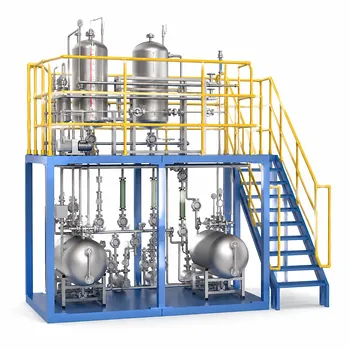
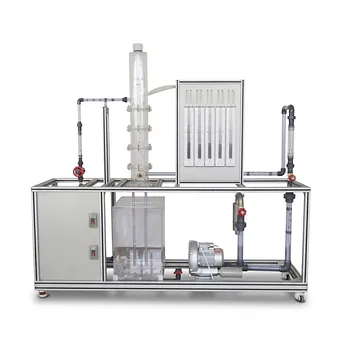
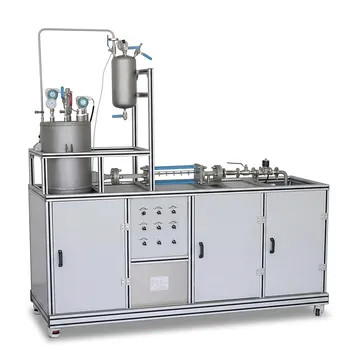
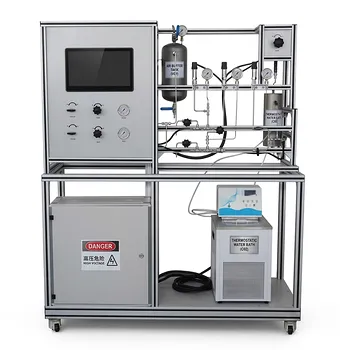
Contact LABPARK to select an Educational or Vocational Unit Operations Pilot Plant for studying pressure gradients, boundary-layer development, laminar-turbulent transition, and flow separation. LABPARK supports universities, research institutes, and enterprises with practical systems for chemical engineering, bioprocess and biotechnology, and environmental and water treatment education. Our pilot plants help users measure pressure distributions, velocity profiles, wall shear, Reynolds-number effects, and separation behavior under controlled operating conditions, turning fluid-dynamics theory into reliable experimental data for teaching, research, and process design.
Related Products
- Two-Dimensional Fluidization Hydrodynamics Educational Pilot Plant for Unit Operations Training
- Comprehensive Fluid Mechanics Educational Unit Operations Pilot Plant
- Fluid Transport and Piping Dynamics Practical Training Unit Operations Pilot Plant
- Liquid-Liquid Mass Transfer Coefficient Determination Educational Pilot Plant
- Orifice and Venturi Flowmeter Calibration Educational Pilot Plant for Fluid Mechanics Laboratory
People Also Ask
- What pressure drop characteristics should students & researchers monitor in a fluidization pilot plant?
- Why is minimum fluidization velocity (U_mf) critical? Optimize Your Pilot Plant Operations
- How is total skin friction drag calculated for laminar flat-plate flow? Blasius formula and valid Reynolds range
- How does active time pulsing mixing enhance fluid homogenization? Configuration Guide for Educational Pilot Plants
- How does Reynolds number characterize flow regimes and momentum transfer? Master pilot-plant analysis