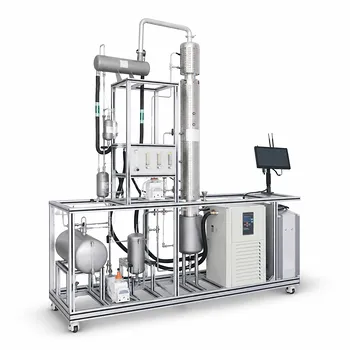
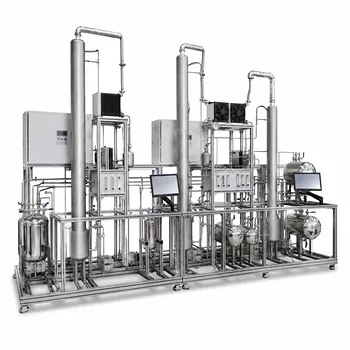
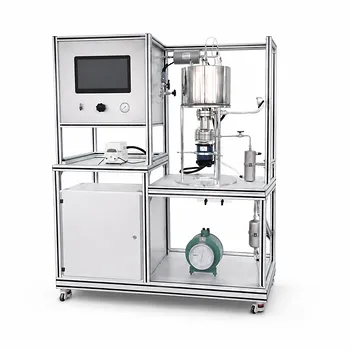
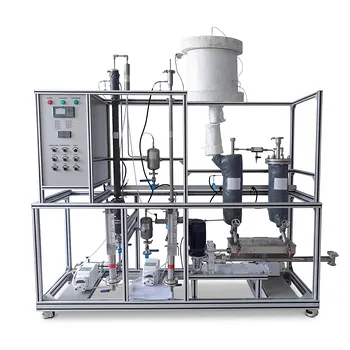
Continuous in-situ product removal is the secret. A reactive distillation pilot plant drives a reversible esterification reaction far beyond its normal equilibrium limit by coupling reaction and separation in a single column. As soon as the volatile products—typically an ester-water-alcohol azeotrope—form, they are distilled out of the reaction zone. This relentless removal, grounded in Le Chatelier’s principle, shifts the equilibrium forward, dramatically elevating reactant conversion compared to a conventional reactor operated at the same conditions.
For equilibrium-limited reactions like esterification, a reactive distillation pilot column is not just a reactor with a still attached—it is a direct teaching tool that makes the concept of shifting chemical equilibrium tangible. By allowing students to observe how continuous product removal directly increases conversion, it transforms a textbook principle into a memorable, quantitative laboratory experience.
The Fundamental Principle: Shifting Equilibrium In-Situ
How Product Removal Drives Conversion
In a reversible reaction, the maximum achievable conversion in a simple batch or continuous stirred-tank reactor is capped by the equilibrium constant at the operating temperature. In esterification, acetic acid (A) and ethanol (B) react to form ethyl acetate (C) and water (D), but the reverse reaction quickly establishes a dynamic equilibrium.
When a reactive distillation column is used, the reaction takes place on catalyst packing or trays inside a distillation column. The moment product C (ethyl acetate) or D (water) is formed, it is subjected to the column’s vapor-liquid equilibrium. Because the azeotrope containing ester, water, and alcohol has a lower boiling point than the reactants, it vaporizes and rises, while the less volatile acid descends.
This simultaneous separation effectively reduces the product concentration in the liquid reaction phase. According to Le Chatelier’s principle, the system responds by shifting the equilibrium position to produce more products, thereby driving conversion well beyond the static equilibrium limit. The pilot plant makes this invisible dynamic visible through real-time temperature and composition profiles.
A Classic Demonstration: Acetic Acid + Ethanol
The esterification of acetic acid with ethanol to produce ethyl acetate and water is a textbook equilibrium reaction. In a traditional single-stage reactor, students would measure a modest conversion (e.g., 60–70% at typical conditions) that never reaches completion.
In a reactive distillation pilot plant, the same feed can be introduced into the column’s reactive section. As the azeotrope is withdrawn from the top and reactants are continuously fed, students can achieve conversions exceeding 95%. The liquid holdup, reflux ratio, and feed location become the levers that demonstrate how process intensification directly controls chemical yield.
Key Operational Considerations for Educational Pilot Plants
Matching Reaction Kinetics and Vapor-Liquid Equilibrium
For the magic to work, the column’s temperature and pressure must simultaneously satisfy two constraints: the kinetics of the reaction and the vapor-liquid equilibrium needed for separation. If the chosen pressure makes the boiling points of products too close to those of reactants, separation will be poor and equilibrium shift will be weak.
In educational settings, instructors often guide students to find the operating window where catalytic activity is sufficient and relative volatilities favor rapid product removal. This teaches a core lesson in process integration—adjusting one variable affects both reaction and separation.
Catalyst Geometry and Column Flooding
Reactive distillation in a pilot column typically uses a structured catalytic packing or Raschig rings coated with catalyst. The liquid flows downward while vapor rises; if the catalyst is too fine or packed too densely, pressure drop skyrockets and flooding occurs.
Students learn to evaluate flooding limits and select catalyst shapes that provide adequate surface area for reaction without choking the column. This hands-on exploration connects fluid dynamics with reaction engineering, a synergy textbook problems rarely provide.
Utilizing Reaction Heat for Near-Isothermal Operation
Esterification is mildly exothermic. In a conventional setup, that heat would need to be removed by a cooling jacket. In a reactive distillation column, the heat of reaction directly vaporizes the liquid in the column, providing boil-up without additional energy input.
The pilot plant thus becomes a showcase for energy integration—students measure the reboiler duty and compare it to a sequential reactor-distillation scheme. They see firsthand that combining unit operations can dramatically reduce energy consumption.
Beyond Esterification: Extending the Learning
Demonstrating Other Reversible Reactions
While esterification is the classic example, reactive distillation pilot plants can be configured for transesterification, acetalization, or etherification. For instance, the synthesis of methyl tert-butyl ether (MTBE) from methanol and isobutylene is another equilibrium-limited reaction that benefits from product removal.
By swapping feed chemicals, students investigate how the same principle—continuous removal of a volatile product—applies across chemistries. This reinforces that the concept is universal, not just an esterification trick.
Quantitative Measurement of Conversion and Kinetics
Modern educational pilot plants are equipped with online sensors: gas chromatographs, conductivity probes, and differential pressure transmitters. Students can directly monitor stream compositions and compute instantaneous conversion rates as they vary feed ratios, reflux, or temperature.
Instead of solving idealized equations, they watch the conversion climb in real time as they adjust the reflux ratio, turning Le Chatelier’s principle into a quantifiable, dynamic experiment.
Understanding the Trade-offs
Complexity in Operation and Control
A reactive distillation column merges two well-understood unit operations into one that is distinctly more complex. Multiple degrees of freedom—reflux ratio, feed location, catalyst loading, reboiler heat input—interact in non-linear ways. For students, the learning curve can be steep. Without careful guidance, a pilot plant run can quickly degenerate into flooding or inefficient separation.
Potential for Column Flooding and Pressure Drop
The very catalyst packing that promotes reaction can also create excessive hydraulic resistance. If the vapor rate is too high for the chosen packing, liquid accumulates, and the column floods. In an educational lab, a flooded column halts the experiment and teaches a memorable (if frustrating) lesson in hydrodynamic limits. Instructors must balance demonstration ambitions with column capacity.
Limited Operating Window
Because the window for simultaneous favorable kinetics and separation is narrow, there may be only a small range of temperatures and pressures where the pilot plant operates effectively. This can make it tricky to explore wide parameter variations, potentially limiting the richness of the laboratory exercise.
Making the Right Choice for Your Educational Goals
Tailoring the pilot plant experience to specific learning objectives maximizes its pedagogical impact.
- If your primary focus is understanding chemical equilibrium: Emphasize experiments where students measure conversion with and without product removal, then plot the equilibrium shift in real time. Let them discover how a column can break the equilibrium barrier.
- If your primary focus is process integration and energy efficiency: Design a lab that compares the total energy consumption of a reactive distillation sequence with a conventional reactor-plus-distillation sequence, using the pilot plant’s heat integration to quantify the savings.
- If your primary focus is operational troubleshooting: Introduce deliberate disturbances—change feed location, increase reflux abruptly, reduce catalyst loading—and task students with diagnosing column behavior using temperature profiles and pressure drop data.
- If your primary focus is reaction kinetics and mass transfer: Use online analytical instruments to measure conversion at various points along the column, linking local composition profiles to the reaction rate and distillation performance.
A reactive distillation pilot plant transforms abstract thermodynamic and kinetic concepts into a living, breathing unit operation. By carefully designing experiments that highlight the cause-and-effect relationship between product removal and conversion, educators can provide a compelling, measurable lesson in process intensification that no slide deck can replicate.
Summary Table:
| Aspect | Details | Educational Value |
|---|---|---|
| Core Principle | Simultaneous reaction & distillation (in-situ product removal) | Demonstrates Le Chatelier’s principle dynamically |
| Target Reaction | Esterification (e.g., acetic acid + ethanol) | Reaches >95% conversion, breaking static equilibrium |
| Energy Efficiency | Utilizes reaction heat directly for column boil-up | Teaches process intensification & energy integration |
| Key Challenges | Column flooding risk & narrow operating windows | Develops troubleshooting & operational control skills |
Bring Process Intensification to Your Chemical Engineering Labs
Ready to transform abstract thermodynamics into hands-on learning? LABPARK provides premium Educational and Vocational Unit Operations Pilot Plants in chemical engineering, bioprocess & biotech, and environmental & water treatment.
Designed specifically for universities, research institutes, and enterprises, our pilot plants deliver safe, reliable, and highly visual training experiences.
Contact LABPARK today to discuss your lab requirements!
Related Products
- Multi-Functional Special Distillation Educational Pilot Plant
- Continuous Sieve-Plate Distillation Pilot Plant for Unit Operations Laboratory Education
- Electrolyte Distillation Purification and Formulation Educational Pilot Plant
- Green Anhydrous Ethanol Purification Extractive Distillation Unit Operations Training Pilot Plant
- Dual-Mode Rectification Pilot Plant for Practical Training Unit Operations
People Also Ask
- Why does simple distillation yield higher efficiency than flash distillation? Key thermodynamic differences.
- How Batch vs Continuous Configuration Affects Distillation Pilot Plant Versatility & Footprint
- How to Verify Distillation Boundary Lines & Composition Regions with Pilot Plants
- Why is the acentric factor important in pilot plants? Fluid property prediction.
- How to Integrate Spectroscopy in Distillation Pilot Plants for Advanced Process Control