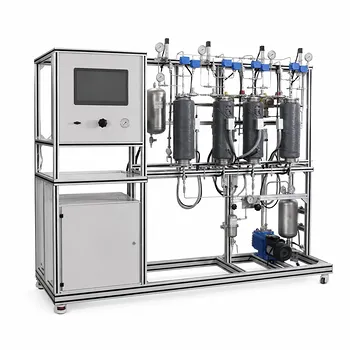
A drying pilot plant doesn’t just dry a solid—it reveals the invisible boundary that separates removable water from what you can never extract.
In a controlled pilot-scale experiment, students set a constant air temperature and relative humidity, then track a material’s weight over time until drying stops. The moisture content at this endpoint—the equilibrium moisture content ($X^*$)—is dictated solely by the drying air conditions. Any moisture the original wet solid held above that $X^$ is, by definition, free moisture: the portion that can actually be removed under those conditions. The pilot plant makes this distinction tangible because it produces a flat weight trace, giving a direct numerical split between $X^$ and the removable water.
The primary demonstration is simple: a pilot plant provides a fixed drying environment and a record of weight loss that plateaus. That plateau is the material’s equilibrium moisture for that air state; everything between the starting moisture content and that plateau is free moisture. The experiment turns an abstract thermodynamic concept into a measured, repeatable endpoint.
What the Pilot Plant Actually Measures
Creating a Fixed Environment
A drying unit operations pilot plant lets you lock the air temperature, relative humidity, and velocity.
These three factors fully define the drying potential of the air and set the theoretical moisture floor the solid can reach.
Tracking Weight, Not Moisture Directly
Students weigh the wet material at regular intervals and compute the moisture content ($X$)—kilograms of water per kilogram of bone-dry solid.
As drying progresses, $X$ drops until it stabilizes. That final, unchanging value is the experimentally determined equilibrium moisture content $X^*$.
Isolating Free Moisture as the Calculated Difference
The free moisture content is not a separate measurement—it’s the computed difference $X_{\text{initial}} - X^*$.
This straight subtraction drives home the point that “removable water” is a conditional property, not a material constant.
Moving from Total Moisture to the Real Types of Water
Equilibrium Moisture: The Unsaturated Limit
Equilibrium moisture is the water a solid retains when its vapor pressure matches the partial pressure of water in the air.
Even after “endless” drying, this water stays put. It is strongly influenced by the material’s pore structure and air conditions, not by drying time.
Free Moisture: The Total Removable Package
Free moisture includes all water above $X^*$. It is the only moisture that can ever leave the solid in that drying environment.
While easy to define, free moisture is physically made of two very different kinds of water.
Unbound vs. Bound Water: Two Behaviors Inside Free Moisture
- Unbound water sits on surfaces and in large pores. It exerts the full vapor pressure of pure water and evaporates easily during the constant-rate period.
- Bound water is held in cell walls, small capillaries, or chemically adsorbed layers. Its vapor pressure is lower, forcing the dryer into a falling-rate period that consumes far more energy.
The pilot plant experiment lets you watch both types leave, but the critical takeaway is that neither is permanent—only the equilibrium moisture survives.
Interpreting the Drying Curve to Cement the Concepts
The Moisture Content vs. Time Plot
A classic batch experiment yields a curve of $X$ vs. $\tau$. At first, $X$ falls linearly; later, it slows and asymptotically approaches a horizontal line.
That asymptote is $X^*$, and the vertical distance from the starting $X$ to the asymptote is the free moisture.
The Drying Rate Curve Puts Speed in Perspective
By applying $U = -\frac{G'}{S}\frac{dX}{d\tau}$, the pilot plant gives a drying rate curve ($U$ vs. $X$).
- The constant-rate period is a flat plateau—unbound water leaving fast, with the surface at the wet-bulb temperature.
- The falling-rate period shows a steep decline in rate—bound water resisting removal as internal diffusion takes over.
The point where the curve bends, the critical moisture content ($X_c$), marks the transition between unbound and bound water dominance, but both exist above $X^*$.
Linking the Measured Endpoint to Energy Decisions
The pilot plant provides the air flow rates and temperature changes needed for heat and mass balances.
Students can calculate the heat required for the preheater ($Q_P$) and dryer ($Q_D$) and compare theoretical loads against real utility consumption. They quickly learn that driving out bound moisture, even if it’s part of free moisture, consumes a disproportionate share of the energy.
Understanding the Trade-offs and Limitations
Equilibrium Moisture Depends on the Air, Not Just the Solid
Changing the air temperature or relative humidity shifts the entire equilibrium point, altering the split between free and bound water.
A student drying cotton at 50°C and 20% RH will get a very different $X^*$ than at 80°C and 10% RH—and that difference changes the definition of “removable” water.
The Experiment Only Gives You One Snapshot per Run
Reaching true equilibrium can take hours or days for some materials, especially those with deep bound water.
A pilot plant does not instantly jump to $X^*$; you must wait until the weight stabilizes, which teaches patience but also the practical need for endpoint estimation in industry.
Free Moisture Is No Guarantee of Easy Drying
Some of the free moisture (the bound portion) still requires high energy and long residence times.
Mistaking “free” for “easy” can lead to undersized dryers and blown energy budgets. The pilot plant’s falling-rate curve is the visual antidote to that mistake.
Making the Right Choice for Your Learning or Design Goal
Leverage the pilot plant’s ability to separate equilibrium and free moisture according to your primary objective:
- If your primary focus is understanding drying limits: Run experiments with multiple air conditions to map how $X^*$ changes. Illustrate that a material can never be dried below its equilibrium moisture for a given air state, no matter how high the air velocity.
- If your primary focus is explaining moisture classification: Have students identify $X^*$ first, then partition total moisture into equilibrium and free. Next, use the drying rate curve to further split free moisture into unbound (constant-rate) and bound (falling-rate) regimes.
- If your primary focus is energy optimization: Use pilot plant heat balances to compare the thermal load during the constant-rate vs. falling-rate periods. Let the data show that the vast majority of energy is spent on removing the bound portion of free moisture.
- If your primary focus is scale-up and design: Mark the critical moisture content $X_c$ from the drying rate curve. Use it to define the length or residence time of a continuous dryer, knowing that all moisture above $X_c$ is relatively cheap to remove and everything below $X_c$ demands oversized equipment.
A drying pilot plant does more than dry material—it converts the invisible concepts of equilibrium and free moisture into curves, rates, and energy numbers that you can feel, measure, and use to build better processes.
Summary Table:
| Moisture Type | Definition | Pilot Plant Indicator | Process Impact |
|---|---|---|---|
| Equilibrium Moisture ($X^*$) | Water retained when vapor pressure matches air. | Weight plateau (asymptote on curve). | Sets the theoretical limit of drying. |
| Free Moisture | Total removable water ($X_{\text{initial}} - X^*$). | Calculated weight loss difference. | Defines the total drying potential. |
| Unbound Water | Surface/large pore water (vapor pressure = pure water). | Constant-rate drying period (flat rate). | Easy and cheap to remove. |
| Bound Water | Capillary/adsorbed water (lower vapor pressure). | Falling-rate drying period (rate drops). | Requires high energy & residence time. |
Optimize Your Unit Operations Training with LABPARK
Are you looking to bridge the gap between thermodynamic theory and practical engineering for your students or researchers?
LABPARK provides state-of-the-art Educational and Vocational Unit Operations Pilot Plants in chemical engineering, bioprocess & biotech, and environmental & water treatment. Designed specifically for universities, research institutes, and enterprises, our pilot plants deliver precise, hands-on control over drying parameters to make complex concepts like equilibrium and free moisture tangible.
Contact LABPARK today to explore our custom pilot plant solutions and upgrade your laboratory capabilities!
Related Products
- Multi-Functional Drying Educational Unit Operations Pilot Plant
- Multi-Reactor Educational Pilot Plant for Reaction Engineering Unit Operations
- Solid Waste Pyrolysis and Refining Educational Pilot Plant for Unit Operations
- Multi-Modal Distillation Unit Operations Training Pilot Plant
- Three-Tube Heat Transfer Educational Pilot Plant for Unit Operations Training
People Also Ask
- Vacuum vs. Atmospheric Drying: How to Choose the Right Pilot Plant Configuration for Your Lab
- How do seasonal changes affect drying pilot plant blower requirements? Key sizing tips.
- Why is dry-basis moisture content preferred over wet-basis? Simplify your drying pilot plant balances.
- How can chemical engineering students use unit operations pilot plants to study kinetics? Master reactor scale-up!
- Why is the chemical plant startup schedule crucial? De-risk scale-up with pilot plants.