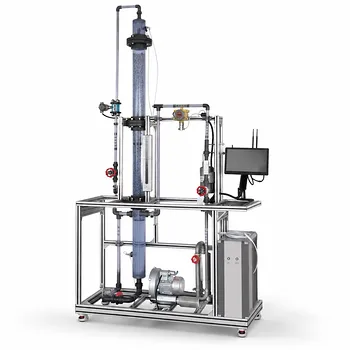
Unconventional column configurations make pilot plants more than demonstration equipment: they turn them into flexible platforms for studying dynamic, multicomponent separation. Middle vessel and multivessel batch distillation systems can separate light, intermediate, and heavy fractions during the same batch operation, while inverted columns support duties where the heavy component is the desired product. At pilot scale, these arrangements expose researchers to real vapor-liquid equilibrium behavior, changing compositions, thermal dynamics, control challenges, and energy-performance trade-offs.
The central benefit is experimental flexibility. By changing vessel locations, feed points, reflux policies, and product withdrawal strategies, one pilot plant can investigate several batch and continuous-style separation duties without requiring a separate column for each process.
Why Conventional Batch Distillation Is Not Enough
The Limits of a Bottom-Charged Column
In conventional batch distillation, the feed is charged to the bottom reboiler and the distillate is withdrawn from the top. As the batch proceeds, the reboiler composition changes, so the distillate composition also changes over time.
This transient behavior is useful for teaching and research, but it can make multicomponent separations inefficient. Intermediate fractions may require slop cuts, repeated processing, or changes in operating policy during the run.
The Value of Multiple Withdrawal Locations
Unconventional configurations add vessels or withdrawal points within the column. This allows different fractions to be concentrated and removed from the top, middle, or bottom of the system.
The result is a broader experimental space for studying how column arrangement affects purity, recovery, batch time, energy demand, and operability.
How Middle Vessel Columns Expand Research
Simultaneous Light and Heavy Product Withdrawal
A middle vessel column places the initial charge in a vessel located between rectifying and stripping sections. The upper section concentrates lighter components, while the lower section concentrates heavier components.
This arrangement can support simultaneous withdrawal of light and heavy products. Researchers can therefore study a separation in both directions during one batch run rather than focusing only on the overhead product.
Reduced Reboiler Holdup
Because the main charge is held in the middle vessel, the reboiler can operate with relatively low liquid holdup. This changes the thermal and dynamic behavior of the process and can reduce the amount of material exposed to prolonged heating.
That feature is particularly relevant when investigating heat-sensitive materials or comparing alternative batch policies.
Studying Feed-Tray and Recycle Behavior
Liquid from the feed tray or middle section can be recycled to the feed vessel to maintain a composition close to the local tray condition. This creates an opportunity to examine internal recycle, composition control, and the interaction between rectification and stripping.
Pilot-scale experiments make these effects measurable through temperature, flow, pressure, composition, and holdup data.
Investigating Complex Mixtures
A middle vessel configuration is well suited to research involving mixtures with difficult separation characteristics. Depending on the equipment and experimental objective, it can support investigations of nonideal, azeotropic, extractive, or reactive distillation behavior.
The configuration does not eliminate the thermodynamic difficulty of these systems. Instead, it gives researchers additional operating degrees of freedom for analyzing and managing it.
How Multivessel Columns Improve Unit Operations Research
Separating Several Fractions in One Batch
A multivessel batch column adds intermediate charge or product vessels between column sections. During operation, lighter components can concentrate toward upper vessels while heavier components accumulate in lower vessels.
This makes it possible to produce several fraction cuts in a single batch operation, reducing reliance on sequential slop-cut steps.
Examining Total-Reflux Dynamics
Multivessel systems can be operated under total reflux while the compositions in the vessels evolve toward different concentration ranges. Researchers can observe how tray count, section arrangement, initial charge volumes, and vapor boil-up affect that evolution.
These experiments provide direct insight into dynamic stagewise separation, rather than only steady-state performance.
Linking Design Variables to Product Purity
Final purity depends on several interacting variables:
- Number of trays or packing height in each section
- Vapor boil-up rate
- Initial liquid volume in each vessel
- Initial composition of the feed
- Duration of the batch
- Reflux and withdrawal policy
A pilot plant allows these variables to be changed systematically. The resulting data can support design correlations, feasibility studies, and dynamic optimization models.
Reducing Batch Transitions
Conventional multicomponent batch distillation may require operators to switch collection vessels or alter cut policies as the composition changes. A multivessel configuration can reduce the number of such transitions by allowing several fractions to develop within the column system.
This can improve experimental repeatability and make the effects of operating conditions easier to isolate.
What Pilot-Scale Experiments Reveal
Vapor-Liquid Equilibrium Under Dynamic Conditions
Pilot systems allow researchers to compare equilibrium expectations with actual column behavior. Temperature and composition profiles change continuously, and tray or packing performance may differ from ideal-stage assumptions.
These deviations are central to understanding scale-up and the limits of laboratory models.
Mass-Transfer Efficiency
Packed and trayed sections can be evaluated under different vapor and liquid loads. Researchers can investigate flooding, weeping, pressure drop, entrainment, and effective mass-transfer performance.
Because unconventional columns divide the separation into multiple sections, they also reveal how local operating conditions influence overall efficiency.
Thermal and Hydraulic Interactions
Adding vessels changes liquid holdup, heat capacity, residence time, and hydraulic response. These factors affect startup, transitions between operating modes, and the response to changes in heat input or reflux.
Pilot equipment captures these interactions more realistically than purely theoretical calculations.
Dynamic Control Strategies
The process is inherently time-dependent. Product compositions, vessel levels, reflux ratios, and boil-up rates must be coordinated as the batch evolves.
This creates a practical test bed for control strategies such as reflux-ratio trajectories, level control, valve switching, endpoint detection, and composition-based batch termination.
Flexibility Through Inverted and Continuous-Column Operation
Inverted Columns for Heavy Products
An inverted batch distillation column charges the feed into an upper vessel while heat is supplied at the bottom. Heavy components can then be withdrawn from the lower section as the operation proceeds.
This is useful when the target product is the least volatile component or when light impurities must be removed from a heavy product. It can also support studies involving heat-sensitive products, although the actual thermal exposure must be evaluated for the specific system.
Repurposing Continuous Infrastructure
A continuous column can be operated in batch mode by changing policies for feed location, reflux, vapor boil-up, liquid holdup, and product withdrawal. This allows researchers to compare batch and continuous dynamics using much of the same physical infrastructure.
The approach is valuable for multipurpose pilot plants because one column can support both conventional continuous studies and dynamic batch experiments.
Comparing Process Architectures
Using a common pilot-scale platform makes comparisons more meaningful. Researchers can evaluate whether a middle vessel, multivessel, inverted, or conventional arrangement is better suited to a particular feed, product specification, or operating constraint.
The comparison can include separation performance, energy use, labor requirements, controllability, and ease of cleaning or reconfiguration.
Understanding the Trade-offs
Greater Flexibility Increases Complexity
Additional vessels, valves, sensors, and control loops create more operating possibilities, but they also increase commissioning and troubleshooting requirements. Reliable experiments depend on accurate level measurement, sound valve sequencing, and clear material-balance procedures.
The configuration should therefore be selected to answer a defined research question rather than added solely for mechanical sophistication.
Lower Energy Use Is Not Automatic
Multivessel operation can reduce processing time and energy demand by producing multiple cuts in one batch. However, the actual benefit depends on thermodynamic properties, vessel holdup, reflux policy, insulation, vapor losses, and the purity and recovery targets.
Energy performance must be measured against a defined conventional-batch baseline.
Purity, Recovery, and Time Are Coupled
Increasing reflux or extending the run may improve purity, but it can also increase energy consumption and reduce throughput. Similarly, aggressive withdrawal can shorten the batch while causing product specifications to be missed.
Pilot studies are valuable because they expose these trade-offs under realistic operating constraints.
Scale-Up Requires Care
Results from a pilot column cannot be transferred directly to industrial equipment. Differences in tray efficiency, packing behavior, heat loss, residence time, control hardware, and feed composition can change performance.
Pilot data should be used to validate models and identify governing mechanisms, with scale-up assumptions stated explicitly.
Making the Right Choice for Your Goal
The most useful configuration depends on the separation duty and the behavior you need to study.
- If your primary focus is multicomponent fractionation: Use a multivessel configuration to investigate simultaneous concentration of several fractions and the effects of vessel charge, section design, and batch duration.
- If your primary focus is light and heavy product recovery: Use a middle vessel column to study simultaneous top and bottom withdrawals with rectifying and stripping sections.
- If your primary focus is heavy-product purification: Evaluate an inverted column when the least volatile component is the desired product or when light impurities must be removed.
- If your primary focus is plant flexibility: Configure continuous-column infrastructure for batch operation to compare batch and continuous dynamics on a shared pilot platform.
- If your primary focus is process control: Measure composition, temperature, pressure, levels, reflux, and boil-up dynamically to develop and validate operating policies.
- If your primary focus is energy efficiency: Compare each unconventional arrangement with a conventional batch baseline using consistent purity, recovery, and throughput targets.
Unconventional column configurations enhance unit operations research by converting a pilot plant into a controllable environment for studying how thermodynamics, mass transfer, equipment design, and operating policy interact during real separations.
Summary Table:
| Configuration | Best suited for | Key research benefits |
|---|---|---|
| Middle vessel | Light and heavy product recovery | Simultaneous top and bottom withdrawal, lower reboiler holdup, and recycle studies |
| Multivessel | Multicomponent fractionation | Multiple fraction cuts, dynamic reflux studies, and reduced batch transitions |
| Inverted column | Heavy-product purification | Removal of light impurities and investigation of heavy-component recovery |
| Batch-operated continuous column | Flexible process comparisons | Shared infrastructure for comparing batch and continuous operation |
| Any unconventional layout | Process control and energy studies | Evaluation of purity, recovery, batch time, energy use, hydraulics, and scale-up behavior |
Select the Right Pilot Plant Configuration
Need to evaluate a complex separation, develop operating policies, or validate scale-up data? Contact LABPARK to discuss a pilot plant configured for your research goals.
LABPARK provides Educational and Vocational Unit Operations Pilot Plants for universities, research institutes, and enterprises. Our chemical engineering, bioprocess and biotech, and environmental and water treatment systems help teams investigate thermodynamics, mass transfer, process control, energy performance, and equipment operation under realistic conditions. We can support studies using conventional, middle vessel, multivessel, inverted, and batch-operated column configurations, with instrumentation for temperature, pressure, flow, level, reflux, boil-up, and composition monitoring.
Tell us your feed characteristics, target products, purity and recovery requirements, and preferred operating mode. LABPARK can help you identify a practical, reconfigurable pilot-scale solution that generates reliable data for teaching, research, process development, and scale-up.
Related Products
- Continuous Batch Extractive Distillation Educational Pilot Plant
- Continuous Sieve-Plate Distillation Pilot Plant for Unit Operations Laboratory Education
- Multi-Functional Special Distillation Educational Pilot Plant
- Multi-Modal Distillation Unit Operations Training Pilot Plant
- Dual-Mode Rectification Pilot Plant for Practical Training Unit Operations
People Also Ask
- How is an extractive distillation pilot plant configured? Setup & Entrainer Roles
- Wilson vs. UNIQUAC: How to Choose the Right Thermodynamic Model for Your Pilot Plant
- How does the feed thermal state influence distillation pilot plant design and utility consumption?
- How to Configure a Distillation Pilot Plant? Key Steps for Multi-Mode Setup
- Why use non-ideal VLE calculations in distillation pilot plants? Ensure accurate scale-up & purity