PVDF-Ti catalytic membranes deliver remarkably consistent recycling performance, maintaining a ~90% nitrone yield for at least five consecutive oxidation runs. In chemical engineering pilot plants, this is achieved with a straightforward operational protocol: after each batch, remove the membrane, wash it thoroughly with a solvent like chloroform, and return it to the reactor. Critically, the reaction rate often increases after the first run, not because of new catalyst loading but due to favorable surface restructuring.
PVDF-based catalytic membranes are not just reusable—they improve with use. The combination of a chemically resilient PVDF backbone and a simple solvent wash cycle eliminates the fear of catalyst leaching, while the polymer surface reorganizes to expose more active Ti sites. For pilot plant operators, this means lower downtime, predictable yields, and a catalyst system that actually becomes more efficient during early cycles before stabilizing.
Why PVDF Membranes Excel in Recycled Oxidation Reactions
The performance data from stereoselective and chemoselective oxidations is unambiguous. When converting secondary amines to nitrones, catalytic activity stays high across multiple recycles, and selectivity never wavers. This stability is rooted in the interplay between the hydrophobic PVDF matrix and the embedded Ti(IV) catalyst complexes.
The “Activation by Recycling” Phenomenon
Reaction rates tend to increase from run 1 to run 2 and beyond.
This counterintuitive boost happens because the solvent washing and reaction environment physically restructure the polymer surface. The surface roughness evolves, or the polymer chains rearrange, which either exposes a larger fraction of the embedded Ti centers or enhances their Lewis acidity through a more open coordination environment. In practical terms, you get a self-optimizing catalyst bed that requires no additional chemical treatment.
Hydrophobic PVDF Outperforms Other Engineering Polymers
The choice of polymer support dictates conversion rates and long-term stability.
In a direct comparison for sulfide oxidation, a PVDF-Ti membrane achieved 93% conversion in just 5 hours, while a PEEKWC-Ti membrane managed only 8% after 100 hours. The hydrophobic nature of PVDF prevents water accumulation around the catalyst sites, preserving the Ti complex’s integrity and maintaining fast mass transfer. For pilot plant reactors running organic oxidation operations, this means PVDF is not optional—it’s the cornerstone of a reliable recycle loop.
Thermal and Chemical Backbone Stability
PVDF can operate from -50°C to 140°C, with a glass transition temperature of -40°C.
It withstands most inorganic/organic acids, aromatic hydrocarbons, alcohols, tetrahydrofuran, and halogenated solvents. This broad compatibility ensures that the chloroform wash does not degrade the membrane, and the support remains intact even under fluctuating reactor temperatures or corrosive oxidizing environments.
The Operational Steps to Maintain Catalytic Activity
Maintaining the 90%+ yield across multiple runs boils down to a disciplined, solvent-based cleaning protocol that removes adsorbed species without pulling catalyst out of the membrane.
Step 1: Gentle Membrane Retrieval
After each batch reaction is quenched, carefully remove the PVDF-Ti membrane from the reactor vessel.
The goal is to avoid physical damage such as tearing or creasing, which could alter the fluid dynamics of the next run. In a pilot plant, this is typically a manual step when using flat-sheet configurations or a simple module extraction for hollow-fiber setups.
Step 2: Solvent Washing to Desorb Reagents and Products
Wash the membrane one to two times with the reaction solvent—chloroform is the validated choice here.
The chloroform dissolves and carries away any adsorbed starting materials, intermediates, or product molecules that would otherwise block active sites in the next cycle. This washing step is what prevents the typical drop in conversion seen with unsupported catalysts. ¹H NMR analysis confirms that these wash cycles cause no significant Ti or ligand leaching; the active complex stays locked in the PVDF matrix.
Step 3: Drying and Reactor Reintegration
Allow the membrane to dry briefly to avoid diluting the next reaction mixture with residual solvent.
Then, place the membrane back into the reactor for the next batch. The entire process adds minimal downtime and does not require re-metallation or activation steps. In a pilot plant setting, you can even prepare spare, pre-washed membranes to swap in and wash the used ones in parallel, maximizing throughput.
Ensuring Leaching Control Over Many Cycles
Regularly analyze reaction mixtures and wash solutions via ¹H NMR or ICP-OES.
This is not a daily operation step, but it is a critical verification protocol for pilot plants. It confirms that catalytic activity is coming from the membrane itself, not from homogeneous catalyst that has bled into the solution. The data consistently shows that the heterogeneous nature of the PVDF-Ti system is what enables true reuse without the need for complex post-reaction purification.
Understanding the Trade-Offs and Potential Pitfalls
While PVDF-Ti membranes are robust, blindly applying the same protocol to every process can introduce problems. Acknowledging these limits builds a safer, more reliable pilot plant operation.
Solvent Compatibility and Membrane Swelling
Chloroform is ideal for the demonstrated oxidation chemistry, but other solvents can swell PVDF.
If your reaction medium or washing solvent is a strong ketone like acetone or a highly polar aprote, test small coupons first. Excessive swelling can mechanically weaken the membrane and disrupt the catalyst dispersion. The hydrophobic backbone handles most non-polar and moderately polar solvents well, but you must verify for any new chemistry.
Hydrophobicity and Aqueous Streams
Native PVDF is hydrophobic, which is an advantage for organic reactions but a fouling magnet for aqueous feeds.
If your pilot reactor handles water-based streams (e.g., wastewater treatment), unmodified PVDF will foul rapidly. In those cases, the membrane may need alkaline/oxidizing pre-treatments, grafting with polyacrylamide, or blending with PVP/PEG to impart hydrophilicity. However, these modifications can alter the catalyst’s local environment, so the recycling performance data (90% yield, five runs) must be revalidated for the functionalized variant.
Limited Run Data vs. Industrial Longevity
Published recycling data extends to five consecutive runs, which is excellent for academic and educational pilot plants.
For a campaign aiming at 50 or 100 cycles, you should gather your own stability data. While the leaching test and polymer resilience are highly encouraging, the rate increase tends to plateau, and eventual mechanical fatigue or trace metal loss cannot be ruled out without empirical evidence on your specific setup.
Making the Right Choice for Your Pilot Plant Goal
The operational protocol you implement should match your primary objective. Here is how to prioritize.
- If your primary focus is maximizing turnover and reducing catalyst cost: Use the standard chloroform-wash cycle between every batch, and leverage the initial rate increase. You will deliver consistent ~90% yields without adding fresh catalyst.
- If your primary focus is demonstrating a green chemistry process: Highlight the catalyst immobilization and the elimination of homogeneous metal waste. Supplement the wash step with a solvent recovery system to minimize chloroform use and strengthen the sustainability narrative.
- If your primary focus is handling aqueous-phase oxidation or bioprocess streams: Start with hydrophilized PVDF-Ti variants, but budget time to re-establish the baseline recycling performance and washing protocol, as the surface chemistry is fundamentally different from neat PVDF.
- If your primary focus is scaling from educational pilot to production: Invest in automated membrane handling and a parallel wash station. The manual protocol works perfectly at pilot scale, but process intensification requires minimizing manual intervention.
Your PVDF-Ti catalytic membrane is a durable, self-improving reactor component, not a consumable—treat it with a consistent solvent wash, and it will deliver predictable, high-selectivity performance run after run.
Summary Table:
| Feature / Step | PVDF-Ti Membrane Performance & Operation |
|---|---|
| Recycling Yield | ~90% nitrone yield for at least 5 consecutive runs |
| Key Phenomenon | "Activation by recycling" (reaction rate increases after run 1) |
| Performance vs PEEKWC | 93% conversion in 5 hours (versus PEEKWC-Ti at 8% in 100 hours) |
| Step 1: Retrieval | Gentle manual or module extraction to prevent structural damage |
| Step 2: Washing | Solvent wash (chloroform) to desorb reagents and prevent active site blockage |
| Step 3: Drying & Reuse | Brief drying and immediate reintegration into the reactor |
| Key Analytical Check | Periodic ICP-OES or ¹H NMR to monitor and control catalyst leaching |
Optimize Your Pilot Plant Operations with LABPARK
Are you looking to scale up catalytic membrane processes, optimize reactor efficiency, or implement advanced chemical separation technologies?
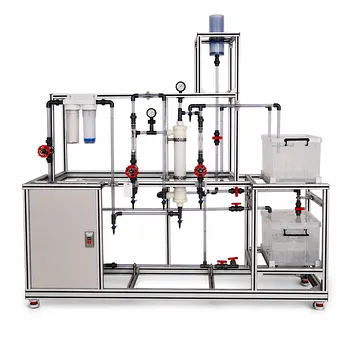
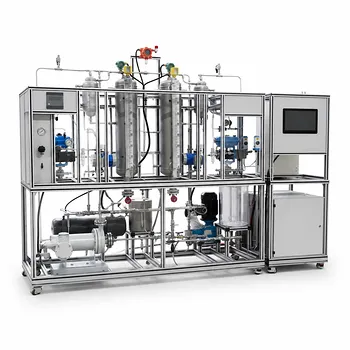
LABPARK provides state-of-the-art Educational and Vocational Unit Operations Pilot Plants in chemical engineering, bioprocess & biotech, and environmental & water treatment. Designed specifically for universities, research institutes, and enterprises, our modular pilot plants enable hands-on training and reliable process scale-up.
Maximize your research yield and train the next generation of engineers—contact our experts today to find the perfect pilot plant solution for your facility!
Related Products
- Photocatalytic Membrane Separation and Degradation Unit Operations Pilot Plant
- Fluidized Bed Gas Solid Catalytic Reaction Educational Pilot Plant
- Fixed Bed Gas Solid Catalytic Reaction Educational Pilot Plant
- Hollow Fiber Ultrafiltration Membrane Separation Educational Pilot Plant
- Internal Circulation Gradient Free Catalytic Reaction Educational Pilot Plant
People Also Ask
- What are the key differences in membrane configurations? Choose the Right Unit Operations Pilot Plant
- How Do Pervaporation, Vapor, and Gas Permeation Differ in Pilot Plants? Key Comparison
- What are the structural & performance trade-offs of flat-sheet, spiral-wound, & hollow-fiber membrane modules?
- How do PEI, PVDF, and PSU membranes compare in pilot plants? Find the best fit.
- Pervaporation vs. Vapor Permeation: Handling Suspended Solids in Membrane Pilot Plants