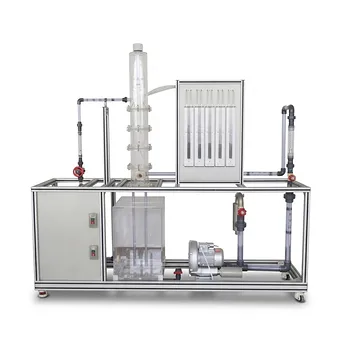
Viscosity isn't just a side note—it's the master switch that controls oxygen delivery in your bioreactor.
In a bubble column, higher liquid viscosity encourages bubble coalescence, slashes gas holdup, and shrinks the interfacial area available for mass transfer. The direct result is a steep drop in the volumetric mass transfer coefficient (kLa) — the key parameter that determines whether your aerobic culture thrives or suffocates.
The central challenge is that the fermentation broths most likely to become viscous (dense microbial cultures, non-Newtonian fluids) are the very ones that demand high oxygen transfer rates. To operate and scale a bubble column reliably, you must understand how viscosity reshapes bubble dynamics and mass transfer, and then strategically compensate—not simply push more gas.
The Physics of Viscosity in Bubble Columns
The Chain Reaction from Viscosity to Bubble Size
Liquid viscosity suppresses the fluid instabilities that break rising bubbles apart. Smaller eddies in the liquid are dampened, so bubbles can merge more easily than they can split.
- Coalescence dominates: Bubbles collide, combine, and grow larger.
- Larger bubbles rise faster. This reduces the fraction of the reactor volume occupied by gas—the gas holdup ($\epsilon_G$).
- A lower gas holdup directly cuts the specific interfacial area ($a$). And $a$ is one of the two multipliers in $k_La$.
For non-Newtonian broths, the apparent viscosity can vary dramatically with local shear rates, making the bubble size distribution even harder to predict.
Why Bubble Size Matters Twice for Mass Transfer
The volumetric mass transfer coefficient combines the liquid-side mass transfer coefficient ($k_L$) and the interfacial area.
- Bubble size sets the interfacial area: Smaller bubbles pack more surface area per unit gas volume, so $a$ rises sharply.
- Bubble size influences $k_L$ itself: This is where the dimensionless correlations come into play.
How Viscosity Reshapes Mass Transfer Coefficients
The Regime Shift in the Sherwood Number
The dimensionless Sherwood number ($Sh = k_L d_b / D$) captures the mass transfer rate relative to diffusion. It does not behave the same for all bubbles.
- Small, rigid bubbles (d_b < 2.5 mm):
$Sh = 2.0 + 0.31 , Gr^{1/3} Sc^{1/3}$ - Large, mobile bubbles (d_b > 2.5 mm):
$Sh = 0.42 , Gr^{1/3} Sc^{1/2}$
The Grashof number ($Gr$) depends inversely on viscosity—higher viscosity lowers $Gr$, reducing $Sh$ and thus $k_L$. But the real penalty is that the transition to larger bubbles changes the exponent on the Schmidt number and pushes you onto a curve with a lower prefactor (0.42 vs. 2.0 plus a term).
The Viscosity Knock-On on $k_La$
When viscosity increases:
- Bubbles coalesce and exceed 2.5 mm, switching to the less efficient mass correlation.
- Gas holdup plummets, so $a$ falls.
- The combined effect can reduce $k_La$ by 50% or more compared to low-viscosity operation—even if the gas flow rate stays the same.
In pilot plant experiments, measuring dissolved oxygen transients at different viscosities (e.g., by adding thickeners like CMC) lets you map exactly how your specific broth and sparger will perform.
Operational Consequences in Bioprocess Pilot Plants
Maintaining Stable Oxygen Transfer
For a given broth viscosity, the operator’s main levers are gas superficial velocity and sparger design.
- Higher superficial velocity raises gas holdup and bubble break‑up to a point, but can also push the column into a slug-flow regime—especially in narrow columns—leading to pressure surges and inconsistent oxygen delivery.
- Sparger type determines initial bubble size. Porous or sintered spargers produce smaller bubbles that offer high interfacial area, but they are more prone to fouling and require careful differential pressure control.
- Draft tubes or internal loops can direct liquid circulation, helping to redisperse bubbles and homogenize the bulk viscosity near shear-sensitive zones.
The Hidden Link to Heat Transfer
Bubble-induced turbulence enhances wall heat transfer coefficients. Viscosity that damps turbulence not only hurts mass transfer but also reduces the ability to remove metabolic heat. In dense cultures, this can create hot spots that damage cells.
- The bubble Sauter mean diameter (typically <2.5 mm in well-designed contactors) is a key driver. Larger bubbles from a viscous broth reduce liquid mixing intensity, making temperature control harder.
Scaling Challenges: From Bench to Pilot Scale
Why Diameter Matters
In small-diameter bench columns, wall effects help break bubbles and mitigate coalescence. As you scale up to a pilot column (e.g., from 0.1 m to 0.5 m inside diameter), those wall effects disappear.
- Increased column diameter allows larger bubbles to form unhindered, so the gas holdup and $k_La$ can drop even if viscosity hasn’t changed.
- The pressure gradient along the column becomes significant. The gas is compressed at the bottom, so the local superficial velocity is lower there. In pilot plants with tall columns, the bottom pressure can be 30% higher than the top, altering the gas density, bubble expansion, and mass transfer kinetics along the height.
Axial Dispersion and Gas-Phase Backmixing
Small bubbles have long residence times and excellent mass transfer per unit volume, but they also encourage liquid backmixing. At scale, this can reduce the driving force for oxygen absorption if the liquid phase becomes well-mixed.
- Viscous broths compound the problem: large bubbles (poor mass transfer) rush through, while smaller bubbles (good transfer) get carried down with recirculating liquid, lowering the effective concentration gradient.
Trade-offs and Hidden Pitfalls
When Pushing More Gas Backfires
Increasing gas rate to compensate for low $k_La$ is tempting, but it carries real limits:
- Transition to slug or churn flow reduces interfacial area and generates pressure pulses that can damage shear-sensitive cells.
- Higher gas throughput raises energy costs and can strip volatile components from the broth.
- Foaming becomes more severe with viscous, proteinaceous media, requiring antifoam, which itself can reduce $k_L$ by adding surface resistance.
Non-Newtonian Behavior: The Invisible Hand
Many fermentation broths are non-Newtonian—their viscosity drops near the rising bubbles (high shear) but stays high in the bulk.
- Peripheral regions far from sparger jets can become stagnant, creating dead zones where oxygen is depleted.
- Scale-up correlations derived for Newtonian fluids often fail. You must rely on pilot-plant data collected at the target broth rheology, not just a look‑alike fluid.
Making the Right Choice for Your Goal
The path forward depends on what you are optimizing: a training exercise, a process demonstration, or a scalable bioprocess.
- If your primary focus is teaching fundamental mass transfer: Use well-characterised water-air systems, then systematically increase viscosity with a model fluid (e.g., glycerol solutions) to map holdup and $k_La$ shifts. This solidifies the link between bubble regime and the Sherwood correlation.
- If your primary focus is developing a scalable fermentation process: Invest in pilot tests with your actual broth at realistic cell densities. Characterize viscosity as a function of shear rate, and test sparger configurations that maintain bubbles below 2.5 mm even as the broth thickens. Consider a gas-lift loop to decouple aeration from bulk mixing.
- If your primary focus is retrofitting an existing pilot column for a more viscous culture: Audit the current holdup and bubble size distribution. A retrofit with a draft tube and a fine‑bubble sparger can restore $k_La$ without exceeding the column’s pressure limit.
You don’t need to eliminate viscosity—you need to understand exactly how it will erode your oxygen transfer and then redesign your bubble column’s operation and geometry to keep the bubbles small, the holdup high, and the mass transfer coefficient safely above the oxygen uptake rate of your culture.
Summary Table:
| Parameter | Impact of High Viscosity | Operational & Scaling Solutions |
|---|---|---|
| Bubble Size & Coalescence | Promotes bubble merging (size > 2.5 mm); reduces interfacial area. | Optimize sparger design (fine/sintered) and control superficial velocity. |
| Gas Holdup | Decreases significantly, leading to a drop in mass transfer ($k_La$) by 50% or more. | Implement draft tubes or gas-lift loops to improve fluid circulation. |
| Mass Transfer ($k_L$) | Lowers the Grashof number, shifting Sherwood number to less efficient regimes. | Conduct pilot tests using actual non-Newtonian broths to map real rheology. |
| Heat Transfer | Dampens bubble-induced turbulence, reducing wall heat removal capacity. | Ensure proper bulk mixing and monitor Sauter mean bubble diameter. |
Scale Up with Confidence using LABPARK Pilot Plants
Managing fluid dynamics and mass transfer in viscous systems requires robust, reliable equipment. LABPARK offers specialized Educational and Vocational Unit Operations Pilot Plants in chemical engineering, bioprocess & biotech, and environmental & water treatment tailored for universities, research institutes, and enterprises. Our pilot systems enable you to accurately model real-world scale-up challenges, optimize $k_La$, and ensure process reliability.
Ready to upgrade your research and training capabilities? Contact LABPARK today to discuss your pilot plant needs!
Related Products
- Plate Column Hydrodynamics Tray Demonstration Educational Pilot Plant
- Absorption and Desorption Educational Unit Operations Pilot Plant
People Also Ask
- How to update chemometric calibration models in pilot plants? Best practices for process engineers.
- How does nuclear yield inefficiency translate to chemical engineering education? Optimize kinetics with pilot plants.
- How can educational pilot plants be used to teach process safety and risk assessment in chemical engineering curricula?
- Why Correct Sig Figs & Rounding Matter in Educational Pilot Plants: Ensure Data Accuracy
- Why Calculate Sieve Tray Pressure Drop? Optimize Distillation Pilot Plant Performance