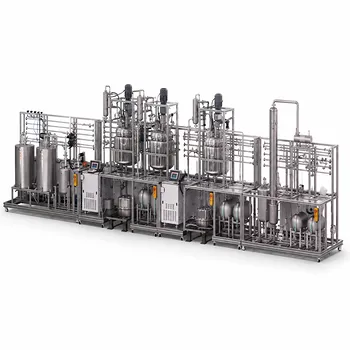
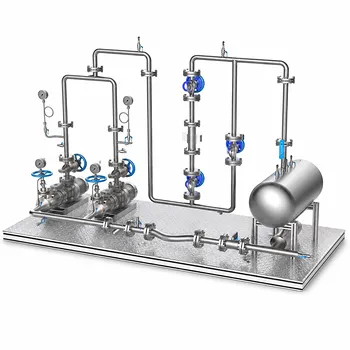
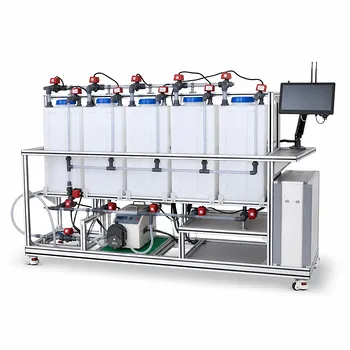
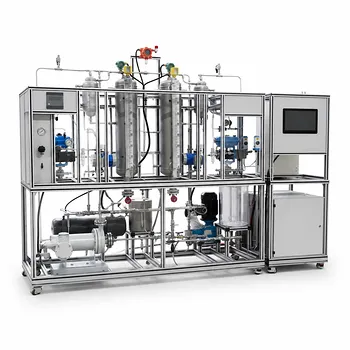
The core answer in one sentence: Industrial chemistry pilot plants make the energy demands of non-spontaneous reactions tangible, showing students that forced processes like electrolysis require a continuous and measurable input of external work—typically as electrical power—while spontaneous reactions release energy without such a drive.
This immediate, physical experience bridges the gap between textbook thermodynamics and real chemical operations. By adjusting voltage and current on a pilot-scale electrolyzer, a student can feel the causal link between bond stability and the electricity demanded to break those bonds, transforming abstract free energy calculations into a controlled, observable phenomenon.
Central insight
Pilot plants transform the thermodynamic difference between spontaneous and forced reactions into a measurable operational parameter: the external energy required. Spontaneous reactions liberate energy; forced reactions cannot proceed without it. On a pilot plant, that “cannot proceed” becomes a dial that must be turned up—students see that the electrical work demanded to decompose a compound is a direct fingerprint of the compound’s thermodynamic stability, deepening their grasp of concepts like Gibbs free energy, enthalpy, and path-dependence.
The Living Demonstration: From Textbook Theory to Touchable Data
Electrolysis as the Quintessential Forced Reaction
Industrial training pilot plants nearly always include an electrolysis module, and for good reason. Decomposing water or brine into hydrogen, oxygen, or chlorine is textbook non-spontaneous chemistry. The standard cell potential is negative, meaning the reaction will not run unless an external voltage pushes electrons against the thermodynamic gradient.
The pilot plant makes this brutally clear. Students start with a silent, static cell. They then bring a DC rectifier online, slowly increasing the voltage. Nothing happens until the applied potential overcomes the cell’s decomposition voltage, including overpotentials. At that moment, gas bubbles form, pumps stir, and data streams start—all because continuous electrical work is being pumped in.
Spontaneous Reactions as the Counterexample
Most pilot plants also host exothermic reactions that run spontaneously once initiated. A neutralization in a jacketed batch reactor, an oxidation, or a polymerization that kicks off with a small shot of initiator—these reactions liberate heat and can even run away if not cooled.
By running both types of processes in the same facility, students experience the fundamental divide viscerally. The spontaneous reactor requires heat removal to stay safe; the forced reactor demands energy input to proceed at all. The control panel tells the story: one displays a cooling water flow rate climbing to manage a temperature spike, the other shows a power supply working hard to sustain gas evolution.
Thermodynamic Principles That Pilot Plants Make Concrete
Gibbs Free Energy Becomes a Physical Threshold
The theoretical condition ΔG = 0 defines equilibrium; ΔG < 0 means spontaneous, and ΔG > 0 means the reaction needs external work. In the pilot plant, that abstract inequality turns into a minimum applied voltage or a threshold temperature.
Students can run an electrochemical cell at progressively higher voltages and record the current, then calculate the electrical work ( W = V·I·t ). When they compare this work with the calculated ΔG of the decomposition reaction, they see the real-world inefficiencies—overpotentials and resistive losses—that pure thermodynamics does not account for. This is the moment when textbook spontaneity meets engineering reality.
Path Functions vs. State Functions: The Work Done Is Not the Same
The supplementary gas expansion experiments present an analogous lesson. For an ideal gas expanding isothermally, the change in internal energy ΔU is zero, yet a single-step expansion yields measurably less work than a multi-step expansion between the same start and end pressures. Students measure pressure-volume work in both cases and see the difference.
This directly illuminates forced chemical reactions. The minimum work required to drive a non-spontaneous process is a state function (ΔG), but the actual work consumed always exceeds it and depends on the path. A pilot plant electrolyzer reveals exactly that: the electrical energy needed to decompose a mole of compound is not a fixed number; it grows with current density and cell design. The difference between theoretical and actual energy input crystallizes the path-dependent nature of real processes.
Bond Stability Quantified by the Control Panel
The primary reference states that “the electrical energy required to decompose a compound is directly related to the thermodynamic stability of the initial chemical bonds.” A pilot plant turn this into a student exercise.
Students electrolyze molten sodium chloride (theoretical decomposition voltage ~4.07 V) and then magnesium chloride (~2.5 V). The more stable the metal-chlorine bond, the higher the voltage they must dial in. By plotting the measured decomposition potentials against standard Gibbs free energies of formation, they create a calibration curve they have earned with their own hands. The bond stability is no longer a number in a table—it’s a specific knob position on a power supply.
Beyond Electrolysis: Other Forced-Reaction Insights
While electrolysis is the starkest example, pilot plants also showcase forced processes in thermal separations and mechanical work. A distillation column operates only because the reboiler supplies heat and the condenser removes it; left alone, the mixture would reach a dead-stop equilibrium. A compressor train illustrates forced pressurization, where shaft work moves the system away from thermodynamic equilibrium. These unit operations reinforce the same message: non-spontaneous processes are pumps, both literal and figurative, that push systems uphill against their natural tendencies.
Understanding the Trade-offs
The Representational Gap
A pilot plant electrolyzer or gas compressor is still a teaching tool. It cannot replicate every industrial nuance—membrane degradation, e–field non-uniformities, or thermal runaway in full-scale stacks. Students must be taught that what they measure is the lab-scale reality, not a carbon copy of plant performance. Without this framing, they may underestimate the engineering challenges that real forced-reaction systems face.
Danger of Oversimplifying Spontaneity
Not all spontaneous reactions are safe or self-evident. Some require a small activation energy input to start, and that initial spark can be misinterpreted as the reaction being “forced.” Trainers must explicitly connect the pilot plant ignition moment to the concept of activation energy, clarifying that the reaction itself is still thermodynamically downhill once the kinetic barrier is crossed.
Instrumentation Can Obscure Thermodynamic Truths
Poorly calibrated sensors, voltage drops across lead wires, and unaccounted heat leaks can make the measured energy input look larger or smaller than reality. Students learn as much from troubleshooting faulty data as from perfect runs, but the curriculum must ensure the fundamental thermodynamic message does not get lost in the noise. A pilot plant without rigorous error analysis can teach bad intuition.
Making the Right Choice for Your Educational Goals
How you deploy a pilot plant to teach forced vs. spontaneous reactions should match the learning objective.
-
If your primary focus is electrochemical fundamentals: Choose a pilot plant with a transparent electrolysis cell and a configurable DC power supply. Let students perform voltage sweeps, record gas evolution, and calculate energy efficiencies. The visual of bubbles at a threshold voltage cements the non-spontaneous character more powerfully than any graph.
-
If your goal is to teach general thermodynamic path dependence: Combine the electrolysis module with gas expansion experiments and a small compressor unit. Have students measure work in both spontaneous and forced mechanical processes, then draw the parallel to chemical reactions. This builds a unified mental model of energy as a path-dependent currency.
-
If you are training future process engineers: Integrate the pilot plant reactor with a data acquisition system and a process simulator. Let students compare the predicted equilibrium conversions of a spontaneous reaction with real yields, and then do the same for a forced reaction’s energy demand. The gaps teach the limits of equilibrium assumptions and the necessity of kinetics and transport considerations.
-
If safety and cost are paramount: Start with a digital twin of the electrolyzer before going to the physical unit. Students can experiment with “what if” scenarios, such as reducing overpotential, and observe the thermodynamic impacts without risk. Then, a short hands-on session with the real plant solidifies the lesson.
The most powerful learning moment often comes when a student turns the voltage dial and nothing happens—until, precisely at the decomposition potential, the meters jump and the product appears. That instant, the abstract barrier of non-spontaneity collapses into a physical threshold that can be measured, tuned, and understood.
Ultimately, industrial chemistry pilot plants teach the thermodynamic divide not by explanation, but by demonstration: they let students supply the very work that theory demands, turning free energy calculations into a tangible control-panel reality.
Summary Table:
| Parameter | Spontaneous Reactions | Forced (Non-Spontaneous) Reactions |
|---|---|---|
| Thermodynamic State | $\Delta G < 0$ | $\Delta G > 0$ |
| Energy Dynamics | Liberates energy (exothermic) | Requires continuous external energy input |
| Control Panel Indicator | Cooling water flow increases to manage heat | Power supply voltage and current draw increase |
| Common Pilot Module | Jacketed batch reactor (neutralization) | Electrolysis unit (water/brine decomposition) |
Bring thermodynamics to life in your lab. LABPARK provides state-of-the-art Educational and Vocational Unit Operations Pilot Plants in chemical engineering, bioprocess & biotech, and environmental & water treatment. Designed specifically for universities, research institutes, and enterprises, our training systems turn abstract theories into hands-on operational mastery. Contact us today to equip your facility with LABPARK pilot plants!
Related Products
- Natural Product Extraction Unit Operations Training Pilot Plant
- Ethyl Acetate Synthesis Unit Operations Pilot Plant for Practical Training
- Multi Pump Fluid Transport Process Piping Unit Operations Training Pilot Plant
- Fixed-Bed Chemical Reaction and Gas Dust Tar Removal Unit Operations Pilot Plant
- Multi-Reactor Educational Pilot Plant for Reaction Engineering Unit Operations
People Also Ask
- How to Demo Solubility Sensitivity in SFE Pilot Plants? Practical Thermodynamics
- How do pilot plants differentiate physical vs chemical extraction? Enhance Chemical Engineering Training
- How are HTU and NTU applied to determine extraction column height? Guide to Pilot Plant Scaling
- How do fluid transport principles apply to pilot plant configuration? Optimize your unit operations.
- What are the limitations of acentric factor models? Avoid pilot plant errors with polar fluids.