The core difference lies in a single physical barrier: film condensation coats the heat transfer surface with a continuous liquid film that insulates it, while dropwise condensation leaves most of the surface exposed. In film condensation, the vapor's latent heat must conduct through that ever-thickening liquid layer, creating a significant thermal resistance. Dropwise condensation, however, forms discrete droplets that quickly roll off, allowing vapor to contact the bare metal directly and achieving heat transfer coefficients over ten times higher. Despite this dramatic performance gap, almost every chemical engineering unit operations pilot plant is designed and analyzed assuming film condensation, and understanding why reveals the essence of practical heat exchanger design.
While dropwise condensation offers vastly superior heat transfer in theory, it is inherently unstable and almost impossible to maintain in a typical industrial or educational setting without specialized, short-lived surface coatings. Because pilot plants aim to mirror real-world chemical processes, the conservative assumption of film condensation ensures that the equipment is sized for reliable, predictable operation, and it turns the condenser into a powerful teaching tool about real thermal resistances and fluid dynamics.
The Two Condensation Mechanisms
How a Liquid Film Becomes a Thermal Insulator
In film condensation, the condensing liquid spreads out and wets the entire heat transfer surface, creating a continuous film. This film is not a static layer—it drains under gravity, but at every moment it acts as a primary conduction barrier. The vapor must release its heat to the wall, and that energy must travel through the liquid film before reaching the cooling medium. The thicker the film gets (as more vapor condenses and flows downward), the higher the thermal resistance becomes. This is why, in a vertical condenser, the local heat transfer coefficient drops significantly from top to bottom.
How Disconnected Droplets Unleash Higher Performance
Dropwise condensation occurs on surfaces that the liquid does not wet—think of water beading on a waxed car hood. Vapor condenses into tiny discrete droplets that grow, coalesce, and then fall away, leaving vast areas of the surface directly exposed to the vapor. Without an insulating liquid blanket, the heat transfer coefficient can be 5 to 20 times higher than in film condensation. However, this behavior depends on maintaining a low-energy surface that prevents wetting, which is easily compromised by fouling, oxidation, or trace contaminants.
The Stability Problem That Drives Design Choices
The critical flaw of dropwise condensation is its fragility. Even if a pilot plant condenser is initially treated with a promoter (like an organic self-assembled monolayer or a noble metal coating), the effect degrades rapidly under sustained operation with industrial-grade steam. Pilot plant runs are often long-duration teaching exercises or research campaigns; a mode that disappears mid-experiment destroys data repeatability. For this reason, heat exchangers are purposely built and analyzed around the stable, if less efficient, film condensation regime.
Why This Distinction Is Central to Pilot Plant Operations
Designing for Reality, Not Laboratory Miracles
A pilot plant's primary mission is to bridge bench-scale chemistry and full-scale production. Industrial condensers overwhelmingly operate in film mode because surfaces become wettable over time and steam rarely stays pure enough to sustain dropwise behavior. By designing for film condensation, the pilot plant gives students and operators a safe, conservative basis for sizing equipment. This teaches the most important design rule: always account for the thermal resistance of the condensate film, otherwise you'll undersized the heat exchanger.
Unpacking the Film: Laminar vs. Turbulent as a Learning Tool
Assuming film condensation doesn't mean the analysis stops at a single number. The condensate film can flow laminarly or turbulently, governed by its Reynolds number—a parameter students can measure directly in a pilot plant by varying cooling water rates and steam pressure. Beneath a Reynolds number of about 1800, the film is laminar, and the coefficient decreases as the film thickens. Above that threshold, turbulent mixing inside the film actually boosts the coefficient. A pilot plant that allows students to cross that transition point and apply correlations like the Badger equation turns a simple condenser into a hands-on fluid dynamics and heat transfer laboratory. This educational depth is only possible because the plant deliberately operates in the well-understood film regime.
Exposing the Hidden Killer: Non-Condensable Gases
The film/dropwise distinction also shapes how a pilot plant teaches the impact of non-condensable gases. Even a tiny amount of air in steam accumulates at the liquid-vapor interface and adds a massive gas-phase mass transfer resistance on top of the liquid film's conduction resistance. In a film condenser, separating these two effects becomes a core calculation exercise—students can vary vent rates and use local heat transfer approximation methods when gas concentrations fall between 0.5% and 70%. If the plant were chasing dropwise condensation, that delicate surface condition would be overprinted by the far larger gas-blanketing effect, making it impossible to isolate the phenomena. So, assuming film condensation actually sharpens the plant's investigative power.
Understanding the Trade-offs
The Allure of Extremely High Coefficients
From a purely thermodynamic standpoint, dropwise condensation is enticing. A tenfold increase in the condensing-side heat transfer coefficient could drastically reduce the required surface area for a given duty, potentially shrinking capital costs. In a pilot plant designed to showcase process intensification, this can spark rich discussions about novel materials.
Why Chasing Dropwise in a Pilot Plant Usually Backfires
The downsides, however, are severe. Maintaining dropwise condensation demands continuous injection of promoters or application of exotic coatings like ion-implanted polymers or ultra-thin precious metals. These solutions are expensive, add variables that confuse mass balances, and fail unpredictably. In a teaching environment, a "successful" dropwise run might fool students into believing that a tiny, 1.5 m² condenser could handle industrial loads—a dangerous lesson when the coating wears off in the real plant. Moreover, if the plant's purpose is to research realistic shell-and-tube performance, film condensation data directly scales to production units, while dropwise data rarely does. The conservative path preserves both safety and pedagogical integrity.
Making the Right Choice for Your Pilot Plant's Mission
The decision between film and dropwise condensation is rarely a free choice; it's dictated by what you need the pilot plant to prove. Here's how to align your operation with your core goal:
- If your primary focus is teaching industrial design principles: Operate and model exclusively in the film condensation regime. This trains engineers to size heat exchangers conservatively, to measure and predict film Reynolds numbers, and to appreciate how real-world fouling and non-condensables degrade performance.
- If your primary focus is advanced surface science research: Consider a dedicated, small-scale apparatus where dropwise condensation can be carefully studied using ultrapure steam and in-situ surface analysis. This is a research module, not a process unit, and its lessons on hydrophobic coatings and promoter lifetimes are the real value.
- If your primary focus is operator training for plant troubleshooting: Use a film-mode condenser and deliberately introduce disturbances—like reducing cooling water or injecting air—to demonstrate how the film resistance and gas-blanketing effects compound. This builds the diagnostic skills needed in a real plant, where the condenser is almost certainly operating in film condensation.
A pilot plant condenser is more than a piece of hardware; it's a physical argument for how heat transfer really happens at scale. Basing that argument on the reliable, teachable physics of film condensation equips your team with skills that translate directly to the field.
Summary Table:
| Feature | Film Condensation | Dropwise Condensation |
|---|---|---|
| Liquid Layer | Continuous film (acts as thermal insulator) | Discrete droplets (leave surface exposed) |
| Heat Transfer Efficiency | Lower (thermal resistance increases with thickness) | 5 to 20 times higher heat transfer coefficient |
| Stability & Reliability | Extremely stable and predictable over time | Fragile; degrades quickly as surfaces foul or oxidize |
| Design Application | Standard for industrial sizing & teaching | Specialized advanced surface science research |
Optimize Your Chemical Engineering Labs with LABPARK
Are you looking to provide hands-on training for heat transfer, fluid dynamics, and real-world industrial processes?
LABPARK provides premium Educational and Vocational Unit Operations Pilot Plants in chemical engineering, bioprocess & biotech, and environmental & water treatment. Tailored for universities, research institutes, and enterprises, our pilot plants are designed to offer safe, reliable, and highly educational environments that mirror actual industrial conditions.
Ready to elevate your training and research capabilities? Contact us today to explore our custom pilot plant solutions!
Related Products
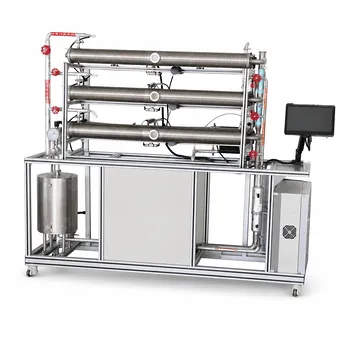
- Three-Tube Heat Transfer Educational Pilot Plant for Unit Operations Training
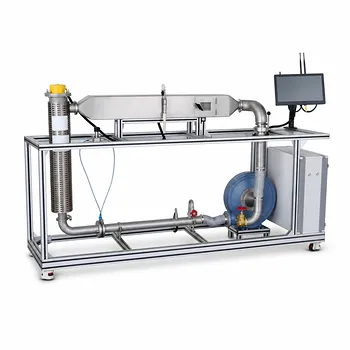
- Circulating Wind Tunnel Drying and Convective Heat Transfer Coefficient Determination Educational Pilot Plant
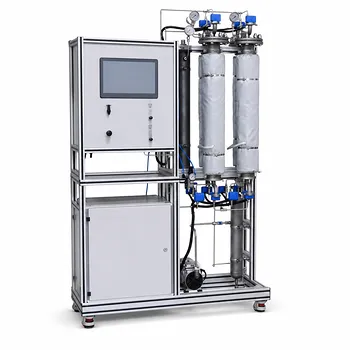
- Low Concentration Carbon Dioxide Capture Pressure Swing Adsorption Educational Pilot Plant
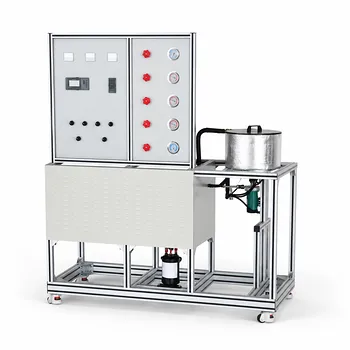
- Educational Compression Refrigeration Performance Determination Unit Operations Pilot Plant
- 100L Continuous Loop Hydrogenation Educational Unit Operations Pilot Plant
People Also Ask
- When is ε-NTU preferred over LMTD in pilot plants? Predict heat exchanger performance without iteration.
- How to Verify Air-Side Heat Transfer Coefficient with a Pilot Plant? Practical Lab Guide
- Why is emissivity critical in heat transfer pilot plants? Bridge the Gap Between Theory & Industrial Design
- How can a heat transfer pilot plant demonstrate waste heat recovery? Learn to optimize industrial thermal systems.
- How does transitioning to a multi-shell heat exchanger affect required area? Optimize pilot plant design.