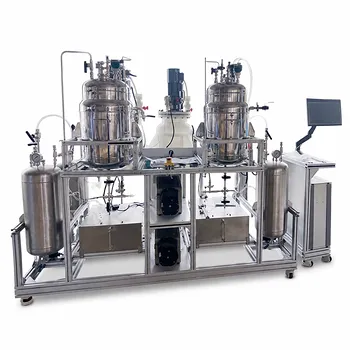
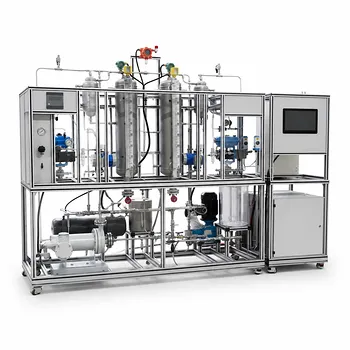
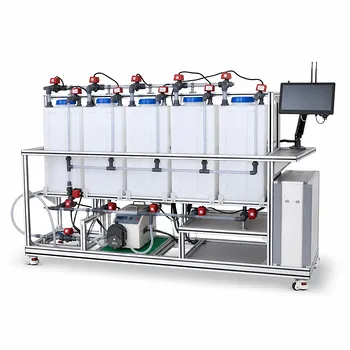
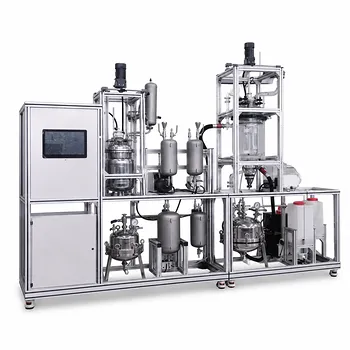
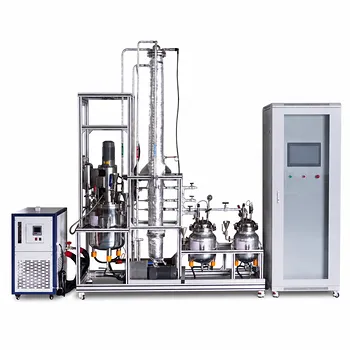
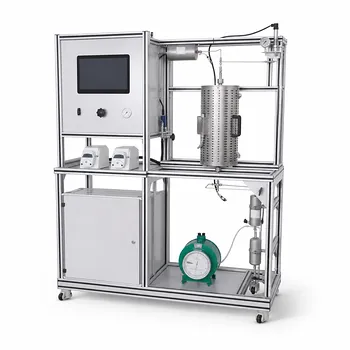
A scaled-down, transparent electrochemical reactor becomes your classroom’s time machine. Educational electrolysis pilot plants recreate the exact operating conditions of industrial copper and silver electrorefining in a safe, observable environment. By integrating adjustable power supplies, temperature-controlled cells, and real-time sensors, these systems let students directly measure how variables like current density, electrolyte concentration, and voltage shape metal purity and process efficiency—turning abstract theory into tangible, quantifiable data.
While a benchtop beaker can demonstrate basic oxidation-reduction, a true educational pilot plant bridges the gap to industry. It combines corrosion-resistant transparent cells, recirculating flow, and precision instrumentation so you can study not just the chemistry, but the mass-transfer limitations, energy consumption, and valuable by-product recovery that define real-world electrolytic refining.
Simulating Industrial Electrorefining at a Visible, Safe Scale
A dedicated pilot plant transforms a textbook diagram into a living process. The core setup mirrors the industrial cell: an impure metal anode dissolves while pure metal plates onto a cathode.
The Copper Refining Cell in Action
For copper, the cell holds an acidic copper sulfate ($\text{CuSO}_4$) electrolyte, a crude copper anode, and a pure copper cathode starter sheet. When direct current flows, copper ions migrate to the cathode and deposit as high-purity metal.
The pilot plant’s transparent vessel construction—often from corrosion-resistant acrylic, polypropylene, or PVDF—lets students watch the anode gradually consume itself and the cathode grow. Even more importantly, they can observe the slow accumulation of anode slime at the bottom of the cell.
Adapting the System for Silver Electrorefining
Silver refining follows a similar principle but uses a different chemistry. An impure silver anode and a pure silver cathode are immersed in an electrolyte of silver nitrate acidified with nitric acid.
The same pilot plant, when built with materials that withstand nitric acid, allows students to study selective dissolution. They can measure how carefully controlled cell voltage prevents base metal impurities from co-depositing on the cathode, a critical purity factor in precious metal refining.
Enabling Quantitative Analysis of Key Variables
The real power of an educational pilot plant lies in its instrumentation. Rather than just watching metal move, students can systematically probe what drives efficiency and purity.
Controlling Current Density and Voltage
An adjustable DC rectifier is the heart of the system. Students can set precise current densities and immediately see the consequences. Too high a current density in copper refining leads to rough, nodular cathode deposits; in silver refining, it risks co-depositing copper or other impurities.
The pilot plant’s integrated voltmeter and ammeter let them record the cell voltage under different conditions, calculate energy consumption per kilogram of metal deposited, and link that directly to Faraday’s laws of electrolysis.
Monitoring Electrolyte Composition and Temperature
Electrolyte conductivity and metal ion mobility are temperature-dependent. The system’s temperature-controlled cell and inline sensors let students maintain a steady temperature and measure the effect of small changes on deposition rate.
In silver refining, the free nitric acid concentration must be kept within a narrow range to prevent cathode dissolution or passivation. Pilot-scale recirculating pumps and sampling ports allow students to analyze electrolyte samples over time and perform mass balance calculations that reveal how concentration changes drive current efficiency.
Measuring Deposition Rates and Material Balance
By weighing the cathode before and after a timed run, students calculate the actual mass of metal deposited and compare it to the theoretical mass predicted by Faraday’s law. The ratio gives them the current efficiency—a direct measure of side reactions and short-circuits.
This quantitative exercise moves beyond simple chemistry into chemical engineering. They can measure the mass of anode sludge, analyze its precious metal content (silver, gold, platinum, palladium from copper anodes), and evaluate the economic viability of by-product recovery.
Visualizing By-Product Recovery and Its Economic Impact
A key teaching point that a pilot plant makes impossible to ignore is the value locked in the sludge at the bottom of the cell.
The Silent Lesson of Anode Slime
When crude copper anodes contain less reactive metals like silver and gold, those metals do not dissolve in the sulfate electrolyte. They fall as a fine powder. In a transparent pilot cell, students watch this sludge accumulate.
They can then filter, dry, and weigh the sludge. Combining this with the cathode’s mass gain, they perform a complete mass balance and calculate the economic credit from recovered precious metals—turning a simple refining exercise into a lesson on circular economy and process engineering economics.
Understanding the Trade-offs and Limitations
No pilot plant is a perfect mirror of a 50,000-amp industrial tankhouse. Recognizing the gaps is essential for honest education.
Scaling Effects and Idealized Conditions
Pilot cells operate at lower current densities and with smaller electrode surface areas, which can mask mass-transfer limitations that dominate industrial cells. The electrolyte volume is small, so concentration changes happen faster and may exaggerate the impact of slight over-potentials.
Students must learn to scale their data carefully. A high current efficiency measured in a pilot plant does not guarantee the same value in a full-scale cell where electrolyte flow maldistribution and anode geometry play a larger role.
Material Compatibility and Safety Constraints
While educational plants use chemically resistant plastics, long-term exposure to hot, acidic copper sulfate or nitric acid can still cause material degradation. Silver refining’s nitric acid electrolyte demands especially vigilant material selection and fume extraction.
These systems also need rigorous safety protocols for handling chlorine or other gases that might evolve if the electrolyte composition drifts out of specification.
Bridging the Gap with Flow-Enhanced Designs
Advanced educational pilot plants incorporate recirculating pumps and heat exchangers to mimic continuous industrial operation. By varying flow rate, students observe how convection affects deposition uniformity and the formation of anode slime, tackling mass-transfer concepts that a static beaker cannot teach.
Making the Right Choice for Your Teaching Goals
The design of the pilot plant should match the specific learning outcomes you need.
- If your primary focus is copper electrorefining fundamentals: Prioritize a system with a fully transparent cell, a precise adjustable DC power supply, and the ability to easily collect and analyze anode sludge.
- If your primary focus is precious metal recovery and process economics: Choose a plant that includes corrosion-resistant plumbing for nitric acid-based silver electrolytes, precise voltage control to avoid co-deposition, and sampling ports for electrolyte analysis.
- If your primary focus is bridging chemical engineering principles with industrial reality: Opt for a pilot plant with recirculating flow, integrated temperature control, and multi-sensor monitoring—this lets students study mass transfer, energy consumption, and current efficiency under continuous operation.
- If your primary focus is basic electrochemical science: A simpler, static pilot cell with transparent walls and a stable power supply remains perfectly adequate; the key is ensuring students can still measure mass changes and connect results directly to Faraday’s laws.
When your pilot plant aligns with the exact phenomenon you need to teach, it transforms electrolytic refining from a confusing set of reactions into an intuitive, quantitative, and unforgettable learning experience.
Summary Table:
| Feature | Copper Electrorefining | Silver Electrorefining |
|---|---|---|
| Electrolyte Used | Acidic copper sulfate ($CuSO_4$) | Silver nitrate acidified with nitric acid ($AgNO_3$ + $HNO_3$) |
| Anodes & Cathodes | Crude copper anode / Pure copper cathode | Impure silver anode / Pure silver cathode |
| Key Phenomena Study | Anode slime accumulation & copper deposition | Voltage control to prevent impurity co-deposition |
| Engineering Metrics | Current efficiency, energy consumption, Faraday's laws | Material compatibility (nitric acid), mass balance |
Bring Industrial-Scale Learning to Your Lab with LABPARK
To master complex electrochemical and chemical processes, students need hands-on experience with real-world dynamics. LABPARK designs and manufactures high-quality Educational and Vocational Unit Operations Pilot Plants in chemical engineering, bioprocess & biotech, and environmental & water treatment for universities, research institutes, and enterprises.
Our pilot plants bridge the gap between classroom theory and industrial reality, offering safe, transparent, and fully instrumented systems tailored to your curriculum.
Contact LABPARK today to customize your pilot plant solution!
Related Products
- Electrolyte Distillation Purification and Formulation Educational Pilot Plant
- Water Electrolysis Hydrogen Production and Storage Educational Pilot Plant
- Alkaline Membrane Water Electrolysis Educational Pilot Plant Unit Operations Training System
- Electrolytic Hydrogen Production Educational Unit Operations Pilot Plant
- Solid Waste Pyrolysis and Refining Educational Pilot Plant for Unit Operations
People Also Ask
- Why does simple distillation yield higher efficiency than flash distillation? Key thermodynamic differences.
- How to Integrate Spectroscopy in Distillation Pilot Plants for Advanced Process Control
- Why is the acentric factor important in pilot plants? Fluid property prediction.
- How to Estimate Distillation Pilot Plant Tray Efficiency? O'Connell's Correlation Guide
- How does double temperature difference control improve distillation pilot plants? Stabilize purity.