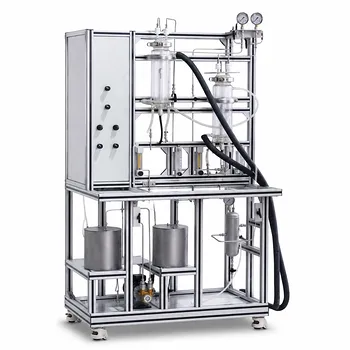
The leap from a bench-scale discovery to a commercial photochemical process hinges on one critical choice: your reactor configuration. Annular photoreactors, with a central light source, excel in pilot and commercial continuous-flow operations by maximizing energy utilization. Elliptical reflector designs, which focus external light to a reactor tube, are a laboratory staple for uniform irradiation but suffer from low incidence efficiency that cripples large-scale viability. This scaling is not merely a matter of size—it’s a complex interplay of radiation field distribution, flow dynamics, and practical operational constraints.
To successfully scale a photochemical unit operation, you must match the reactor’s fundamental light utility and flow characteristics to the scale of production. Annular designs win at commercial scale for their efficiency in continuous flow, while elliptical reflectors remain a precise but power-limited lab tool. The real challenge is navigating the hydrodynamic and selectivity pitfalls that emerge when the radiation field and fluid dynamics no longer behave like they did on the benchtop.
The Geometry of Light: How Annular and Elliptical Designs Work
Elliptical Reflectors: Precision at the Bench Scale
Cylindrical reactors with elliptical reflectors use an external lamp placed at one focal point, focusing the radiation onto a reactor tube at the other. This arrangement provides a highly uniform irradiation profile across the tube, which is ideal for precise kinetic studies. It allows researchers to isolate photochemical effects with minimal axial or radial variation in light intensity.
Annular Reactors: Efficiency at Scale
An annular photoreactor places the light source directly along the central axis of a cylindrical housing, with the reaction fluid flowing through the surrounding annular gap. This geometry maximizes photon capture because the light travels only a short distance through the reaction medium. The result is significantly higher energy efficiency, which becomes the dominant factor when you move beyond single-experiment studies into continuous production.
The Scaling Gap: From Lab Data to Pilot Reality
Radiation Field Distribution and Incidence Efficiency
The fundamental performance metric changes with scale. In a lab, the elliptical design’s uniform field delivers highly reproducible data. However, its incidence efficiency—the fraction of emitted photons that actually enter the reaction zone—is low. In a commercial-scale unit, this wasted energy translates directly into prohibitive operating costs and heat management nightmares. The annular design’s direct irradiation path inherently yields a higher photon utilization rate, a non-negotiable trait for a viable commercial plant.
Flow Rates and Residence Time Distribution
The physical geometry also dictates how the fluid moves. The narrow tube in an elliptical reflector setup works for low-flow, small-volume lab experiments. But to achieve commercially meaningful throughput, you need a much larger cross-sectional area. The annular reactor’s large flow path is perfectly suited for high-volume continuous operation, while that same large cross-section would be impractical for a lab experiment requiring only microliters of a precious photo-catalyst.
Hydrodynamic Complexity and the Limits of Similarity
Scaling a photochemical process is not a linear exercise. Just as with fixed-bed catalytic reactors, you cannot simply apply similarity theory to jump from a gram-scale lab rig to a ton-scale plant. Commercial-scale annular units introduce complex hydrodynamics—such as non-ideal velocity profiles and potential for backmixing—that are absent in a small tubular reactor. A pilot-scale unit becomes essential to study these emergent behaviors and tune the “effective” parameters in your mathematical models with semi-empirical data.
Beyond Light: Practical Considerations for Scale-Up
Selectivity and Backmixing in Series Reactions
Your reactor choice can make or break your product yield. In a series reaction (A + B → R → S, where R is your desired product), backmixing is the enemy. It keeps product R in the reactor too long, allowing it to degrade into the unwanted by-product S. Large-bore annular reactors, especially those operated with a wide residence time distribution, can promote this backmixing. If your chemistry is sensitive, the configuration's ability to enforce plug-flow-like behavior becomes as important as its light-capturing ability.
Cleaning Protocols and Maintenance Downtime
In an educational pilot plant or multi-product development facility, cleanability is a critical scaling concern. Flat-plate reactors shine here because they are designed for rapid disassembly and manual cleaning. In contrast, the tight geometry of a pseudoannular reactor makes mechanical scrubbing nearly impossible, forcing you to rely entirely on chemical cleaning protocols. This can sharply increase downtime and the frequency of solvent use, directly impacting a facility’s operational throughput.
Understanding the Trade-offs
Lab Flexibility vs. Commercial Throughput
An elliptical reflector gives you the perfect, controlled environment for an R&D chemist to understand a new reaction. An annular reactor is the workhorse that can produce kilograms of that material continuously. You cannot have both. Basing a commercial design on lab-optimal geometry leads to an energy-inefficient plant with poor production economics.
Cleaning Ease vs. Reactor Compactness
A compact annular design maximizes space and photon efficiency but hides its inner surfaces from a cleaning brush. A modular, flat-plate design is a maintenance manager’s dream but may sacrifice some of the light efficiency that photochemists crave. The right choice depends on whether your primary bottleneck is photon cost or operator time during product changeovers.
Making the Right Choice for Your Goal
The configuration you select must be the one that de-risks the scale-up for your specific priorities.
- If your primary focus is bench-scale reaction discovery: Use a cylindrical reactor with an elliptical reflector. Its uniform irradiation minimizes data noise, letting you accurately determine reaction kinetics on a small scale.
- If your primary focus is pilot-scale validation for commercial production: Design around an annular photoreactor. Its high energy efficiency and suitability for high-flow continuous operation make it the only practical model for industrial translation.
- If your primary focus is maintaining product selectivity in a series reaction: Favor a configuration that strictly minimizes backmixing, such as a spray tower or venturi loop reactor, attached to your light source. This protects your intermediate product from over-reacting.
- If your primary focus is minimizing operational downtime in an educational setting: Choose a flat-plate reactor. Its rapid disassembly allows students to clean the unit between experiments without the need for aggressive chemical procedures.
The path from a successful lab reaction to a functioning commercial plant is paved with these critical, configuration-level decisions, each one balancing the purity of light against the reality of flow.
Summary Table:
| Feature | Elliptical Reflector Design | Annular Reactor Design |
|---|---|---|
| Primary Scale | Laboratory / Bench | Pilot & Commercial |
| Photon Efficiency | Low (high external loss) | High (direct axis irradiation) |
| Flow Suitability | Low-flow, micro-volume | High-volume continuous |
| Backmixing Risk | Low (plug-flow) | High (needs careful control) |
| Cleanability | Relatively easy | Hard (requires chemical CIP) |
| Best Application | Kinetic studies & R&D discovery | Commercial-scale production |
Bridge the Gap from Lab to Pilot Scale with LABPARK
Ready to scale your chemical engineering, biotech, or water treatment operations? LABPARK provides premium Educational and Vocational Unit Operations Pilot Plants designed specifically for universities, research institutes, and enterprises. Our systems help you transition seamlessly from benchtop research to commercial-scale reality.
Contact LABPARK Today to discuss your pilot plant needs and get a tailored solution!
Related Products
- Photocatalytic Membrane Separation and Degradation Unit Operations Pilot Plant
- Rising and Falling Film Evaporation Educational Unit Operations Pilot Plant
- Educational Unit Operations Pilot Plant for Intraparticle Diffusion Effective Factor Measurement
People Also Ask
- What are the key differences in membrane configurations? Choose the Right Unit Operations Pilot Plant
- How Do Pervaporation, Vapor, and Gas Permeation Differ in Pilot Plants? Key Comparison
- What are the structural & performance trade-offs of flat-sheet, spiral-wound, & hollow-fiber membrane modules?
- Pervaporation vs. Vapor Permeation: Handling Suspended Solids in Membrane Pilot Plants
- How do PEI, PVDF, and PSU membranes compare in pilot plants? Find the best fit.