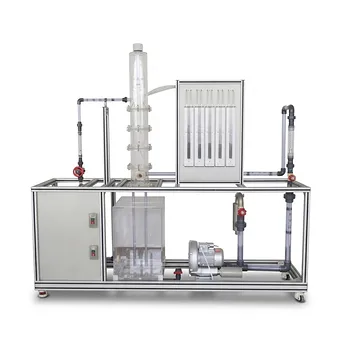
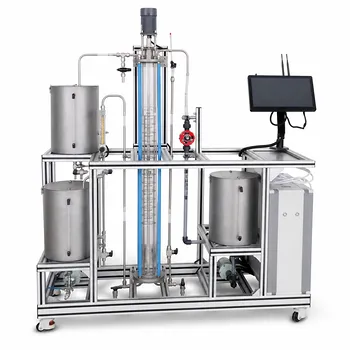
The answer lies in understanding the interplay of corrosive chemistry and fluid mechanics. In a bubble cap rectification column handling acidic media like hydrofluoric acid (HF), corrosion deposits form when the acid attacks metal components, generating solid metal fluorides. These particles are then carried upward by vapor entrainment and redistributed across trays during reflux. The resulting deposit patterns serve as a diagnostic map, revealing exactly which upstream materials are degrading. For pilot plant design, this means that instrumentation and metallurgy must be chosen not just for the bulk process fluid, but for the corrosive cocktails created by acid recycling and unintended leaks.
Corrosion deposits originate from acid-induced metal dissolution, then migrate through the column via entrainment and liquid reflux. Their distribution reveals the location and severity of material attack. Pilot plants must therefore incorporate strategic corrosion-resistant materials, leak prevention, and dedicated monitoring ports to turn these deposits from a catastrophic failure into a valuable learning tool.
How Corrosion Deposits Form in an Acidic Environment
Acid-Mediated Metal Dissolution
When hot, acidic media like HF contact internal surfaces, they strip metal atoms from steel, copper, or nickel alloys. The resulting ions immediately react with fluoride to form insoluble compounds that precipitate as solid deposits. These particles are both a symptom of material loss and a secondary source of process contamination.
The Role of Reflux and Entrainment
In a rectification column, rising vapor can carry fine solid particles upward—this is entrainment. Simultaneously, downward-flowing liquid reflux continuously washes trays. Acidic liquid recycled from the condenser back down the column spreads dissolved metal fluorides over every tray. This dual transport mechanism turns a localized corrosion problem into a column-wide deposition pattern.
What Distribution Patterns Reveal About the System
Iron as a Telltale of Steel Corrosion
High iron content found uniformly across all trays points directly to extensive corrosion of carbon steel components. Steel attacked by HF anywhere in the loop—column shell, reboiler, or piping—generates iron fluoride particles that entrain and redistribute. This uniform signature is often the first warning that the bulk metallurgy is incompatible with the process.
Nickel and Copper Migration from Specialty Alloys
Nickel and copper deposits typically trace back to high-performance alloys like Monel used in condensers or reflux lines. As acid chews into these components, nickel fluoride dissolves, migrates down the column with the reflux, and precipitates on lower trays. A concentration gradient—higher nickel readings near the top—often indicates the attack zone is in the condenser or regenerator.
Catastrophic Acceleration from Condenser Leaks
If a condenser develops a leak, external contaminants like salt water can introduce sodium, calcium, and magnesium into the acidic stream. These elements form fluoride salts that dramatically accelerate steel corrosion, often leading to rapid, unexpected tray damage. Their sudden appearance in deposit analysis is a clear red flag of a compromised heat exchanger.
Implications for Pilot Plant Design
A pilot plant intended for education or process development must be engineered as a diagnostic instrument, not just a miniature production unit.
Building with Purpose-Chosen Metallurgy
Material selection must consider all potential corrosion couples. Using a carbon steel column with a Monel condenser creates a galvanic pathway that feeds aggressive fluoride complexes back into the steel trays. Designers must either match materials homogeneously or isolate dissimilar metals with reliable inert barriers.
Installing Corrosion Monitoring Ports
Sampling ports at multiple tray levels and in the reboiler/condenser loops are non-negotiable. By periodically analyzing deposit composition, operators can spot early-stage material loss and trace it to its source before a leak becomes catastrophic. This transforms unit operations training from a black-box exercise into a living lesson in material compatibility.
Designing for Robust Sealing Against Leaks
Condenser leaks are especially dangerous because they inject accelerants directly into the reflux. Pilot plant designs must therefore prioritize double-sealed tube sheets, welded plate exchangers, or shell-and-tube units with easily inspectable joints. The cost of a leak-proof heat exchanger is trivial compared to the data lost and damage done by a contaminated system.
Balancing Cost, Safety, and Educational Value
No pilot plant budget is infinite, and using all-Monel construction is often impractical. The trade-off is between capital expense and the operational discipline of monitoring.
Cost-driven designs using carbon steel with a few corrosion-resistant internals can work safely if paired with rigorous deposit surveillance and a planned replacement schedule for vulnerable trays. However, this approach demands that operators interpret deposit data as a primary safety indicator, not an afterthought.
Performance-driven designs that upgrade the condenser and top trays to Hastelloy or Monel eliminate many failure sources but hide the educational value of watching corrosion patterns evolve. A well-designed pilot plant intentionally leaves some components as “sacrificial sensors” so that students and researchers can observe real-world corrosion dynamics without risking catastrophic failure.
Making the Right Choice for Your Pilot Plant Goal
The decision matrix depends on whether the plant is for advanced research, vocational training, or process scale-up validation.
- If your primary focus is fundamental research on corrosion mechanisms: Design with a mix of standard and exotic alloys, and fill the column with extra sample ports to study deposition kinetics in fine detail.
- If your primary focus is vocational training for operators: Choose a cost-optimized metallurgy but invest heavily in monitoring instrumentation and leak-detection protocols, so every run becomes a lesson in failure prevention.
- If your primary focus is scale-up validation for industrial production: Eliminate all known weak points—use corrosion-resistant materials throughout, especially in the condenser, and validate seal integrity with multiple independent methods before each campaign.
Build your pilot plant not just to run the process, but to illuminate every hidden chemical interaction that could one day threaten the full-scale operation.
Summary Table:
| Deposit Indicator | Probable Source | Design Recommendation |
|---|---|---|
| Iron (Uniform) | Carbon steel corrosion in shell/piping | Standardize metallurgy or plan tray replacement |
| Nickel & Copper | Monel alloy degradation in condenser/reflux | Install multi-level monitoring & sampling ports |
| Sodium & Calcium | External water leak in the condenser | Integrate double-sealed tube sheets or welded plates |
Are you designing a pilot plant for your laboratory or training facility? LABPARK provides premium Educational and Vocational Unit Operations Pilot Plants in chemical engineering, bioprocess & biotech, and environmental & water treatment. We help universities, research institutes, and enterprises build safe, reliable, and corrosion-resistant systems tailored to their educational and research goals.
Contact LABPARK today to consult with our engineering experts and find the perfect pilot plant configuration for your needs.
Related Products
- Plate Column Hydrodynamics Tray Demonstration Educational Pilot Plant
- Dual-Mode Rectification Pilot Plant for Practical Training Unit Operations
- Educational Rotary Disc Liquid-Liquid Extraction Pilot Plant
People Also Ask
- How to update chemometric calibration models in pilot plants? Best practices for process engineers.
- How does nuclear yield inefficiency translate to chemical engineering education? Optimize kinetics with pilot plants.
- How can educational pilot plants be used to teach process safety and risk assessment in chemical engineering curricula?
- Why Correct Sig Figs & Rounding Matter in Educational Pilot Plants: Ensure Data Accuracy
- Why Calculate Sieve Tray Pressure Drop? Optimize Distillation Pilot Plant Performance