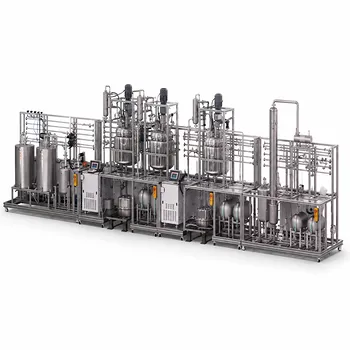
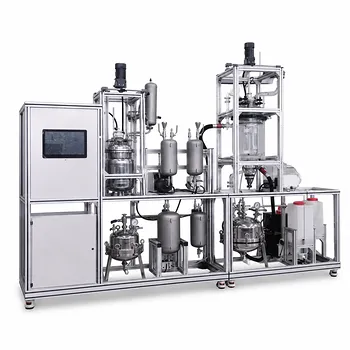
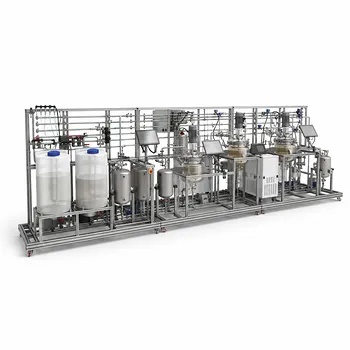
The leap from a 100-milliliter flask to a 10,000-liter reactor is not a linear progression—it is a transformation in physics. Chemical engineering unit operations pilot plants assist educational and research facilities by providing an authentic, intermediate-scale environment where students and researchers can physically confront the non-linear challenges of mixing, heat transfer, and process control that emerge during API scale-up. These systems bridge the gap between benchtop chemistry and full commercial production, turning abstract equations into tangible experience with industrial reality.
The core value of an educational pilot plant is its ability to make the invisible visible: it forces students to grapple with the transport phenomena, fluid dynamics, and integrated unit operations that determine whether a lab-scale synthesis becomes a safe, profitable, and high-purity manufacturing process. Without this hands-on bridge, education remains theoretical; with it, students learn to anticipate and mitigate the critical risks that define successful API scale-up.
Closing the Gap Between the Beaker and the Batch Reactor
The primary challenge in teaching API scale-up is that the physical rules governing a reaction change dramatically with size. A magnetic stir bar in a round-bottom flask creates a world that simply does not exist at the 100-kilogram scale. Pilot plants dismantle these illusions.
Experiencing the Criticality of Heat and Mass Transfer
In a laboratory flask, the high surface-area-to-volume ratio makes heating and cooling nearly instantaneous. In a pilot-scale vessel, this ratio collapses. Students using pilot plants quickly learn that exothermic reactions can run away, and cooling can take hours instead of minutes. They see firsthand how heat transfer limitations force a redesign of reaction protocols, mandating slower reagent additions or different cooling strategies that were irrelevant on the bench.
Similarly, mixing is no longer a simple matter of a spinning magnet. At pilot scale, students encounter mass transfer limitations where poor bulk mixing creates concentration gradients, leading to by-product formation and inconsistent crystal nucleation. By physically operating agitated vessels with different impeller types, they internalize why the "stir well" step in a lab notebook is a dangerous oversimplification for manufacturing.
Studying Fluid Dynamics and Process Control Under Realistic Conditions
Laboratory glassware offers visual clarity but hides the influence of fluid velocity, shear, and residence time. Pilot plants with inline sensors and process control systems teach students how to manage these hidden variables. They learn to interpret data from flow meters, thermocouples, and pressure transducers, developing an intuition for process dynamics and loop tuning that is essential for safe and consistent operation. This hands-on control experience cannot be replicated through simulations alone.
Mastering the Integrated Sequence of Unit Operations
An API is not made by a single step; it is forged through a chain of interconnected physical transformations. An educational pilot plant designed as a complete mini-plant exposes the domino effect that cascades through a process.
From Reaction to Isolation: The Crystallization Conundrum
A seemingly successful reaction in a pilot-scale batch reactor can fail miserably in the filtration and drying stages. The upstream conditions—cooling rate, mixing intensity, and impurity profile—directly dictate the downstream API crystal form, particle size distribution, and powder flow properties. Students using a pilot plant that integrates a crystallizer, filter dryer, and dryer witness this cause-and-effect relationship. They can analyze how an overly aggressive post-reaction cooling ramp produces dendritic crystals that clog the filter cloth, a painful but invaluable lesson.
Batch vs. Continuous Processing: A Physical Evaluation
API manufacturing increasingly incorporates continuous processing for hazardous or highly exothermic reactions. Pilot plants that allow for modular reconfiguration (switching from a batch stirred tank to a tubular reactor or continuous stirred-tank reactor cascade) let researchers physically evaluate residence time distribution, steady-state control, and heat transfer intensification. They can compare the impurity profile of a batch nitration against a microscale continuous flow nitration, understanding why a continuous setup not only improves safety but also yield and quality.
Preparing for the Regulated, High-Purity Reality of APIs
Teaching chemical engineering principles is one thing; teaching them within the context of Good Manufacturing Practice (GMP) expectations is another. Educational pilot plants serve as a proxy for this regulated environment.
Defining Critical Process Parameters and Quality
The scale-up phase is where a process's robustness is truly tested. Students using pilot-scale equipment learn to perform process characterization studies, deliberately varying parameters like temperature, stoichiometry, and agitation speed to identify their effect on critical quality attributes. This hands-on investigation of proven acceptable ranges teaches the fundamental logic behind a control strategy and the validation lifecycle, directly aligning with pharmaceutical industry needs.
Instilling a Culture of Process Safety
A runaway reaction in a 100-liter pilot reactor is a terrifying and potentially fatal event. Operating at this scale, even with inherently safer materials, ingrains a visceral understanding of thermal runaway scenarios, vent sizing, and the importance of procedural discipline. This training breeds the process safety mindset that is non-negotiable in API manufacturing, a perspective that glassware simply cannot convey.
Understanding the Trade-offs of Pilot-Plant Education
While indispensable, reliance on pilot plants for teaching scale-up is not without its limitations. A critical, objective view is necessary to avoid creating new blind spots.
The Fidelity Gap: Pilot is Not Plant
A 20-liter pilot reactor does not perfectly emulate a 10,000-liter production vessel. Surface-to-volume ratios, mixing dead zones, and cleaning challenges differ by orders of magnitude. Students must be taught that the pilot plant is a scale-down model, not a miniature replica. Over-reliance on a single pilot scale can instill false confidence; educators must explicitly link pilot observations to mathematical modeling and dimensional analysis to predict performance at full scale.
The Cost and Safety Overhead
Operating a comprehensive pilot plant requires significant capital investment, rigorous maintenance, raw material costs, and dedicated safety infrastructure. The educational value is immense, but the operational complexity can distract from core learning objectives if not managed by experienced technical staff. The focus must remain on the principles, not just machine operation.
Designing an Educational Pilot Plant for Maximum Impact
The true power of a pilot plant lies not in the size of its steel but in how it is integrated into the curriculum. It must be a tool for inquiry, not a static museum.
- If your primary focus is fundamental process engineering: Design a flexible skid with a glass-lined reactor, a once-through heat exchanger, and a vacuum-capable filter dryer. Prioritize clear viewing ports and identical instrumentation to what students analyze in class, allowing them to directly correlate theory with observation.
- If your primary focus is API-specific quality and regulatory training: Integrate a crystallization system with inline particle size analysis and a column for distillation or extraction. Emphasize procedural documentation and the demonstration of how upstream reaction conditions create polymorphic and purity outcomes downstream.
- If your primary focus is bridging to industrial R&D roles: Build a modular system that can physically swap between a batch stirred tank and a coiled tubular reactor. Complement this with open-sourced data streams for advanced process modeling, teaching students to validate a predictive model against their own experimental data.
The goal is not to train operators of a specific machine, but to create adaptive problem-solvers who can diagnose a fluid flow miscalculation by the sound of a pump, and who respect the profound shift in physical law that occurs when a discovery moves from the beaker to the world.
Summary Table:
| Scale-Up Challenge | Laboratory Illusion (Flask) | Pilot Plant Reality (Unit Operation) |
|---|---|---|
| Heat Transfer | Instant heating and cooling | Collapsing surface-to-volume ratio; risk of thermal runaway. |
| Mass & Mixing | Simple magnetic stirring | Complex fluid dynamics; concentration gradients and bypasses. |
| Downstream Flow | Disconnected batch steps | Integrated sequence from crystallization to filtration and drying. |
| Process Control | Basic manual monitoring | Automated sensor loops monitoring flow, pressure, and temperature. |
Bring Industrial Scale-Up into Your Lab with LABPARK
Bridge the gap between laboratory benchtop chemistry and commercial-scale manufacturing. LABPARK provides high-quality Educational and Vocational Unit Operations Pilot Plants specializing in:
- Chemical Engineering (distillation, crystallization, heat transfer, and reaction dynamics)
- Bioprocess & Biotech (fermentation and bioreactor systems)
- Environmental & Water Treatment (filtration, purification, and wastewater processing)
We help universities, research institutes, and enterprises equip their facilities with the tools needed to train the next generation of engineers in process dynamics, GMP validation, and process safety.
Ready to elevate your training and research capabilities? Contact LABPARK today to design your custom pilot plant solution!
Related Products
- Aspirin API Synthesis Unit Operations Training Pilot Plant
- Ethyl Acetate Synthesis Unit Operations Pilot Plant for Practical Training
- Educational Unit Operations Pilot Plant for Intraparticle Diffusion Effective Factor Measurement
- Gallium and Indium Selective Extraction Educational Pilot Plant
- Bio-fermentation Ethanol Production Practical Training Unit Operations Pilot Plant
People Also Ask
- How do ergonomic and operational accessibility guidelines influence the equipment layout of a training pilot plant?
- What are the limitations of acentric factor models? Avoid pilot plant errors with polar fluids.
- Why use step disturbance in pilot plants? Master process control dynamic response.
- How can Hotelling's T² & Q statistics detect pilot plant abnormalities? Optimize Safety
- Why use split-plot designs in pilot plants instead of CRD? Optimize process parameters effectively.