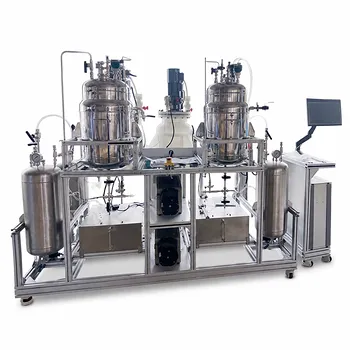
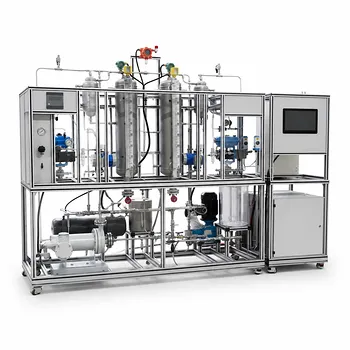
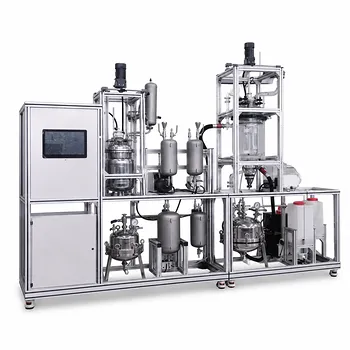
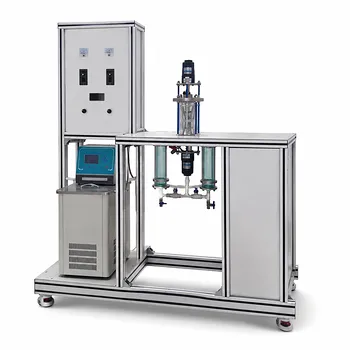
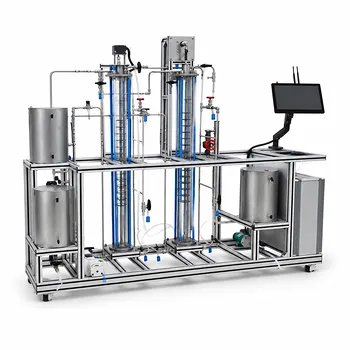
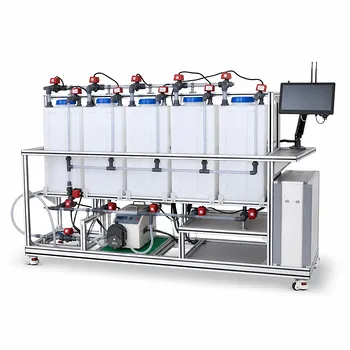
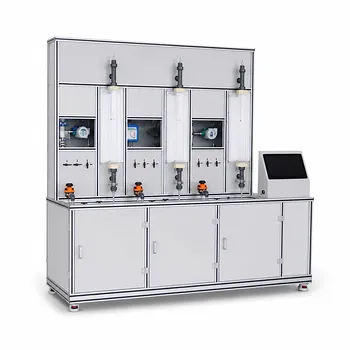
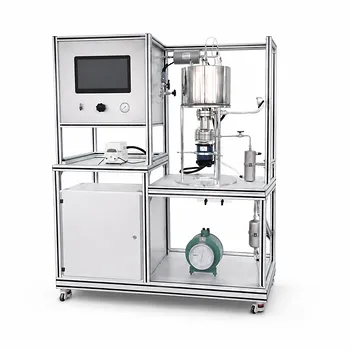
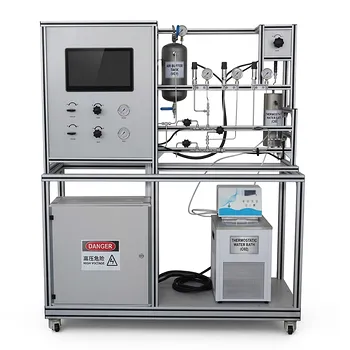
At the heart of every electrochemical teaching pilot plant lies a direct, measurable answer to Faraday’s foundational laws. These systems take the abstract proportionality “mass is proportional to charge” and make it tangible: students control a direct current, time the run, and then physically weigh the metal deposited on a cathode or collect the volume of gas evolved at an anode. By comparing the carefully logged electrical input (ampere-hours) against the actual yield, the plant transforms textbook equations into an experimental audit of electrochemical efficiency and equivalent weight.
The real power of an educational pilot plant is not just proving that Faraday’s laws exist—it’s giving you the tools to calculate exactly how far a real reaction deviates from the ideal, and why. It bridges the gap between a steady current reading on a power supply and the complex, multi‑physics reality inside an industrial electrolyzer.
The Foundation: Faraday’s Laws in a Practical Context
An educational pilot plant doesn’t change the theory; it changes the level of interrogation you can apply to it. Instead of a passive demonstration, it becomes a quantitative tool for process analysis.
The Two Laws that Govern Electrochemical Change
Faraday’s First Law tells you that the mass of substance altered at an electrode is directly proportional to the total electrical charge passed. Faraday’s Second Law refines this by stating that for a fixed amount of charge, the masses of different elements produced are in the ratio of their chemical equivalent weights—approximately 96,500 coulombs being needed to liberate one gram‑equivalent weight. In a liquid‑phase pilot plant, these are not just statements; they are design specifications for every measurement you take.
From Equations to Experiments: Why Pilot Plants are Essential
A simple beaker and copper plate experiment can show a bubble or a color change. But a scaled‑up educational pilot plant closes the loop between the charge you deliver and the products you can actually capture. It forces students to confront mass‑balance verification: did every electron passed go into your target product, or were some lost to side reactions? The integrated sensors and controlled flow conditions turn Faraday’s laws from a stoichiometric promise into a practical diagnostic tool for current efficiency, electrode passivation, and energy consumption.
The Anatomy of an Educational Electrolysis Pilot Plant
To demonstrate Faraday’s laws credibly, the hardware must do three things simultaneously: make the reaction visible, measure the charge precisely, and capture the products without loss. Industrial‑grade educational plants are built around these demands.
Transparent Cells and Direct Observation
Unlike opaque industrial reactors, teaching pilot plants often use transparent, scaled reaction chambers. This allows students to watch zinc metal plate out from a zinc chloride solution or see chlorine gas bubble off the anode. Visibility turns an electrochemical reaction from a mysterious flux of ions into a kinetic, observable process—metal thickness growing, gas columns rising—which directly reinforces the mass‑charge connection.
Precision Instrumentation for Charge Measurement
A laboratory rheostat gives you a rough current. An educational pilot plant integrates industrial‑grade rectifiers, power analyzers, and online current and voltage logging. This lets students record the exact ampere‑hours passed over time. Crucially, the setup also tracks cell voltage and temperature—vital data points that, alongside Faraday’s laws, enable the calculation of energy efficiency and the thermodynamic decomposition voltage.
Gas Collection and Mass Deposition Techniques
The second half of the equation is product quantification. For gas‑evolving reactions, plants feature automated gas‑liquid separators and mass flow meters to measure hydrogen, oxygen, or chlorine volumes accurately. For metal deposition, they use electrodes that can be removed, dried, and weighed on a precision balance. With both the charge in and the product out known, the student can directly compute the electrochemical equivalent and compare it to the theoretical value.
Demonstrating Faraday’s Laws Step-by-Step
When a class runs a zinc chloride electrolysis or a water splitting experiment, the pilot plant walks them through a natural verification sequence.
Verifying the First Law: Mass Proportional to Charge
By running the cell at a constant current and taking timed samples at increasing charge totals, students can plot the measured mass of zinc deposited (or gas volume evolved) versus ampere‑hours. The resulting straight‑line relationship is a visual, data‑driven confirmation of Faraday’s First Law. The slope of that line is the electrochemical equivalent for the specific reaction.
Verifying the Second Law: Equivalent Weights in Action
Switching the electrolyte—say, from a copper‑based solution to a silver‑based one—with exactly the same charge passed reveals the Second Law. The masses deposited differ, but when each mass is divided by its own equivalent weight (atomic mass divided by valency), the ratios become simple integers. The pilot plant’s ability to precisely control charge makes this comparative experiment routine, rather than a theoretical abstraction.
Calculating Current Efficiency: The Gap Between Ideal and Real
In any educational pilot plant, the most valuable lesson is that the measured mass rarely equals the theoretical mass. The ratio gives the current efficiency. Here, Faraday’s laws become a diagnostic tool: a 95% efficiency means 5% of the electrons were diverted to side reactions (like hydrogen evolution alongside metal plating) or lost to leaks. The plant’s sensors—pH, conductivity, temperature—allow students to investigate why efficiency drops at higher current density or lower concentration.
Bridging Theory and Industrial Process Design
Demonstrating Faraday’s laws doesn’t end with a lab report. These pilot plants show how the same principles govern scaled‑up unit operations.
In a chlor‑alkali brine electrolysis module, students see that theoretical hydrogen and chlorine production rates can be predicted directly from the current using Faraday’s laws. They then measure the actual gas flows and pH changes at the cathode to calculate caustic efficiency. The plant’s gas absorption systems and explosion‑proof fittings emphasize that applying Faraday’s laws at an industrial scale means also managing safety hazards. Similarly, a proton exchange membrane (PEM) water electrolyzer setup uses the same laws to benchmark faradaic and voltage efficiencies against the molar enthalpy of water formation (285.86 kJ/mol). Students learn that the theoretical minimum energy needed to split water has to be compared with the actual voltage × current × time product—a direct application of Faraday’s charge‑mass link combined with thermodynamics.
Understanding the Trade-offs and Limitations
An educational pilot plant is honest pedagogy: it reveals where the neat, linear world of Faraday’s laws collides with the messy reality of liquid‑phase electrochemical reactions.
Side Reactions and Efficiency Losses
Not all current goes to the intended product. Dissolved oxygen reduction, hydrogen evolution on the cathode during metal plating, or the formation of unwanted intermediates all consume charge. The pilot plant’s transparency and sensors make these parasitic reactions visible as discrepancies in the mass balance, forcing students to learn that current efficiency is never 100%—and that Faraday’s laws give you the baseline to measure against.
The Complexity of Real Electrolyte Solutions
Faraday’s laws assume 100% current efficiency for a single ionic species. In a real mixed electrolyte, multiple ions can discharge simultaneously. The pilot plant’s online conductivity and pH meters show how changes in mass transfer limitations, local concentration gradients, and electrolyte composition can shift which reaction dominates at the electrode. This teaches that applying Faraday’s laws at scale requires a detailed understanding of the reaction kinetics, not just the total charge passed.
Safety Hazards in Scaling Up
Scaling from a manual burette to a pilot plant means dealing with toxic gases like chlorine, explosive hydrogen, and high current densities. Educational plants incorporate gas absorption scrubbers, specialized ventilation, and automated shut‑offs. The trade‑off is clear: you gain the ability to measure and apply Faraday’s laws to real‑world processes, but you must also learn the rigorous safety protocols that industrial electrochemistry demands.
Making the Right Choice for Your Learning or Research Goal
How you use an electrolysis pilot plant determines which aspects of Faraday’s laws become central to your work. Align your objectives with the right experimental design.
- If your primary focus is mastering electrochemical fundamentals: Start with a transparent cell for metal deposition (like copper or silver). Measure mass versus charge for a single, well‑behaved reaction. This isolates Faraday’s laws in their purest form and builds intuition for equivalent weights and current efficiency.
- If your primary focus is industrial process design: Move to a flow‑through, plate‑and‑frame reactor with recirculating pumps and heat exchangers. Use the charge‑mass link to calculate energy consumption per kilogram of product, and study how electrode passivation and mass transfer limitations degrade current efficiency over time.
- If your primary focus is renewable energy and hydrogen technology: Adopt a PEM water electrolyzer with mass flow meters and power analyzers. Apply Faraday’s laws to directly compute the faradaic efficiency of hydrogen production and combine it with the thermodynamic minimum energy to evaluate overall system performance.
- If your primary focus is safety and operational training: Select a chlor‑alkali or chlorine‑generating pilot unit with full gas absorption. Practice using the charge‑to‑product relationship to predict gas generation rates and validate that the scrubbing system is sized correctly—turning Faraday’s laws into a live safety calculation tool.
As you move from a simple laboratory beaker to a sensor‑rich pilot plant, Faraday’s laws stop being a static, historical formula and become the dynamic, quantitative backbone of your entire electrochemical thinking.
Summary Table:
| Focus Area | Key Measurement | Hardware Needed | Educational Goal |
|---|---|---|---|
| Electrochemical Fundamentals | Mass deposited vs. total charge | Transparent cells, precision balances | Verifying First & Second Laws, equivalent weights |
| Industrial Process Design | Energy consumption per kg, current efficiency | Flow-through reactors, pumps, heat exchangers | Understanding mass transfer, voltage loss, passivation |
| Renewable Energy (Hydrogen) | Hydrogen/oxygen flow rates vs. current | PEM water electrolyzers, mass flow meters | Benchmarking faradaic and voltage efficiency |
| Safety & Industrial Training | Gas generation rates, scrubber capacity | Chlor-alkali units, gas absorption scrubbers | Scaling up reactions, managing toxic/explosive gases |
Bring Electrochemical Theory to Life with LABPARK
Looking to enhance your chemical engineering curriculum or research capabilities? LABPARK provides state-of-the-art Educational and Vocational Unit Operations Pilot Plants in chemical engineering, bioprocess & biotech, and environmental & water treatment.
Our customized pilot plants empower universities, research institutes, and enterprises to:
- Bridge the Gap: Translate textbook formulas (like Faraday's laws) into hands-on, industrial-scale operations.
- Analyze Precisely: Conduct accurate mass-balance, thermodynamic, and efficiency calculations with integrated online sensors.
- Prioritize Safety: Train students and operators on advanced gas absorption, venting, and automated safety systems.
Ready to upgrade your lab's training equipment? Contact LABPARK today to discuss your specific educational and research requirements!
Related Products
- Water Electrolysis Hydrogen Production and Storage Educational Pilot Plant
- Electrolytic Hydrogen Production Educational Unit Operations Pilot Plant
- Ternary Liquid-Liquid Equilibrium Educational Pilot Plant
- Alkaline Membrane Water Electrolysis Educational Pilot Plant Unit Operations Training System
- Gallium and Indium Selective Extraction Educational Pilot Plant
People Also Ask
- How do chemical engineering pilot plants demonstrate electrolysis? Bridge Theory & Industrial Scale
- Bipolar vs Monopolar Electrolysis: Key Configuration Details to Analyze in Pilot Plants
- Which Electrolysis Pilot Plant Parameters Ensure Safety & Efficiency? Key Controls Explained
- Why is the selection of electrode materials critical when configuring or operating educational electrolysis pilot plants?
- How to update chemometric calibration models in pilot plants? Best practices for process engineers.