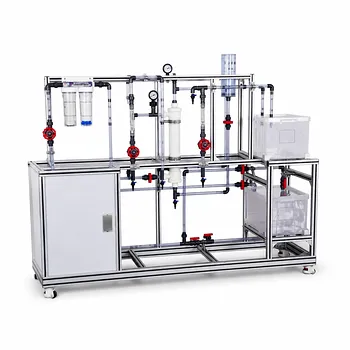
Nanostructured membranes redefine pilot-scale water treatment by fundamentally altering how water and contaminants interact at the molecular level. They directly boost the mass transfer coefficient, enabling higher permeation rates and lower energy consumption. In a pilot plant, this translates to measurable gains in efficiency, longer membrane life from reduced fouling, and richer experimental insight into real-world viability.
Advanced nanostructured membranes improve pilot plant performance not just by making water pass through faster, but by engineering surface chemistry and pore architecture to minimize resistance and foulant adhesion. The result is a more predictive and efficient platform for validating next-generation water treatment processes.
The Core Mechanism: Breaking Down Boundary Layer Resistance
How Nanostructures Increase the Mass Transfer Coefficient
The primary reference points to a fundamental transport phenomenon: the mass transfer coefficient of water or solutes across the membrane. Nanostructured materials introduce highly ordered, hydrophilic channels or atomically thin layers that reduce tortuosity and create a near-frictionless flow path. This increase in the coefficient means that a given pressure drives more permeate through the membrane, directly improving the productivity of a pilot plant.
Optimized Pore Networks and Surface Structures
Conventional membranes often have a broad pore size distribution and a passive surface. Advanced nanostructured membranes, however, can feature uniform nanopores (like those in carbon nanotube arrays or graphene oxide laminates) and tuned surface energy. These optimized structures shrink the stagnant boundary layer thickness at the liquid-membrane interface, where concentration polarization usually builds up. By reducing this resistance, the pilot plant operates closer to the theoretical osmotic pressure, not the much higher one caused by accumulation of rejected solutes.
The Result: Higher Flux at Lower Pressures
Fewer boundary layer losses directly manifest as two critical pilot plant metrics: higher permeate flux and lower driving pressure. This decoupling of productivity from energy input is transformative. During a pilot study, researchers can demonstrate a 30–50% reduction in specific energy consumption compared to traditional thin-film composite membranes, all while maintaining the same or higher clean water output. This is the most immediate performance improvement nanostructured membranes deliver.
Beyond Permeability: How Nanostructured Membranes Tackle Fouling
Graphene Oxide and Biomimetic Coatings
Membrane fouling remains the Achilles’ heel of water treatment. Nanostructured membranes address this proactively. Graphene oxide layers can create an atomically smooth, highly hydrophilic surface that resists the adhesion of proteins, oils, and biofilms. Similarly, biomimetic coatings inspired by aquaporins or shark skin introduce surface patterns that repel foulants. In a pilot plant, these materials are tested head-to-head with conventional membranes, often showing a 50% slower flux decline when processing high-organic wastewaters.
Smart, Self-Cleaning Membranes
Pilot plants can also host stimuli-responsive membranes that change their surface properties in reaction to temperature or pH shifts. When a fouling layer forms, a short spike in temperature causes the membrane to swell or switch its surface charge, releasing the foulants without chemical cleaning. This self-cleaning behavior is evaluated in pilot plants by cycling between normal operation and cleaning triggers, quantifying the recovery of flux and the reduction in downtime. It is a direct demonstration of a membrane that actively maintains its own performance.
Synergy with Process Integration
Advanced membranes shine when integrated into a well-designed pre-treatment train. For instance, placing an activated carbon adsorption unit before the nanostructured membrane module removes dissolved organics that would otherwise consume the membrane’s high-performance surface. The pilot plant becomes a testbed to optimize this sequence, where students can measure how the combination extends membrane lifespan by 2–3 times compared to using the advanced membrane alone. The performance gain is a system-level outcome, not just a material property.
Demonstrating Selective Separation in Pilot Plants
Nanofiltration’s Charge-Based Rejection
Nanostructured NF membranes push separation science further by combining size sieving with electrostatic effects. In a pilot plant, these membranes consistently reject 90–98% of divalent ions like MgSO₄ while allowing 20–80% of monovalent NaCl to pass. This is due to precise charge-dependent rejection engineered into the membrane’s nanopores. By tuning feed pH and pressure, researchers can directly observe how surface charge modulation alters separation performance—an insight unattainable with generic membranes. This allows pilot plants to simulate water softening and resource recovery with a single, energy-efficient step.
Using Pilot Plants to Validate Organic-Inorganic Separation
Pilot plants are where selective rejection gets quantified against real-world challenges. Nanostructured membranes with tailored pore sizes (sub-1 nanometer) can separate organic molecules of 200–400 Da from inorganic salts. By spiking feeds with specific pollutants, students measure removal rates that exceed 99% for certain pesticides or pharmaceuticals while letting desired minerals pass. This performance data is critical for designing industrial plants that aim to recover valuable resources from wastewater rather than just discharge it.
Understanding the Trade-offs
The Cost and Scalability Challenge
While lab-scale demonstrations are compelling, nanostructured membranes currently face higher manufacturing costs and challenges in producing defect-free large-area modules. A pilot plant may show a 40% flux improvement, but that advantage can erode if the membrane costs three times more and must be replaced more frequently due to mechanical fragility. Student experiments should therefore include a life-cycle cost analysis to ground the performance data in economic reality.
Operational Complexity and Measurement Demands
These advanced membranes often require tightly controlled pre-treatment and narrower operating windows. A pH or temperature excursion that a conventional membrane tolerates might permanently damage a delicate nano-coating. In a pilot plant, this means extra sensors, tighter control loops, and more complex data interpretation. The performance gain is real, but so is the increased operational vigilance needed to sustain it.
Potential for Nanoparticle Leaching
Certain nanomaterials (e.g., silver nanoparticles used for antimicrobial action) may gradually release from the membrane matrix. Pilot plant studies must include effluent quality tests for these leachates to ensure that solving one water problem does not create another. This is an essential regulatory consideration that the performance data alone cannot answer.
Making the Right Choice for Your Pilot Plant Study
The specific performance improvements you observe will depend on the problem you design the experiment to solve. Align your pilot plant configuration accordingly.
- If your primary focus is energy efficiency: Prioritize membranes with high mass transfer coefficients, such as aligned carbon nanotube or graphene oxide laminates, and design experiments to measure specific energy consumption (kWh/m³) across a range of pressures.
- If your primary focus is fouling resistance: Select membranes with biomimetic coatings or self-cleaning functionality, and run extended trials with challenging feed waters while tracking flux decline and cleaning frequency.
- If your primary focus is selective contaminant removal: Use nanostructured NF membranes with charge-dependent rejection, and systematically test divalent vs. monovalent ion separation and organic micropollutant rejection at varying pH and concentration conditions.
- If your primary focus is process intensification: Integrate the advanced membrane with optimized pre-treatment (e.g., activated carbon) and measure membrane lifespan, water recovery, and overall system footprint to quantify the holistic performance leap.
Nanostructured membranes turn pilot plants from mere simulators into uncovering the true limits of water treatment productivity, selectivity, and resilience—provided you measure what matters.
Summary Table:
| Membrane Feature | Primary Benefit | Key Pilot Plant Metric |
|---|---|---|
| Optimized Pore Networks | Higher mass transfer & lower resistance | 30–50% lower specific energy consumption |
| Graphene Oxide / Biomimetic | Active fouling resistance | 50% slower flux decline in organic wastewater |
| Self-Cleaning Coatings | Thermal/pH responsive regeneration | High flux recovery and reduced cleaning downtime |
| Charge-Based NF | Selective ion & organic rejection | 90–98% divalent ion rejection, 99%+ organic removal |
Bring Next-Generation Water Treatment to Your Lab
Ready to validate advanced membrane separation technologies in your curriculum or research? LABPARK designs and manufactures high-performance Educational and Vocational Unit Operations Pilot Plants in chemical engineering, bioprocess & biotech, and environmental & water treatment.
We help universities, research institutes, and enterprises bridge the gap between laboratory discovery and industrial application. Our custom-engineered pilot systems provide the precise control and data acquisition required to test next-gen nanostructured membranes under real-world conditions.
Contact LABPARK Today to discuss your project requirements and find the ideal pilot plant solution for your institution!
Related Products
- Multifunctional Membrane Separation Educational Pilot Plant with Ultrafiltration, Nanofiltration, Reverse Osmosis
- Multi-Functional Membrane Separation Educational Pilot Plant for Unit Operations Lab
- Ultrafiltration Membrane Separation Educational Pilot Plant
- Hollow Fiber Ultrafiltration Membrane Separation Educational Pilot Plant
- Photocatalytic Membrane Separation and Degradation Unit Operations Pilot Plant
People Also Ask
- Pervaporation vs. Vapor Permeation: Handling Suspended Solids in Membrane Pilot Plants
- How do PEI, PVDF, and PSU membranes compare in pilot plants? Find the best fit.
- What are the trade-offs of polymer vs inorganic membranes in teaching pilot plants? Key laboratory comparison.
- What are the key flow configuration loops in membrane pilot plants? Optimize Performance
- How can operators optimize operating conditions and cleaning protocols in membrane separation pilot plants to mitigate fouling?