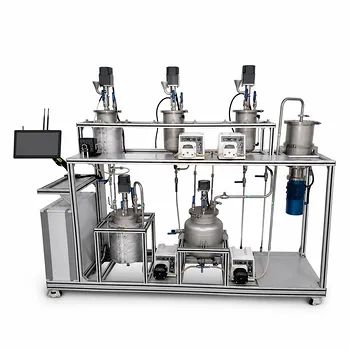
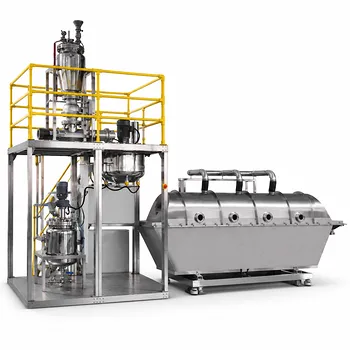
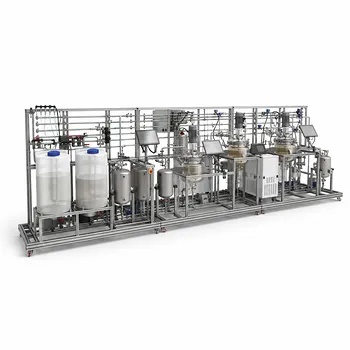
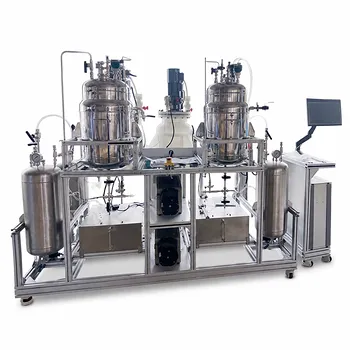
The most direct way to demonstrate the impact of process choice on formulation stability is to run the same powder blend through two different processing paths—one wet, one dry—inside a bioprocess pilot plant, then subject the resulting materials to identical accelerated stability testing. This side-by-side comparison makes the often-invisible effects of moisture, heat, and mechanical stress physically measurable. It transforms a theoretical risk into a clear, data-driven lesson about why the chosen granulation method chemically matters.
The critical insight is that formulation stability is not just a property of the drug itself; it is a product of the entire processing history. A pilot plant demonstration that couples realistic unit operations with follow-up stability analysis provides the definitive, hands-on proof of how wet granulation’s thermal and moisture stresses can accelerate degradation far more than a dry blending or dry granulation route.
Designing the Core Demonstration: A Tale of Two Processes
The key is to isolate the process variable. Everything else—formulation, storage, analytics—must be identical.
Splitting the Blend to Eliminate Variables
Begin by preparing a single, large batch of the drug-excipient powder blend. Divide this master batch precisely in two. This single action removes any doubt that differences later seen are due to ingredient variation or weighing errors.
Subjecting Each Half to a Different Unit Operation
Process one half using dry techniques. Depending on your pilot plant’s capabilities, this could be simple direct compression or a dry granulation step using a roller compactor. The defining characteristic is the absence of water and the avoidance of a wet mass drying step.
Process the other half through a wet granulation train. This typically involves a high-shear granulator to mix the powder with a binder fluid, followed by a fluidized bed dryer or tray dryer to remove the added moisture.
Exposing Both to Identical Stress Conditions
Place the final granules or compacts from both pathways into stability chambers set to stressed temperature and humidity conditions. Analyze chemical degradation products and physical changes at predefined time points. Any divergence in impurity growth curves points directly back to the single processing difference you introduced.
Mapping the Equipment to the Mechanism of Degradation
Different pilot-scale machines impart very different stress profiles. A well-equipped bioprocess lab lets you make these mechanisms visible.
The Dry Path: Compaction Without Moisture
Dry granulation equipment, such as roller compactors, works by squeezing powder between two counter-rotating rolls under immense pressure. This creates a solid ribbon that is then milled into granules. Critically, it achieves particle agglomeration without adding water. For a moisture-sensitive active pharmaceutical ingredient (API), this route avoids hydrolytic degradation and the thermal exposure of a drying step.
The Wet Path: Introducing Water, Heat, and Shear
Wet granulation equipment introduces three degradation vectors simultaneously. Low-shear mixers provide long residence times; high-shear granulators add intense mechanical energy and localized heating; fluid bed granulators combine spraying, agglomeration, and drying in one vessel, demanding precise control of inlet air temperature. The subsequent drying step forces the wetted mass to endure sustained heat. This combination is what can cause an API to degrade orders of magnitude faster than during a dry process.
Monitoring the Critical Link: Moisture as a Real-Time Variable
Modern pilot plants can go beyond a simple before-and-after experiment. They can capture the dynamic stress the product experiences.
Using Process Analytical Technology (PAT) to See the Stress
A continuous wet granulation line—coupling a twin-screw granulator with a multi-stage fluidized bed dryer—offers a uniquely direct demonstration. By installing non-invasive Near-Infrared (NIR) probes at different drying stages, you can track the exact moisture content the API is swimming in at every second. Inspection windows allow users to visually correlate the product’s physical state with the real-time NIR spectra, turning an abstract risk into an observable event.
From Data to Decision: Automated Control and CQV
This real-time data can be fed into a centralized control system. The system can be programmed to automatically trigger a discharge to the next stage only when the product drops below a target moisture threshold. This is a powerful demonstration of Continuous Quality Verification (CQV)—showing not just that moisture causes degradation, but how to build a closed-loop control that mitigates that risk.
Understanding the Trade-offs and Common Pitfalls
While this demonstration is educationally powerful, its interpretation requires nuance. Ignoring these subtleties can lead to wrong conclusions.
- Granulation is not inherently bad: The demonstration shows a stability risk, but wet granulation often provides superior flow, compressibility, and content uniformity. A student must learn that a stable but unmanufacturable powder is not a viable product.
- Scale-down fidelity: The thermal and mechanical history in a small pilot dryer can differ substantially from a production-scale unit. The absolute degradation rate is less important than the clear, relative difference between the two process choices.
- The hidden stress of dry processing: Roller compaction introduces its own high-pressure stress, which can activate mechanochemical degradation or create amorphous regions that later recrystallize. This means "dry" is not synonymous with "zero stress," and the demonstration should never be framed as such.
Making the Right Choice for Your Educational or R&D Goal
The specific equipment you highlight depends entirely on the lesson you want to teach.
- If your primary focus is fundamental chemical stability education: Keep it simple. Use a high-shear wet granulator with a tray dryer for one arm and a V-blender for direct compression for the other. The dramatic difference in impurity profiles under heat and humidity makes the clearest, most memorable impact.
- If your primary focus is advanced process design and CQV: Prioritize the continuous twin-screw granulator with the NIR-monitored fluid bed dryer. The goal is to shift the narrative from "wet is bad" to "with the right real-time controls, the wet granulation risk can be managed and verified continuously."
- If your primary focus is comparative material science: Include an intermediate third arm using a roller compactor. This allows a three-way comparison that teases apart the separate effects of purely mechanical compaction (dry granulation), and combined moisture/thermal/mechanical stress (wet granulation).
A well-designed pilot plant experiment doesn't just teach a fact; it reveals a design principle. By letting students and researchers hold the data—the diverging impurity curves born from a single, controlled decision—you give them a physical intuition for the irreversible chemical consequences of a process choice.
Summary Table:
| Process Path | Key Equipment | Main Stress Vectors | Stability Impact |
|---|---|---|---|
| Wet Granulation | High-shear granulator, fluid bed dryer | Moisture, high shear, thermal drying | Higher risk of chemical/hydrolytic degradation |
| Dry Blending / Granulation | Roller compactor, V-blender | High mechanical pressure | Low chemical degradation; minor physical stress risk |
Elevate Your Practical Education with LABPARK
LABPARK provides state-of-the-art Educational and Vocational Unit Operations Pilot Plants in chemical engineering, bioprocess & biotech, and environmental & water treatment for universities, research institutes, and enterprises. Empower your students and researchers to master formulation stability, CQV, and process design with hands-on, industry-grade equipment.
Ready to upgrade your lab? Contact us today to discuss your custom pilot plant needs!
Related Products
- Bio-fermentation Ethanol Production Practical Training Unit Operations Pilot Plant
- Natural Product Extraction Unit Operations Training Pilot Plant
- Electrolyte Distillation Purification and Formulation Educational Pilot Plant
- High-Gravity Emulsification and Mass Transfer Educational Pilot Plant
- Continuous Batch Extractive Distillation Educational Pilot Plant
People Also Ask
- Why Use PTFE & Hastelloy in Chemical Pilot Plants? Prevent Corrosion & Ensure Safety
- Why Compare Predicted and Experimental Excess Enthalpy? Key to Accurate Pilot Plant Scale-up
- Why is the chemical plant startup schedule crucial? De-risk scale-up with pilot plants.
- When to transition from PID to adaptive control in pilot plants? Key process indicators.
- Why must batch and fed-batch fermentation pilot plants be designed to accommodate changing rheological conditions?