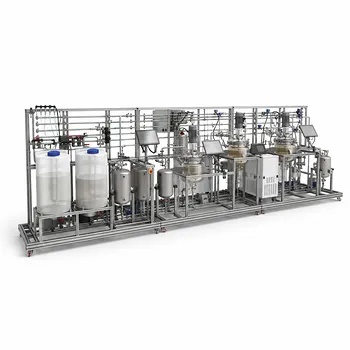
The answer is straightforward. Researchers and students utilize bioprocess pilot plants to study shear stress by systematically manipulating impeller tip speed, power per unit volume (P/V), and gas sparging designs at an intermediate scale. This hands-on environment allows them to experimentally determine the damage thresholds where shear forces reduce mammalian or microbial cell viability—and then use that data to build scaling strategies that maintain a healthy culture into full production.
The core insight: A pilot plant is your living laboratory for shear stress. It turns abstract equations into physical cause-and-effect. You actively create controlled shear environments, measure the biological response, and directly observe the trade-offs between mixing, oxygen transfer, and cell health—information that is impossible to get from bench-scale flasks alone.
Understanding Shear Stress: The Hidden Threat in Scale-Up
Shear stress is the mechanical force generated by fluid motion, and its impact is rarely linear. At pilot scale, you finally see how local forces near the impeller or bursting bubbles translate into systemic culture damage.
Why Mammalian Cells Demand a Different Approach
Mammalian cells lack a protective cell wall, making them exquisitely sensitive to hydrodynamic forces. While microbial cells can tolerate brief spikes in energy dissipation, even short exposure to high-shear zones can rupture CHO or HEK cells, releasing host cell DNA, proteases, and other impurities that compromise downstream processing.
This sensitivity transforms pilot plants from simple mixing vessels into tools for forensic cell biology. You can trace exactly when and where damage occurs, correlating a specific agitation rate with a measurable drop in viability and an increase in free DNA.
The Role of Bubble Bursting: A Second Front
Shear isn't just about stirrers. In aerated bioreactors, the most lethal events often happen at the liquid surface. When a bubble bursts, the rupturing film generates micro-eddies with extremely high energy dissipation rates—far exceeding those in the bulk fluid.
Pilot plants give you the spatial control to isolate this effect. By using different sparger designs (macro-porous vs. micro-porous) and managing the superficial gas velocity, you can compare cell damage caused by bubbling alone versus combined agitator and aeration stress.
Using the Pilot Plant as a Research Laboratory
At the pilot scale (e.g., 10L to 200L), you can instrument the vessel far more comprehensively than a production tank ever would be. This transforms the unit into a precise experimental rig, not just a smaller factory.
Manipulating Impeller Tip Speed and Power Input
The primary levers for inducing shear are impeller tip speed and volumetric power input (P/V) . In a pilot plant, you deliberately step up agitation rates across multiple runs, holding all other parameters constant.
You measure tip speed directly (RPM × impeller diameter). As it increases past a critical threshold—often around 1.5–2.0 m/s for sensitive mammalian cells—you’ll observe a sharp viability drop. By plotting viable cell density against tip speed, you build a damage curve specific to your cell line, medium, and bioreactor geometry.
Similarly, P/V (W/m³) integrates power draw and working volume. Pilot plants let you verify calculated P/V against actual motor draw readings, revealing losses from mechanical seals or gearboxes that textbook equations ignore. This teaches a crucial lesson: the power actually delivered to the fluid often differs from the motor’s nameplate rating.
Investigating Gas Sparging and Bubble Dynamics
A pilot plant allows you to swap sparger elements and impeller combinations quickly. You can run an experiment with a porous frit sparger that creates fine bubbles (high kLa but more damaging bursts) versus a drilled pipe sparger producing larger, gentler bubbles.
By holding P/V constant and varying only the sparger type, you isolate the contribution of bubble-associated shear. This is where students visually link the physical mechanism (foam, wall jetting) to biological outcome (apoptosis assays, LDH release). It’s a revelation that oxygen delivery and cell safety are often in direct conflict.
Quantifying Damage: Measuring Cell Viability and Impurities
Observation alone isn’t enough. Pilot plants come with sampling ports that enable real-time monitoring. You pull samples at set intervals and immediately analyze:
- Viable cell density via trypan blue exclusion or automated counters.
- Lactate dehydrogenase (LDH) release as a marker of membrane compromise.
- Host cell DNA/protein levels as indicators of full lysis and impurity generation.
This creates a time-resolved picture of damage progression. You might find that cells undergo a period of metabolic stress (reduced growth, increased lactate) before outright death—a subtlety easily missed at shake-flask scale.
Common Pitfalls in Shear Stress Studies
Not all forces are equal. A major pitfall is conflating average shear rate with maximum shear rate. A well-mixed bioreactor may have a low average shear, but the zone around the impeller tips experiences forces orders of magnitude higher. Pilot studies that ignore this spatial heterogeneity will underestimate the real threat to cells.
Scaling a bad geometry. If your pilot-scale vessel has a different aspect ratio (H/D) or impeller placement than your target industrial reactor, your shear data won’t transfer. Geometric similarity must be part of the experimental design, or you’ll develop a “safe” operating window that fails at larger scales because the flow patterns fundamentally change.
Overlooking additive effects. Shear stress rarely acts alone. When combined with rapid temperature shifts, pH gradients, or oxygen deprivation, even sub-lethal mechanical forces become catastrophic. A proper pilot plant study examines the interaction of these stresses, not just each in isolation.
From Data to Design: Developing a Scale-Up Strategy
The ultimate output is not a list of do’s and don’ts, but a scale-up protocol that maintains a quantifiable viability margin. You use the pilot data to define the maximum allowable tip speed, the minimum acceptable kLa, and the trade-off envelope where cells thrive.
Determining Safe Operating Windows
Plot your key performance indicators—viability against tip speed, kLa against P/V—and identify the overlap. The “safe zone” is the region where oxygen transfer meets the culture’s demand while keeping mechanical forces below the damage threshold.
For a mammalian cell process producing a fragile antibody, this might mean accepting a lower P/V (50 W/m³) and compensating with oxygen enrichment rather than increasing agitation. That decision is only credible when backed by pilot data showing exactly where viability plummets under the alternative.
Applying Geometric Similarity and Process Intensification
For students, this is the bridge from theory to practice. They can verify that maintaining a constant P/V when scaling from 10L to 1,000L predicts viable cell density only if geometric similarity (impeller-to-tank diameter ratio, number of baffles) holds. If it doesn’t, they learn why impeller tip speed or energy dissipation rate at the impeller zone (ε_max) is a more reliable scaling criterion for shear-sensitive systems.
They also get to test more intensified configurations, like replacing a standard Rushton turbine with a lower-shear axial-flow impeller, and directly see how the viability window expands without sacrificing mixing time.
Making the Right Choice for Your Research Goal
Your approach to using a pilot plant for shear studies depends on whether you’re solving an industrial scaling problem or building foundational knowledge. Tailor your experimental design accordingly.
- If your primary focus is developing a scalable mammalian cell process: Prioritize studies that map viability loss to impeller tip speed and bubble burst events. Run a full matrix of aeration rates and impeller combinations, and validate your safe zone by measuring post-harvest impurity levels (DNA, HCP). This data directly informs equipment specification and operating procedures for larger vessels.
- If your primary focus is fundamental education on bioreactor hydrodynamics: Use the pilot plant to replicate classic scaling equations. Run experiments where you keep P/V constant and vary the scale geometrically, observing the deviation in viability. This vividly illustrates why a single scaling rule cannot capture all biological and engineering interactions, and makes the case for computational fluid dynamics (CFD) or empirical multi-parameter approaches.
A well-executed pilot-scale shear study does more than answer one question—it gives you a mental model for anticipating where failure will occur before you invest in a full-scale batch.
Summary Table:
| Shear Source | Key Parameter / Mechanism | Effect on Cell Viability |
|---|---|---|
| Impeller Agitation | Tip speed & Volumetric power input ($P/V$) | Mechanical rupture of sensitive cell membranes (e.g., CHO, HEK). |
| Bubble Bursting | Gas sparging & superficial gas velocity | High energy dissipation at the surface lyses cells and releases impurities. |
| Geometric Mismatch | Aspect ratio ($H/D$) & impeller placement | Alters flow patterns, leading to localized high-shear zones during scale-up. |
Enhance Your Bioprocess Training and Research with LABPARK
Transitioning from bench-scale theory to industrial reality requires hands-on experience with physical scale-up challenges. LABPARK designs and manufactures high-quality Educational and Vocational Unit Operations Pilot Plants in chemical engineering, bioprocess & biotech, and environmental & water treatment.
Engineered specifically for universities, research institutes, and enterprises, our pilot plants enable you to:
- Analyze Critical Process Parameters: Effectively study the impact of agitation, gas sparging, and shear stress on cell viability.
- Deliver Hands-On Education: Equip students and researchers with the practical skills needed to develop robust scale-up protocols.
- Ensure Equipment Reliability: Benefit from industrial-grade, fully instrumented systems built to validate complex biological models.
Ready to elevate your laboratory capabilities? Contact LABPARK today to discuss your project requirements!
Related Products
- Bio-fermentation Ethanol Production Practical Training Unit Operations Pilot Plant
- Natural Product Extraction Unit Operations Training Pilot Plant
- Continuous Batch Extractive Distillation Educational Pilot Plant
- Electrolyte Distillation Purification and Formulation Educational Pilot Plant
- High-Gravity Emulsification and Mass Transfer Educational Pilot Plant
People Also Ask
- Why Use PTFE & Hastelloy in Chemical Pilot Plants? Prevent Corrosion & Ensure Safety
- Why Compare Predicted and Experimental Excess Enthalpy? Key to Accurate Pilot Plant Scale-up
- Why is the chemical plant startup schedule crucial? De-risk scale-up with pilot plants.
- When to transition from PID to adaptive control in pilot plants? Key process indicators.
- Why must batch and fed-batch fermentation pilot plants be designed to accommodate changing rheological conditions?