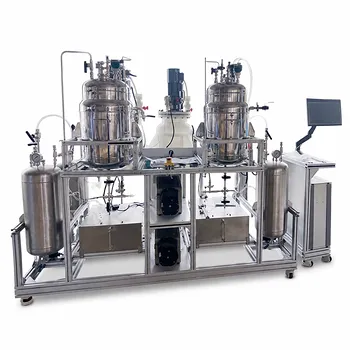
To immediately solve sample instability during calibration, you must prevent the chemical or biological composition of your sample from changing after it leaves the process. This is achieved by quenching the reaction immediately upon sampling and enforcing strict, repeatable protocols for sampling timing and subsequent laboratory analysis. However, a single stable sample is just the starting point. The deeper challenge is integrating these corrected reference values into a robust calibration model that accounts for the inherent noise and errors that still sneak through—a challenge solved through a combination of chemometric best practices, hybrid data strategies, and proactive model health monitoring.
While quenching and disciplined sampling stem the tide of immediate instability, the true calibration battle is won against residual reference error. A multi-layered strategy—combining large, cleaned-up datasets with a hybrid approach that marries process relevance and reference accuracy—is what transforms an unstable inline sensor into a trustworthy real-time process monitor.
The Root of the Problem: Why Bioprocess and Chemical Pilot Plant Samples Become Unstable
Samples removed from a pilot plant are not inert. They remain chemically or biologically active, or they interact with their environment in ways that dilute the very truth an inline sensor is trying to capture.
Continuing Reactions After Sampling
In condensation polymerization, living bioprocesses, or any reaction with residual reactants, activity continues the moment the sample is pulled. Without an immediate stop to the reaction kinetics, the reference value measured later in the lab will systematically drift, creating a ghost offset between what the online sensor saw in real time and what the reference method eventually reports.
Moisture Gain or Loss During Transport
Many chemical products are hygroscopic or contain volatile components. A sample that loses moisture or absorbs ambient humidity between the pilot plant floor and the lab bench alters its composition. The resulting reference reading no longer reflects the true process condition, skewing any calibration that maps sensor signals to that reference.
The Direct Impact on Sensor Calibration
Online analyzers like NIR spectrometers capture a snapshot of the in-process material. If the reference value used to model that spectral snapshot is from a degraded sample, the calibration model learns the wrong correlation. This produces persistent, often non-linear offsets that erode the sensor's predictive reliability for future runs.
The Direct Fix: Stabilizing Your Pilot Plant Samples
The primary reference points to a non-negotiable first step: stop the change as soon as the sample exits the process. This is an operational discipline challenge, not a modeling one.
Immediate Quenching of the Reaction
A chemical or thermal quench must be applied instantly upon sample collection—not minutes later in the lab. For bioprocesses, this might mean a rapid pH shift, a metabolic inhibitor, or flash freezing. For chemical polymerizations, it often involves a pre-measured inhibitor in the sampling container itself. Quenching freezes the composition at the exact moment of sampling, locking in a true reference point that mirrors what the online sensor saw.
Strict Standardization of Sampling Timing and Measurement Procedures
Even with quenching, the time lag between grabbing a sample and starting the lab analysis introduces variability. Operators must define and religiously follow a Standard Operating Procedure (SOP) that dictates: the exact timing of sample extraction, the transport conditions (e.g., sealed containers, temperature control), and the precise delay window before the lab measurement begins. Consistency here removes a key source of random error.
Consistent Handling to Prevent Environmental Changes
Sample containers must be sealed against moisture exchange. Any filtration or dilution step should match the process conditions exactly. By treating every sample identically, you eliminate the “special cause” variations that poison calibration datasets with outliers that have nothing to do with process chemistry.
Beyond a Single Stable Sample: Mastering the Chemometric Model
A perfect sample is a myth. Random lab errors, even with quenching, persist. The next line of defense is the statistical treatment of the calibration dataset itself.
Leveraging Large Sample Sets to Average Out Errors
Random laboratory reference errors (e.g., a pipetting mistake, a minor titration error) are unbiased but noisy. A dataset containing hundreds of samples allows the chemometric model—typically built with Partial Least Squares (PLS) regression—to average this noise out. The sheer volume of data drowns out the random instability that can't be physically quenched.
Iterative Outlier Detection and Exclusion
Not all reference errors are random; some are gross mistakes or unquenched samples that slipped through. Modern chemometric modeling includes an essential step: iterative outlier identification. By computing metrics like the spectral residual (Q-residual) and the Hotelling's T² statistics, you identify samples whose reference values do not align with their spectral signatures. A careful, documented exclusion of true outliers prevents a single bad sample from skewing the entire predictive model.
The Calibration Sampling Paradox: Bridging the Accuracy-Relevance Gap
Stable process samples still carry the baggage of unavoidable in-process reference errors. Synthetic laboratory standards, conversely, are impeccably accurate but may fail to capture the complex, real-world matrix of a pilot plant broth or reaction mass. This is the calibration sampling paradox.
The High-Accuracy, Low-Relevance Trap of Synthetic Standards
Precisely prepared synthetic mixtures yield flawless reference values. However, they lack the temperature variations, bubble entrainment, particle scattering, and minor impurities present in a real process. A calibration model built exclusively on these standards often fails spectacularly when exposed to the online process environment—it's accurate in theory but irrelevant in practice.
The High-Relevance, High-Error Issue with Online Process Samples
Samples taken directly from the process at the point of analysis are highly relevant—they contain all the matrix effects. But their reference values, as discussed, suffer from timing lags and incomplete quenching. This leads to a model that is relevant but inaccurate, locking in the very errors you are trying to eliminate.
A Hybrid Strategy to Bridge the Gap
The solution is to combine the two. Inject well-characterized, laboratory-synthesized calibration standards directly through the field-installed online analyzer on your pilot plant. This captures the instrument's true optical path and environmental conditions while providing a gold-standard reference concentration. Then, use chemometric techniques like Principal Component Analysis (PCA) to compare these high-accuracy spectra to the historical process spectral data. This hybrid approach detects outliers in the process data and anchors the model to known truths, producing a calibration that is both highly relevant and highly accurate without exploding model complexity.
Proactive Model Health: Ensuring Long-Term Accuracy
A calibration model, even a hybrid one, is not immortal. Pilot plant conditions drift, raw materials change, and sensor optics age. The model must be guarded.
Monitoring Performance with T² and Q-Residuals
These are multivariate statistical process control metrics. In real-time operation, a new spectrum gets a T² value (a measure of its Mahalanobis distance from the model's training data) and a Q-residual (how well the model can reconstruct the spectrum). A sudden increase in either is an immediate, data-driven alarm that the sample is outside the calibrated operational envelope—the model's predictions are no longer trustworthy.
Documenting Operational Boundaries and Triggering Recalibrations
Engineers must explicitly document the parameter space (temperature, concentration ranges, etc.) over which the model is valid. When health indicators show a systematic drift, or when a new campaign operates outside those boundaries, a prompt recalibration—informed by the same quenching and hybrid strategies—must be initiated. Staying ahead of drift is far more cost-effective than discovering a bad prediction after a batch is ruined.
Understanding the Trade-offs and Pitfalls
Every fix carries its own cost. Ignoring these is the hallmark of a brittle strategy.
- Aggressive Quenching: Can alter the sample matrix (e.g., precipitation, pH shock) in a way that changes its NIR spectrum, making it less representative of the unquenched process fluid. The quench must not become the source of a new spectral artifact.
- Large Sample Sets: Demand enormous pilot plant resources and time, potentially delaying the development of a usable calibration. A large, poorly quenched dataset is worse than a small, well-handled one.
- Hybrid Complexity: The apparatus for injecting synthetic standards into a pressurized or sterile pilot plant stream adds capital cost and contamination risk. The model fusion techniques require advanced chemometric expertise.
- Model Health Negligence: A health monitoring dashboard that no one checks is useless. False positives from overly sensitive limits can trigger expensive, unnecessary recalibration cycles.
Making the Right Choice for Your Pilot Plant Goal
Your strategy must align with your immediate operational reality and your long-term scale-up ambitions.
- If your primary focus is salvaging the current pilot plant run with known instability: Enforce immediate, operator-proof sample quenching and a draconian SOP for sampling and lab analysis right now.
- If your primary focus is building a first-principles calibration model with limited resources: Invest time in collecting a very large set of process samples and apply rigorous iterative outlier detection. Quantity and statistical cleanup are your allies.
- If your primary focus is achieving the highest possible accuracy for a critical process scale-up: Implement the hybrid calibration approach. Inject synthetic standards into your online analyzer to anchor your model in truth while retaining the richness of real process spectra.
- If your primary focus is ensuring the model remains trustworthy across a long, multi-year piloting campaign: Install a live multivariate monitoring dashboard (T² and Q-residuals) with clearly documented alarm limits and a pre-planned recalibration workflow.
By methodically first locking down the physical sample with a quench and then locking down the chemometric model with a hybrid, health-monitored strategy, you transform sample instability from a source of constant error into a managed, understood variable.
Summary Table:
| Strategy | Core Action | Key Benefit |
|---|---|---|
| Immediate Quenching | Apply chemical/thermal inhibitors instantly | Freezes sample composition to prevent reaction drift |
| Strict SOPs | Standardize sample timing, transport, and handling | Eliminates operator-induced variations |
| Chemometric Modeling | Use large datasets & iterative outlier detection | Averages out noise and removes bad data |
| Hybrid Calibration | Blend synthetic standards with process samples | Balances high analytical accuracy with process relevance |
| Health Monitoring | Track T² and Q-residual statistics in real-time | Flags sensor/process drift before predictions fail |
Optimize Your Pilot Plant Operations with LABPARK
Reliable sensor calibration starts with robust pilot plant design. LABPARK provides state-of-the-art Educational and Vocational Unit Operations Pilot Plants in chemical engineering, bioprocess & biotech, and environmental & water treatment. Designed specifically for universities, research institutes, and enterprises, our systems offer integrated sampling and monitoring capabilities to help you eliminate sample instability and ensure precise data.
Ready to scale up your research and training efficiency? Contact LABPARK today to discover how our tailored pilot plant solutions can support your goals.
Related Products
- Bio-fermentation Ethanol Production Practical Training Unit Operations Pilot Plant
- Natural Product Extraction Unit Operations Training Pilot Plant
- Electrolyte Distillation Purification and Formulation Educational Pilot Plant
- Continuous Batch Extractive Distillation Educational Pilot Plant
- High-Gravity Emulsification and Mass Transfer Educational Pilot Plant
People Also Ask
- Why Use PTFE & Hastelloy in Chemical Pilot Plants? Prevent Corrosion & Ensure Safety
- Why Compare Predicted and Experimental Excess Enthalpy? Key to Accurate Pilot Plant Scale-up
- Why is the chemical plant startup schedule crucial? De-risk scale-up with pilot plants.
- When to transition from PID to adaptive control in pilot plants? Key process indicators.
- Why must batch and fed-batch fermentation pilot plants be designed to accommodate changing rheological conditions?