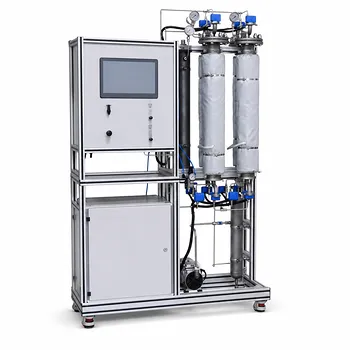
In a pilot plant setting, a razor-thin guard bed of microfibrous entrapped ZnO/Carbon sorbent—often as thin as 3 mm—placed directly upstream of a sensitive catalyst can neutralize trace H2S at ambient to mild temperatures, effectively preventing poisoning.
Operating from room temperature to 100°C in the presence of moisture, this structured sorbent delivers up to 3-fold longer H2S breakthrough times than traditional carbon-based or high-temperature extrudates at equivalent bed volumes. The result is sustained downstream catalyst activity, selectivity, and a dramatically minimized reactor volume.
The deep value of microfibrous entrapped ZnO/Carbon sorbents lies not just in superior sulfur capture, but in the radical miniaturization of the guard bed—enabling a compact, high‑efficiency protection layer that preserves both the performance and the scientific validity of downstream catalytic studies.
Why Sensitive Catalysts Demand Ultra‑Pure Gas Streams
The Fragility of Preferential Oxidation Catalysts
Preferential Oxidation (PrOx) CO catalysts, often based on platinum or gold, are notoriously sensitive to sulfur poisoning.
Even single‑digit ppm levels of H2S can irreversibly bind to active sites, rapidly degrading both CO conversion and the crucial selectivity toward CO2 over H2.
In a pilot plant, this contamination leads to misleading kinetic data, wasted resources, and a false picture of catalyst durability.
The Drawbacks of Conventional Guard Bed Solutions
Traditional packed beds of large extrudates (1–5 mm) suffer from severe intraparticle mass‑transfer resistance, limiting the fraction of zinc oxide that actually contacts the gas.
Many commercial ZnO sorbents also require temperatures above 200°C to be effective—conditions that are incompatible with low‑temperature PrOx catalyst operation and add complexity.
Carbon‑based sorbents work at milder conditions but often exhibit shorter breakthrough times and demand more bed volume, making them bulky and inefficient in a research‑scale setup.
How Microfibrous Entrapped ZnO/Carbon Solves the Protection Puzzle
Structuring for Maximum Active Site Accessibility
The sorbent is fabricated by entrapping small ZnO‑loaded carbon particulates (150–250 µm) within a sintered metal fiber mesh.
This microfibrous carrier creates a high‑void‑volume structure that shortens diffusion paths and exposes nearly all active sites to the gas stream.
The result is up to 5‑fold higher ZnO utilization compared to conventional packed beds—you get far more protection from far less material.
Performance at Ambient to Mild Temperatures
Unlike high‑temperature ZnO extrudates, this composite sorbent works effectively from room temperature to 100°C, right in the same thermal window as many downstream precious‑metal catalysts.
Crucially, it operates in the presence of moisture, which is often unavoidable in real reformate streams.
This eliminates the need for inter‑stage heating or condensing, drastically simplifying the pilot‑plant flow sheet.
Dramatic Breakthrough Time Extension
When you switch to a microfibrous entrapped ZnO/Carbon guard bed, the breakthrough time for H2S can be 2‑ to 3‑fold longer than what commercial packed beds deliver at an equivalent bed volume.
This extended lifetime means fewer bed changes, more stable operation, and significantly reduced sorbent inventory—a critical advantage in a research environment where time on stream and data consistency are paramount.
Thin and Compact Guard Bed Design
Thanks to its high contacting efficiency, a functional guard bed can be fabricated as a sheet as thin as 3 mm.
This ultra‑compact format can be placed directly inside the reactor tube or in a small upstream cartridge, consuming almost no precious pilot‑plant volume.
Researchers can even pleat the sheet to further optimize flow distribution and pressure drop while keeping the entire protection stage invisible to the main reaction kinetics.
Understanding the Trade-offs and Implementation Pitfalls
Moisture Management Is a Double‑Edged Sword
The sorbent thrives in humid streams, but if the relative humidity approaches saturation, capillary condensation can temporarily block micropores and slow H2S capture kinetics.
Design your guard bed with a small temperature margin above the dew point, and consider a hydrophobic pretreatment if the gas is consistently water‑saturated.
Mechanical Stability of the Entrapped Structure
The sintered metal fiber mesh firmly holds the entrained particulates, but long‑term vibration or frequent thermal cycling could theoretically release fines.
In a pilot plant, it is prudent to place a micro‑porous frit or a thin glass‑wool retainer downstream to catch any potential particulate breakthrough, while still allowing full gas flow.
Temperature Window Hard Limit
While the operating range (25–100°C) is ideal for PrOx and similar low‑temperature catalysts, this sorbent cannot be pushed above 100–120°C without risking the degradation of carbon support and loss of entrapment integrity.
For higher‑temperature gas purification, you would need to revert to conventional ZnO extrudates or a heated ZnO‑only guard bed, which reintroduces the volume and efficiency penalties you aimed to avoid.
Making the Right Choice for Your Pilot Plant
Your decision depends on what you are trying to protect and the constraints of your experimental setup.
- If your primary focus is preserving a precious‑metal PrOx catalyst: Use a microfibrous entrapped ZnO/Carbon guard bed placed immediately upstream. Its ambient‑temperature efficiency keeps catalyst activity and selectivity intact over weeks of testing.
- If your primary focus is minimizing reactor footprint and sorbent inventory: Deploy a thin (3‑mm) pleated sheet of this sorbent; you will achieve the same H2S capacity with a fraction of the volume compared to conventional carbon or extrudate beds.
- If your primary focus is educational demonstration of advanced reactor concepts: Let students fabricate and install these flexible guard beds themselves. They will learn firsthand how structured sorbents decouple mass transfer, pressure drop, and bed utilization in a modern micro‑reactor environment.
By adopting a microfibrous entrapped ZnO/Carbon guard bed, your pilot plant gains the ability to run sensitive catalytic experiments with the confidence that the measured kinetics reflect true catalyst behavior—not the slow, silent creep of sulfur poisoning.
Summary Table:
| Feature | Microfibrous Entrapped ZnO/Carbon | Traditional Sorbents (Packed Beds) |
|---|---|---|
| Bed Thickness | Ultra-compact (as thin as 3 mm) | Thick, bulky beds |
| Operating Temp | Ambient to 100°C (low-temp) | Often requires >200°C |
| Breakthrough Time | 2x to 3x longer lifetime | Shorter, frequent changeouts |
| ZnO Utilization | Up to 5-fold higher efficiency | Low due to mass-transfer resistance |
Elevate Your Research with LABPARK Pilot Plants
Protect your catalysts and guarantee precise experimental data. LABPARK provides high-performance Educational and Vocational Unit Operations Pilot Plants in chemical engineering, bioprocess & biotech, and environmental & water treatment for universities, research institutes, and enterprises.
Let us help you implement advanced chemical engineering solutions like structured guard beds to maximize efficiency. Contact LABPARK today to discuss your project requirements with our technical team!
Related Products
People Also Ask
- How does operating pressure influence the transition between absorption and desorption in a CO2 pilot plant?
- What unit operations are critical for CCUS training pilot plants? Build hands-on engineering expertise.
- How can pilot plants show tail gas vs flue gas CO2 capture differences? Key educational insights.
- What are the differences between post- and pre-combustion carbon capture training pilot plants?
- How do temperature variations affect CO2 transport models in pilot plants? Model vs Reality