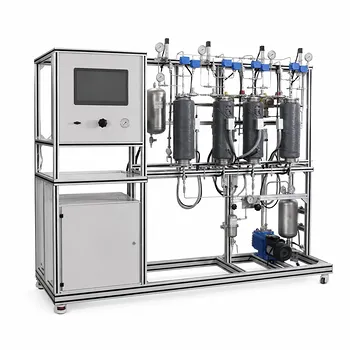
Environmental pilot plants are the essential bridge between a laboratory flask and a field-scale site cleanup.
They allow researchers to build realistic, scaled-down versions of contaminated soil and water environments under precise control. By doing so, they provide a rigorous platform to systematically study both bioremediation—where microorganisms break down pollutants—and phytoremediation—where plants extract or stabilize contaminants like heavy metals.
Pilot plants transform a promising lab concept into an engineered cleanup reality. By meticulously tuning parameters like moisture, aeration, nutrient supply, and flow rates, they generate the performance data needed to verify effectiveness, optimize conditions, and confidently scale a remediation technique from the bench to a polluted site.
The Pilot Plant as a Simulated Contaminated Site
A pilot plant is essentially a test kitchen for environmental cleanup. Instead of cooking meals, you’re cooking down contamination. It recreates the key physical, chemical, and biological conditions of a polluted site, but with the ability to isolate variables that are impossible to separate in the field.
Building a Representative Model
A pilot system can be configured as soil columns, constructed wetlands, slurry reactors, or continuous-flow tanks, depending on whether you’re treating solid soil or a water stream.
Researchers spike these media with known concentrations of target pollutants—such as crude oil, chlorinated solvents, or heavy metals—to create a controllable, repeatable contamination profile.
The Power of Parameter Control
The system becomes a rigorous scientific instrument because you can dial in and monitor:
- Soil moisture and water content to sustain microbial or plant life
- Aeration rates to manage oxygen for aerobic degradation
- Nutrient levels (nitrogen, phosphorus) to boost biological activity
- Retention time and flow rates to mirror realistic hydraulic conditions
This control allows you to see exactly which variable moves the needle on cleanup performance, without the noise of weather, geology, or inconsistent field sampling.
Unlocking Bioremediation: A Controlled Study of Microbial Cleanup
Bioremediation relies on microbes to eat pollution. In a pilot plant, you’re not just hoping they do—you’re measuring every bite.
Precision Inoculation and Degradation Kinetics
You can introduce specific microbial strains—for example, Pseudomonas species known for degrading oil. Then you track the real-time consumption of contaminants.
Key monitoring parameters become your dashboard:
- Chemical Oxygen Demand (COD) and Biological Oxygen Demand (BOD) to measure the overall organic load being reduced
- Nutrient consumption to ensure the microbes aren’t starving
- Contaminant concentration over time to build degradation rate curves
These kinetics tell you how fast treatment happens and where the process might slow down, revealing the optimal dose of microbes, nutrients, or oxygen.
Scaling Biological Activity with Confidence
A pilot plant mimics continuous flow or batch operation, just like a real treatment cell would. This lets you test how the microbial community behaves over weeks or months, including stress responses to shock loads or seasonal temperature changes.
By the time you consider field deployment, you have a quantitative blueprint: how many cubic meters of soil a unit can treat at what cost, and with what final contaminant level.
Exploring Phytoremediation: Tracking Plant-Based Metal Uptake
When using plants to clean up heavy metals or other inorganic pollutants, the pilot plant becomes a living laboratory for plant-soil-contaminant interaction.
Observing Uptake and Translocation
You can plant hyperaccumulator species—like willows or poplars for metal-rich soils—in controlled columns. Then, by adjusting soil pH, moisture, and nutrient availability, you watch how these variables influence metal uptake into roots, stems, and leaves.
The pilot plant enables destructive and non-destructive sampling at precise time intervals, something rarely feasible at a full-scale site. You measure metal concentrations in plant tissue and see how biomass growth correlates with removal rates.
Optimizing the Growing Environment
Just as in bioremediation, controlling the substrate is key. You tweak:
- Chelating agents (or organic acids) to boost metal solubility and plant availability
- Irrigation regimes to avoid leaching while keeping plants healthy
- Harvesting cycles to maximize total metal extraction per growing season
These small-scale trials answer whether phytoremediation can realistically meet cleanup goals in an acceptable timeframe, or if it should be paired with other methods.
The Critical Bridge from Lab to Field
A small petri dish test rarely translates directly to a hectare of contaminated land. A pilot plant fills that gap by demanding engineering realism while preserving scientific measurability.
Hands-On Data for Scale-Up Design
Pilot systems run with real flowrates, real biomass, and real mechanical equipment—pumps, aerators, and sensors. This generates the mass balances, energy consumption data, and maintenance schedules that a full-scale operation would need.
Engineers use this data to calculate:
- The required retention time to reach a target contaminant level
- The effective lifetime of a biological system or adsorbent
- The volume of waste (sludge or metal-laden plant biomass) that must be managed
Proof of Economic and Technical Feasibility
A pilot study answers the make-or-break question: is this removal method fast and reliable enough to be worth the investment? You get hard numbers on contaminant degradation rates and remaining concentrations. Without that, funding for large-scale remediation is just a guess.
Understanding the Trade-offs and Limitations
Pilot plants are powerful, but they aren’t miniature duplicates of the natural world. Acknowledging their limits is what makes them useful rather than misleading.
- Simplified heterogeneity: Real sites have erratic geology, mixed contamination, and unpredictable groundwater flow. A pilot column or tank can’t capture every variable, so scale-up factors are always needed.
- Edge effects and wall effects: In small vessels, biofilms can behave differently, and flow patterns can be more uniform than in the field. This can overestimate performance.
- Operational intensity: Running a pilot plant demands skilled staff, continuous monitoring, and resources. It’s not a “set it and forget it” experiment.
- Time compression: You may accelerate degradation in a pilot by keeping conditions perfect. The field rarely cooperates so neatly, so real-world cleanup could take longer.
Being aware of these pitfalls allows you to design conservative scaling margins and interpret pilot results as informed projections, not perfect predictions.
Making the Right Choice for Your Remediation Goal
Your pilot plant design should directly mirror the questions you need answered before moving to field scale.
- If your primary focus is optimizing microbial degradation kinetics: Design a tank or column system that allows you to vary oxygen, nutrients, and residence time. Prioritize sensors for COD, BOD, and biomass density to build a kinetic model you can trust.
- If your primary focus is evaluating plant species for heavy metal uptake: Use constructed soil columns with controlled moisture and metal loading. Schedule multiple harvests to calculate total metal mass removed per square meter and identify the most effective species and amendment strategy.
- If your primary focus is assessing economic feasibility and site readiness: Run the pilot in continuous-flow mode with real or synthetic contaminated water/soil. Measure energy use, chemical inputs, and waste generation so you can produce a realistic cost-per-ton or cost-per-liter number for stakeholders.
A well-designed pilot study does more than prove a concept—it transforms environmental hope into an engineered reality, one measured parameter at a time.
Summary Table:
| Feature / Method | Bioremediation Pilot Plants | Phytoremediation Pilot Plants |
|---|---|---|
| Primary Agent | Microorganisms (bacteria, fungi) | Plants (e.g., hyperaccumulators, willows) |
| Target Pollutants | Organic contaminants (crude oil, solvents) | Inorganic contaminants (heavy metals) |
| Key Control Variables | Aeration, soil moisture, nutrients (N, P) | Soil pH, irrigation, chelating agents |
| System Configurations | Slurry reactors, continuous-flow tanks | Soil columns, constructed wetlands |
| Primary Metrics | COD/BOD reduction, degradation kinetics | Metal accumulation in biomass, removal rates |
Scale Up Your Environmental Research with LABPARK
Are you looking to bridge the gap between laboratory concepts and field-scale environmental cleanup?
LABPARK provides premium Educational and Vocational Unit Operations Pilot Plants in chemical engineering, bioprocess & biotech, and environmental & water treatment. Designed specifically for universities, research institutes, and enterprises, our advanced pilot systems enable you to accurately simulate site conditions, optimize bioremediation kinetics, and validate cleanup techniques with confidence.
Contact us today to explore our pilot plant solutions!
Related Products
- Fixed-Bed Chemical Reaction and Gas Dust Tar Removal Unit Operations Pilot Plant
- Bench Scale Carbon Dioxide Capture Educational Unit Operations Pilot Plant
- Solid Waste Pyrolysis and Refining Educational Pilot Plant for Unit Operations
- Ion Exchange Water Purification Educational Pilot Plant for Engineering Unit Operations
- Electrolytic Hydrogen Production Educational Unit Operations Pilot Plant
People Also Ask
- When to transition from PID to adaptive control in pilot plants? Key process indicators.
- How do deviations in estimating latent heat impact pilot plant thermal systems? Avoid hardware mis-sizing.
- Why Compare Predicted and Experimental Excess Enthalpy? Key to Accurate Pilot Plant Scale-up
- Why Use PTFE & Hastelloy in Chemical Pilot Plants? Prevent Corrosion & Ensure Safety
- How do steady-state and dynamic simulations complement pilot plants? Validate scale-up and controllability